


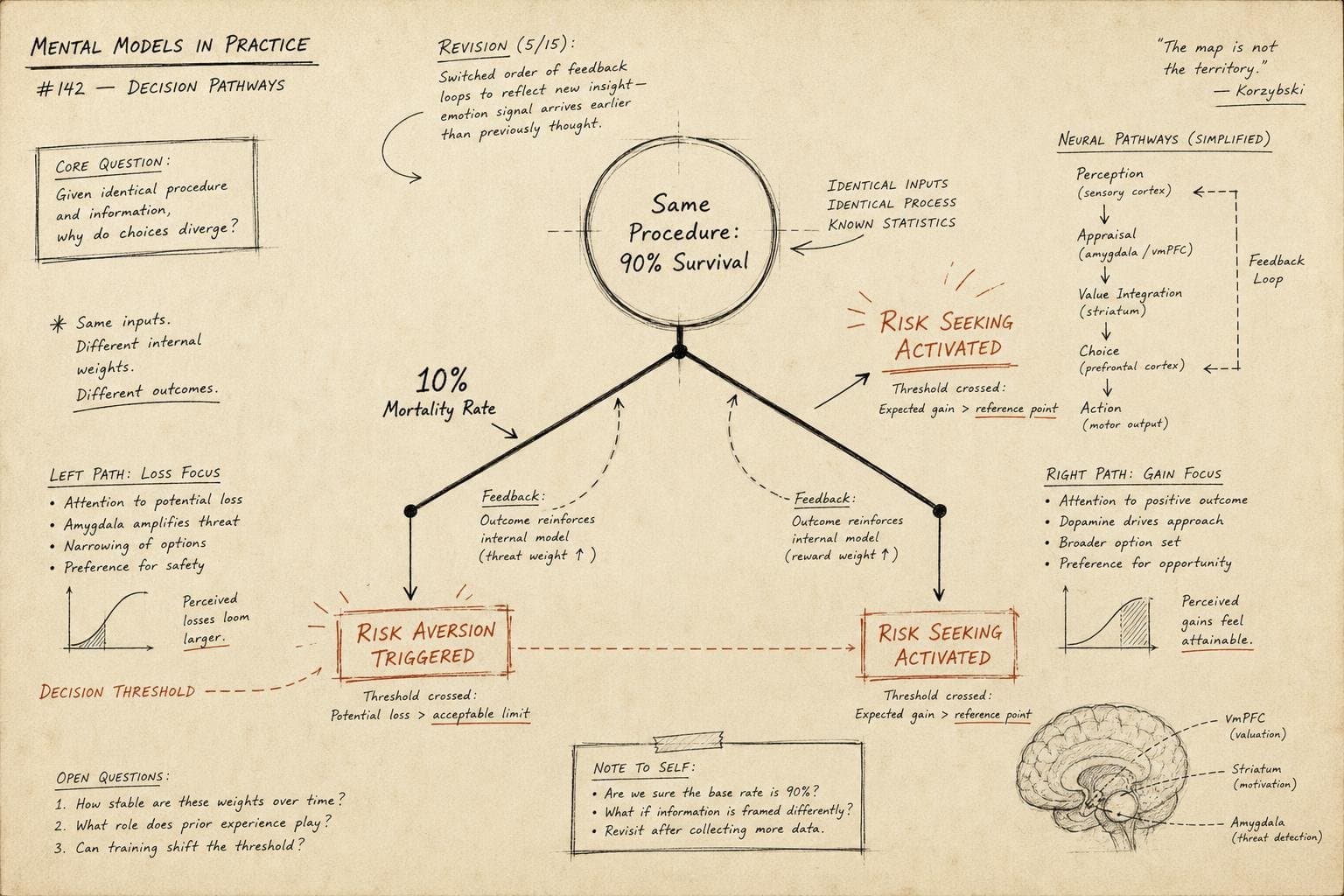

Picture a doctor explaining a treatment option. "Ninety percent of patients survive this procedure" sounds like good news. "Ten percent of patients die from this procedure" sounds like a warning. Same number. Same procedure. Completely different gut reaction. That's the framing effect, and medicine may be the field where it does the most damage — because the stakes are life and death, and the person hearing the frame is often scared, tired, and in no position to do the math themselves.
The core finding goes back to Tversky and Kahneman's original work on how people shift from risk aversion to risk seeking depending on whether a choice is framed as a gain or a loss, a pattern that researchers have since traced down to specific brain regions involved in reward valuation and self-control, according to a 2026 editorial in Frontiers in Behavioral Neuroscience. The editorial notes that framing effects extend well past abstract gambles — into food choices, future reward valuation, and prosocial behavior — which is a useful reminder that this isn't a quirky lab trick. It's how the brain processes information whenever the information involves uncertainty, which describes most of medicine.
It's Not Just Patients Who Get Framed — Clinicians Frame Themselves
The flattering story mental-model enthusiasts like to tell is that the expert is immune — that doctors, armed with training and experience, see through the gain/loss wrapper to the underlying number. A 2025 cross-sectional study published in BMJ Open tested exactly that question, examining whether cognitive framing shapes clinical reasoning among medical students. The fact that researchers felt the question needed empirical testing at all tells you something: nobody assumes expertise automatically neutralizes a bias this fundamental. Framing doesn't just change how a patient hears a risk number from a doctor — it can shape how a clinician-in-training interprets a case in the first place, before a patient is even in the room.
This matters because of where clinical judgment sits in the decision chain. A doctor who frames a diagnosis one way in her own head is going to frame the explanation to the patient the same way downstream. The bias doesn't enter the conversation at the bedside. It enters earlier, in the clinician's own reasoning, and then gets handed to the patient as if it were simply "the facts."
When the Frame Breaks, It Breaks the Relationship Too
There's a classic paper in CMAJ by Donald Redelmeier and Robert Cialdini — the social-psychology of persuasion researcher — on the principles of influence operating in medical practice, built in part on Redelmeier's earlier work with Kahneman on how patients understand their own decisions from cognitive and emotional perspectives. The throughline in that tradition is that patients aren't processing medical odds the way a statistician would. They're processing a story, and the frame is the story.
That's a liability when the broader data on medical communication is this grim. A 2025 benchmarking analysis of malpractice claims closed between 2014 and 2024 found that cases involving a breakdown in communication between provider and patient rose from 58 to 63 percent of all communication-related claims, with 40 percent of those cases closing with an indemnity payment averaging $338,000, according to CRICO's Candello report. A separate review of 46 studies covering more than 67,000 patients found that poor communication was the sole cause of patient-safety incidents in more than one in ten cases, and a contributing factor in one in four, according to The Conversation. Neither of those sources is specifically measuring framing effects. But they describe the environment framing operates in: a system where how something is said carries as much clinical weight as what is said, and where the gap between the two routinely produces harm.
The Fix Isn't a Better Frame — It's Hearing Both
The tempting response is to look for the "correct" frame — tell patients survival rates instead of mortality rates, always lead with the positive number. That's backwards. The lesson from the framing literature isn't which wrapper to pick; it's that any single wrapper distorts, no matter how well-intentioned. The more honest practice, for clinicians and for patients advocating for themselves, is to ask for the number stated both ways before deciding anything. If a 10% mortality rate sounds unacceptable but a 90% survival rate sounds reassuring, you haven't learned anything about the procedure. You've learned something about your own wiring. The next time someone hands you odds dressed up in only one direction, the move isn't to trust your gut reaction to the wording — it's to ask them to say it the other way, and see if your decision survives the flip.