


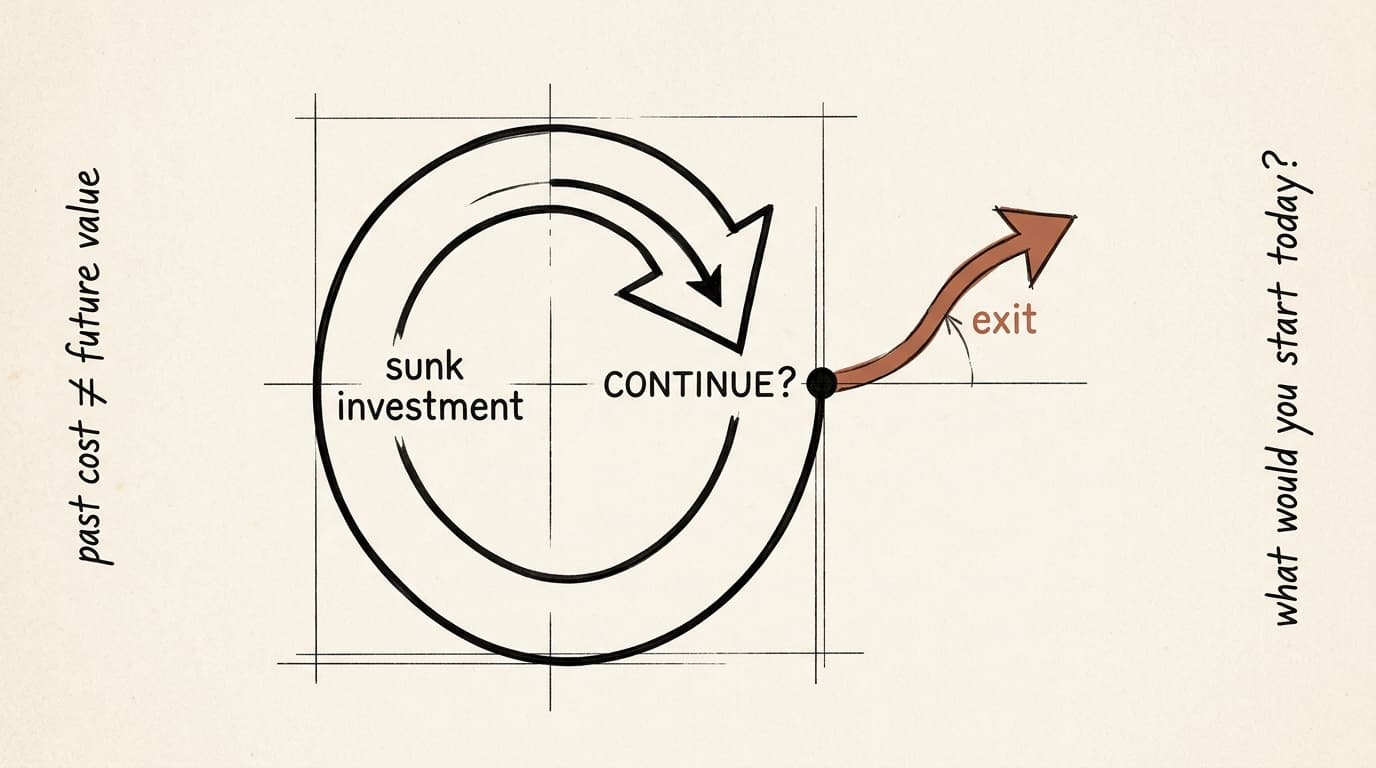

You're three months past the original deadline. The budget has been revised twice. The team is tired. And in your last status meeting, you caught yourself explaining — again — why the delays are temporary and the fundamentals are still sound.
They might be. But there's a decent chance you're not evaluating the project anymore. You're defending it.
This is the sunk cost effect in its natural habitat: not a dramatic boardroom moment, but a slow accumulation of small justifications, each one reasonable on its own, collectively pulling you deeper into something that stopped making sense a while ago.
The Bias Isn't Stupidity — It's Architecture
The sunk cost effect describes the tendency to factor previously incurred, irrecoverable costs into decisions about future actions — even though those past costs are, by definition, irrelevant to what you should do next. Research published in the Journal of Business and Economic Research frames this as one of the most pervasive and consequential cognitive biases in economic decision-making, showing up across investment, consumption, and organizational behavior.
The mechanism isn't hard to understand in the abstract. The problem is that it doesn't feel like a bias when you're inside it. It feels like commitment. It feels like not being a quitter. It feels like honoring the work that's already been done.
That's the architecture of the trap: the very qualities that make someone a good project leader — persistence, ownership, belief in the work — are the same qualities the bias exploits.
What "Killing Your Darlings" Actually Costs You
The Journal of Business and Economic Research makes this point at scale: when sunk cost reasoning aggregates across an organization, it doesn't just produce bad individual decisions. It distorts resource allocation, inhibits innovation, and creates structural barriers to the exit of unproductive work. The project you're keeping alive because of what you've already spent isn't just a budget problem. It's occupying headcount, attention, and organizational credibility that could go somewhere else.
There's also a subtler cost. Teams are good at reading the room. When leadership keeps a struggling project on life support past the point of honest assessment, people notice. They learn that the organization's stated commitment to evidence-based decisions has an asterisk: unless we've already spent a lot on this one.
The Diagnostic That Actually Works
The standard advice — "ignore sunk costs, only evaluate future costs and benefits" — is correct and nearly useless in practice. You can't just decide to not feel the weight of eighteen months of work.
What's more tractable is changing the question you're asking. Instead of should we continue this project? ask: if we were starting fresh today, with full knowledge of what we know now, would we choose to begin this project?
That reframe doesn't eliminate the bias, but it creates enough distance to surface the honest answer. If the answer is "probably not," you're not evaluating a project anymore — you're managing a commitment. Those require different responses.
A second diagnostic: notice the language in your status updates. Research from Cornell cognitive psychologist Shane Littrell found that heavy reliance on vague, jargon-heavy framing in organizational communications correlates with worse decision-making. When your project updates start sounding like they're explaining away problems rather than reporting on them — when the language gets more abstract as the results get worse — that's a signal worth taking seriously.
Try This
Pick one project you're currently involved in that has slipped on timeline, budget, or both. Write a one-paragraph pitch for it — as if you were proposing it for the first time, today, to someone who knows nothing about the history. Don't mention what's already been spent or built. Just make the case for why it's worth starting.
If you can't write that paragraph without referencing the sunk investment, that's your answer. The project's best argument for continuing is what you've already spent — not what it will deliver. That's the moment to have the honest conversation, before the next budget revision makes it even harder.
The work you've done doesn't disappear when you stop. It just stops costing you more.