


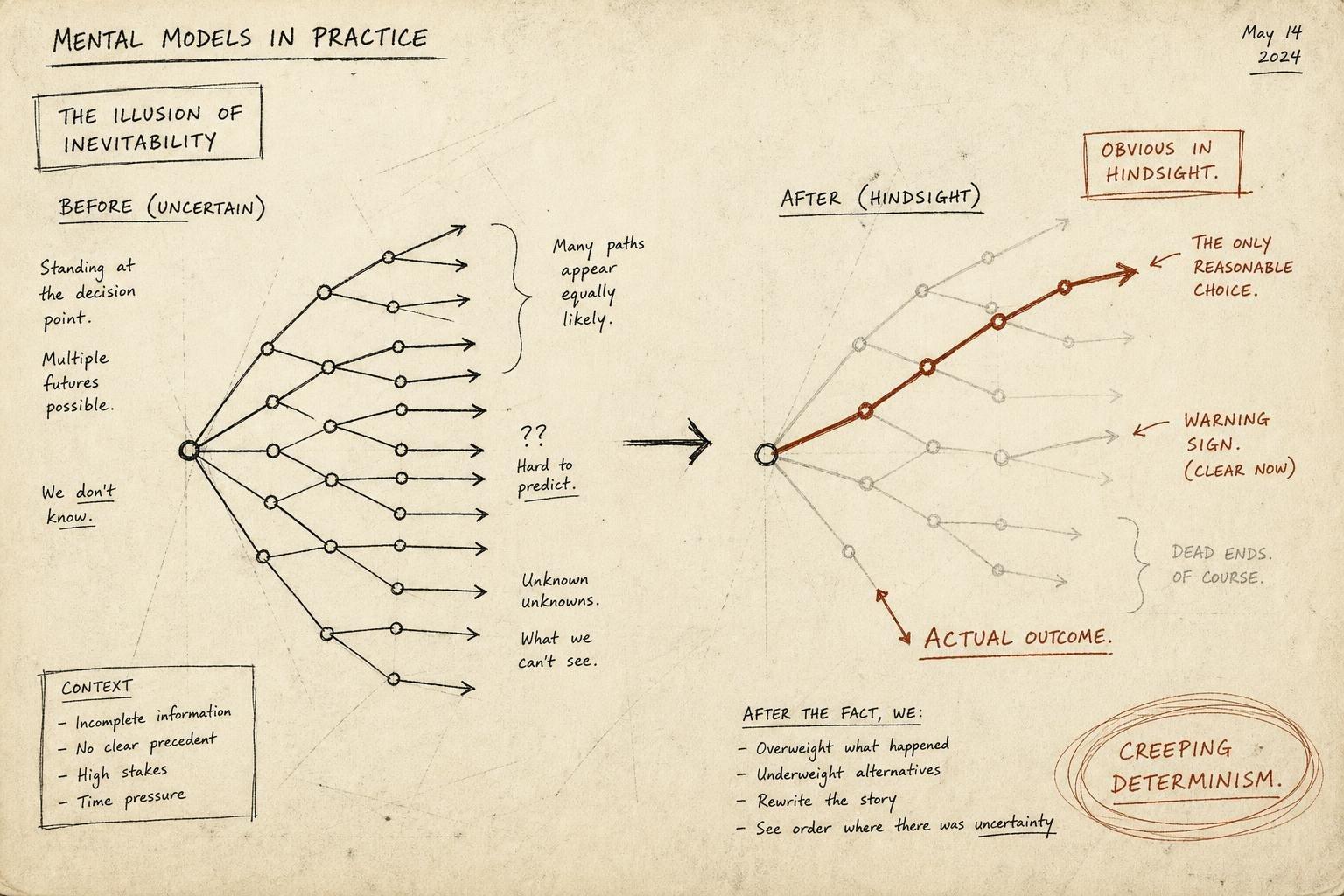

Here's a small experiment you can run on yourself. Think of the last project at work that blew up — missed deadline, blown budget, a launch that fizzled. Now ask: when did you first know it was going to fail?
If you're being honest, the answer is probably "sometime after it failed." But if you're doing a post-mortem right now, the answer that comes out of your mouth is going to be different. It's going to be something like "we should have seen it coming." The delayed reply from the vendor. The budget that was never quite solid. The one person in the kickoff meeting who raised a concern nobody addressed. All of it suddenly reads like a trail of breadcrumbs leading straight to disaster, as described in one breakdown of how this plays out in failed projects — the ending seems to have been there from the beginning, even though at the time those same details sat right next to encouraging feedback and workable plans, with several futures still seeming possible (Psychology Fanatic).
That's hindsight bias, and it's the reason most post-mortems are quietly useless.
Your Brain Isn't Lying to You, Exactly — It's Just Rewriting the File
Baruch Fischhoff named this back in 1975, running an experiment where people read about a historical event — in his case, an obscure 1814 military campaign — and some were told the outcome while others weren't. Knowing how it turned out changed how likely people thought that outcome had been all along, and it changed which details in the story suddenly seemed to matter (psychology.com). Fischhoff called the underlying mechanism "creeping determinism": the past doesn't stay put once you know how it ends. It reorganizes itself around the outcome. The signals that pointed in other directions lose their weight in your memory, and the one thing that happened becomes, in retrospect, the only thing that could have happened.
Later researchers, Neal Roese and Kathleen Vohs, broke this into three distinct things people actually mean when they say "I knew it all along" — misremembering your own prediction, believing the event itself was bound to happen, and believing specifically that you would have called it. Those are different claims, and a given post-mortem can get all three wrong at once without anyone noticing, because they feel like the same observation (psychology.com).
A basketball analogy makes this easier to feel in your gut than any business example does. Two minutes left, score close, nobody in the room has any idea who's going to win. The underdog hits a buzzer-beater. Within seconds, someone who ten minutes earlier said "it could really go either way" is now telling you they knew it the whole time — that missed free throw suddenly looks pivotal, the coach's substitution suddenly looks brilliant (The Medical). Nobody is being dishonest in that moment. Their memory of their own uncertainty has just been overwritten by the outcome.
Why This Breaks the One Thing a Post-Mortem Is Supposed to Do
Here's the part that should bother anyone who runs retrospectives for a living: hindsight bias doesn't just distort blame, it erases the lesson. If a bad outcome looks like it was obvious from the start, there's nothing left to learn from it — the "warning signs" were only warning signs because you already know what they were warning about. Mark Pezzo's research adds a useful wrinkle here: the bias isn't a flat tax on every surprising outcome. It shows up hardest when an unexpected result triggers active sense-making that succeeds — when you can build a tidy story that explains what happened. When the outcome stays genuinely baffling and sense-making fails, the bias shrinks or even reverses, and people say they never would have guessed (psychology.com). Which means the post-mortems that feel the most satisfying, the ones that produce a clean narrative everyone nods along to, are exactly the ones most contaminated by hindsight.
Investors do a milder version of this constantly. Someone passes on a company because the future looks genuinely uncertain. Months later it breaks out, and the same person remembers "knowing" it would succeed all along — not out of dishonesty, but because memory is reconstructive, and new information about the outcome gets folded into the recollection of what they believed beforehand (Prime Assets).
What Actually Helps
The fix isn't to distrust every post-mortem. It's to distrust the feeling of obviousness specifically. If your retrospective produces a story where the failure looks inevitable, that's the signal to go find contemporaneous notes — the actual kickoff deck, the actual Slack thread, the actual email where someone raised a worry and three other people raised reasons it was fine. Compare what was written down at the time against the story you're telling now. If they match, you've learned something real. If they don't, you've just watched your own brain tidy up a mess after the fact, and the next project is going to get the same blind spot the current one did, dressed up as a lesson learned.