
A student in one of Guhan Subramanian's negotiation simulations at Harvard Business School spent most of the exercise arguing that a wage rate of $10.69 per hour was completely unreasonable. Couldn't be right. Shouldn't be the basis for any deal. When the simulation ended, the final agreement landed at exactly $10.69 — the number the student had been fighting against the whole time.
That's anchoring. Not a subtle nudge. A full gravitational capture.
I've written about this before — the May issue covered the roulette wheel experiments, and the June issue looked at how anchors shape counteroffers. What's worth returning to is a question those pieces left open: why does anchoring persist even when people know it's happening? New research has a more specific answer than "we're all irrational," and it points toward something you can actually do about it.
Skilled Negotiators Are Not Immune — They're Just Confident They Are
The frustrating thing about anchoring isn't that it affects novices. It's that it affects experts just as reliably. Research published in the Journal of Experimental Social Psychology and summarized in MIT Sloan Management Review found that the bias persists in procurement, strategic deals, and executive compensation conversations — any situation where one party gets a number on the table early and the other must respond under time pressure.
The standard advice — do your homework, know your target, don't reveal too much — doesn't actually solve the problem. When the first offer lands, your mind starts generating counteroffers close to that number, regardless of your preparation. Experience makes you more confident in your judgment, which can make the trap worse: you're less likely to question a counteroffer that feels like it came from your own reasoning.
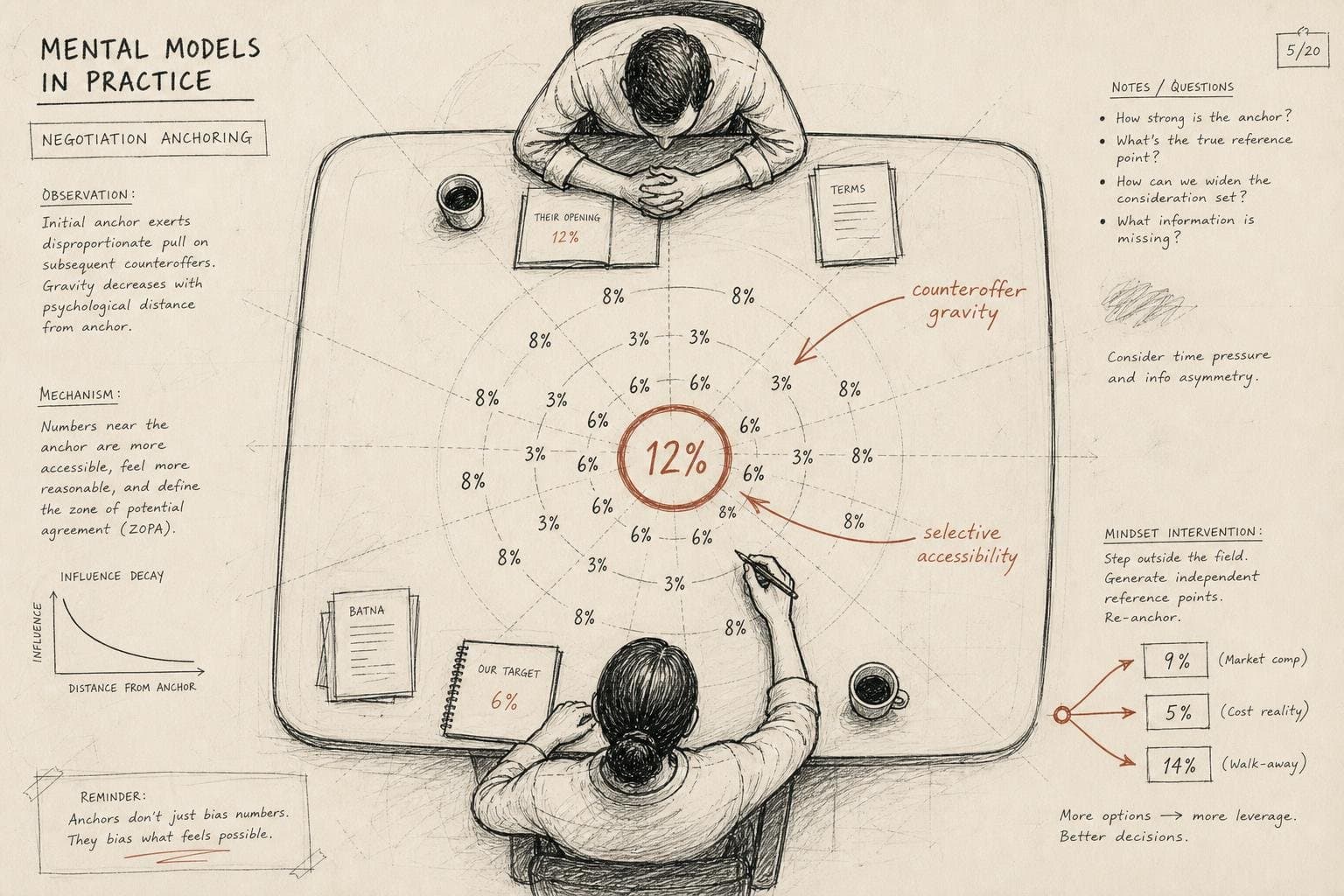
A meta-analysis published in Organizational Behavior and Human Decision Processes drawing on 374 effect sizes from 90 studies and over 16,000 individuals found that ambitious first offers increase economic value for the person making them — but also impair deal likelihood and leave recipients feeling worse about the outcome. The mechanism driving the counteroffer effect is what researchers call "selective accessibility": the anchor activates information consistent with that number, making it feel more justified than it is.
So you're not just pulled toward the anchor. You're actively generating reasons why it might be reasonable.
The Supplier Who "Won" 6%
Here's a clean real-world illustration. A supplier opens a contract renewal with a 12% price increase. The buyer planned for 3%. After two rounds of negotiation, they "win" a 6% increase. The buyer feels like they pushed back hard. But the outcome still tracks the first number — not the market rate, not the buyer's actual target. The anchor set the ceiling of what felt like a victory.
This is the part that gets missed in most anchoring discussions. The damage isn't just that you end up near the anchor. It's that you redefine "winning" relative to it. A 6% increase feels like a concession extracted through skill. Measured against the buyer's original 3% target, it's a failure. The anchor didn't just move the number — it moved the goalposts.
Sales negotiation practitioners at Shapiro Negotiations make a related point from the other side: when a customer opens with price, the seller's first instinct is to defend the number. That's the wrong move. The price-first opening is a position, not the full picture — and responding to it directly means you've already accepted the anchor as the frame for the conversation.
The Choice Mindset Fix
The MIT Sloan research offers something more actionable than "be aware of anchoring." The intervention that actually reduced anchoring in experiments was adopting what the researchers call a choice mindset — a deliberate reminder, right when the first offer lands, that you can counter with any number, not just numbers near the anchor.
It sounds almost too simple. But the mechanism makes sense: anchoring works partly because it narrows the range of options you're actively considering. A choice mindset expands that range back out. You're not just telling yourself "ignore the anchor" — you're actively generating alternatives before you respond.
The practical version: before you counter, write down three possible counteroffers at very different points. Not to use all three, but to break the gravitational pull of the first number. Research on salary negotiation makes the same point from a different angle — the negotiator who names a number first often wins, but only if they anchor ambitiously enough. Letting the other side go first hands them the reference point. If they do go first, your job is to actively resist treating their number as the center of gravity.
The anchor is always in the room. The question is whether you put it there, or whether you let someone else do it for you.


