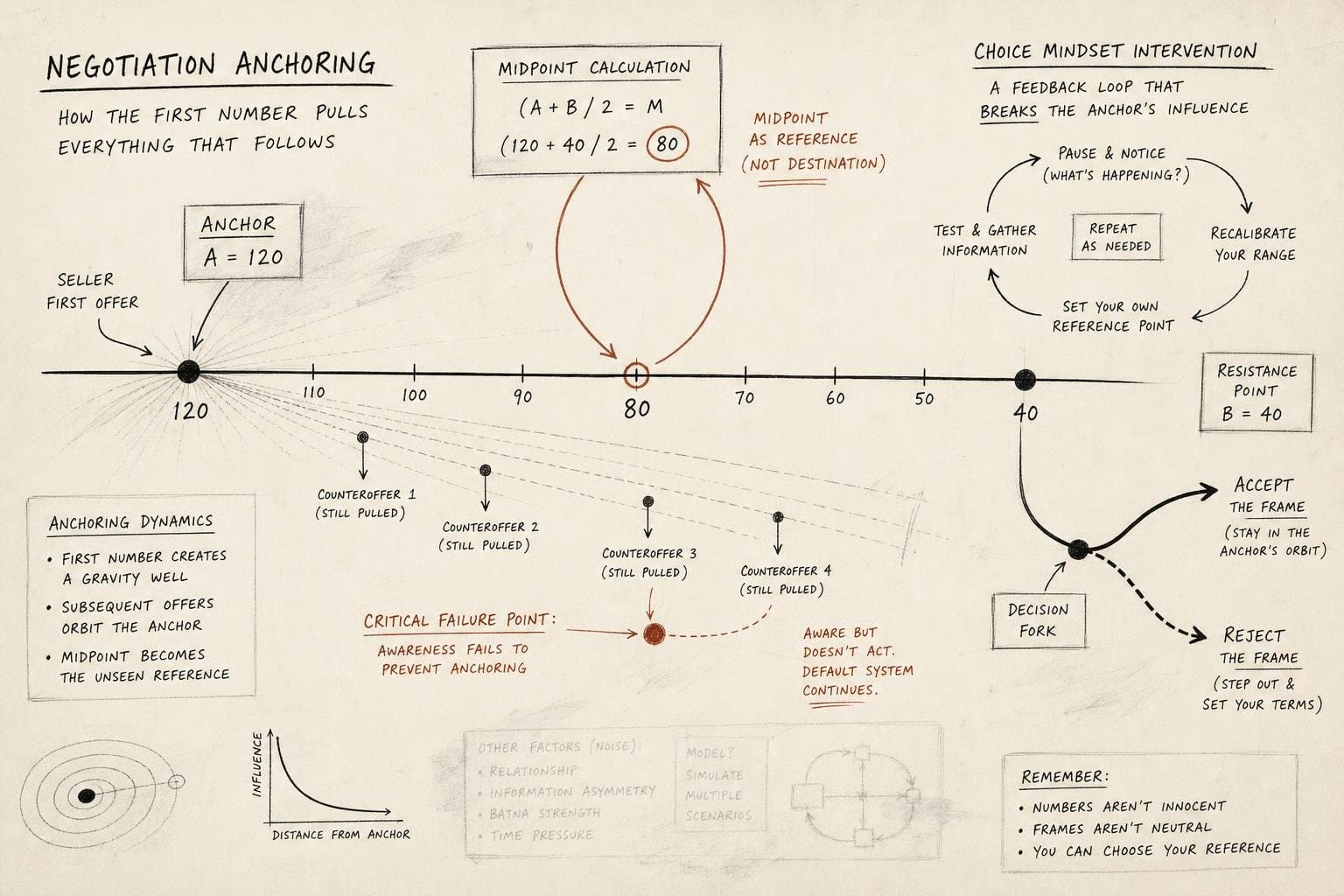

You walk into a salary negotiation having done your homework. You know the market rate. You have a number in mind. Then the hiring manager opens with something lower than you expected — and suddenly, without quite meaning to, you're thinking about how to get from their number to something reasonable, rather than anchoring on your own research.
That's the trap. And it catches people who know exactly what it is.
Anchoring bias — the tendency to give disproportionate weight to the first number introduced — is one of the most documented effects in behavioral economics. Kahneman and Tversky first described it in 1974, using a roulette wheel experiment: subjects asked to estimate the percentage of African countries in the UN gave answers that tracked the random number the wheel had landed on, even though that number had zero connection to the question. When the wheel hit 10, average estimates clustered around 25%. When it hit 60, they clustered around 45%. A meaningless number moved the needle by 20 points.
That was a lab. In negotiations, the stakes are real — and the effect is just as stubborn.
Expertise Doesn't Immunize You
Here's the part that should make you uncomfortable: anchoring doesn't spare skilled negotiators. Research published in the Journal of Experimental Social Psychology, summarized in MIT Sloan Management Review, finds that even experienced dealmakers fail to adjust far enough away from a first offer. The anchor doesn't just influence naive participants — it shapes procurement professionals, executives in compensation discussions, and lawyers in settlement negotiations.
The Harvard Program on Negotiation offers a vivid illustration of this. In a negotiation simulation, one student spent considerable time arguing why $10.69 per hour was an impossible wage rate — explaining at length why that number was unreasonable, why it couldn't work, why it was off the table. The final deal price: $10.69 per hour. The protest had actually validated the anchor by keeping the conversation orbiting around it.
This is the counterintuitive failure mode. You think you're fighting the anchor. You're actually feeding it.
A review of empirical research from 2020–2025 found that high anchors maintain strong influence across scenarios — job offers, procurement contracts, diplomatic trade agreements — and exert the greatest effect on expectations even when counterparts are aware of the tactic. Awareness helps, but it doesn't solve the problem.
The Midpoint Rule and Why It Should Worry You
There's a structural implication here that most negotiators underestimate. According to Harvard's Program on Negotiation, the best predictor of a final deal price is the midpoint between the first semi-reasonable offer and the counteroffer. Not the "fair" price. Not market value. The midpoint.
Think about what that means in practice. If someone opens at $100 and you counter at $50 without first explicitly rejecting the anchor, you've just told both parties that $75 is the logical destination. Insurance claims professionals have understood this dynamic for years — plaintiff attorneys open with high demands not because they expect to get that number, but because it shifts the entire range of "reasonable." The defense team that waits for a demand before making its own offer has already ceded the frame.
The practical implication: your counteroffer is not just a number. It's a vote on what range the negotiation lives in.
The Intervention That Actually Works
So what do you do when you don't control the first offer?
The MIT Sloan research points to something deceptively simple: adopt a "choice mindset" the moment you receive the first offer. This means actively reminding yourself that you can counter with any number — not just one that feels like a reasonable adjustment from theirs. The act of expanding your perceived option set before you respond reduces how much the anchor pulls your counteroffer toward it.
This sounds almost too easy. But the mechanism makes sense: anchoring works partly because ambiguous situations make us reach for a reference point. A choice mindset interrupts that reflex by reminding you that the reference point is arbitrary.
The Harvard advice adds a sequencing point: defuse the anchor before you counter. Not "here's my number" but "we're miles apart — that number doesn't reflect reality, and here's why" — followed quickly by your own anchor. The goal is to make clear that their number isn't in the bargaining zone before you introduce yours.
What you're really doing in both cases is the same thing: refusing to let their number define the coordinate system. The negotiation has to start somewhere. Make sure it starts somewhere you chose.
I've written before about how the first number shapes negotiations before anyone starts arguing and how anchoring plays out in specific deal structures. What the newer research adds is the failure case that matters most: the negotiator who knows about anchoring, protests the anchor loudly, and still ends up at the anchor's number. Recognition is necessary. It's not sufficient. The intervention has to happen before you open your mouth to respond.


