
There's a version of opportunity cost that lives in economics textbooks. It's clean, rational, and almost insultingly simple: every choice forecloses other choices, so the real cost of any decision includes what you gave up. Got it. Makes sense. Moving on.
Then there's the version that actually governs career decisions — which looks almost nothing like that.
Smart people, with full access to this framework, still systematically choose poorly. Not because they don't understand opportunity cost in the abstract, but because the way the concept actually functions in high-stakes decisions is more complicated than the textbook suggests. Understanding why the model fails is more useful than understanding the model itself.
The Framework Sounds Simple Because It Is
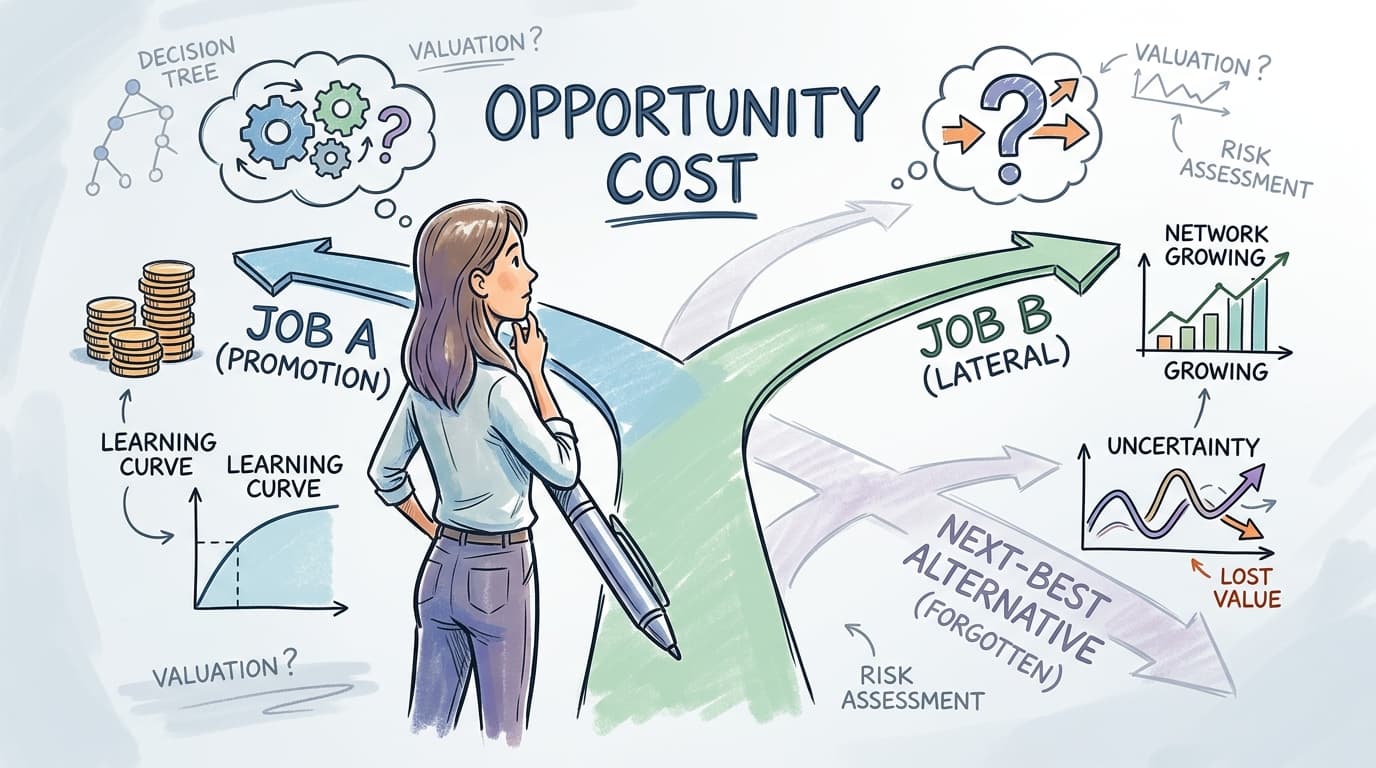
Opportunity cost is the value of the next-best alternative you didn't choose. If you take Job A over Job B, the opportunity cost of Job A is everything Job B would have given you — salary differential, skill development, network access, optionality for future moves. The framework asks you to evaluate not just what you're getting, but what you're giving up.
Applied to career decisions, this should produce something like: before accepting a promotion, a lateral move, or a new role, you explicitly identify the realistic alternatives and compare their full value — not just compensation, but trajectory, learning rate, and what doors each path opens or closes.
The mechanism is sound. The execution is where things collapse.
Why the Model Breaks Down Under Pressure
The core problem is what researchers studying delay discounting call the "tunnel effect" — when you're inside a decision, the alternatives that aren't immediately in front of you become cognitively invisible. Research on financial decision-making under stress describes this precisely: the costs and alternatives that exist outside the tunnel — the five-year trajectory, the compounding effects, the comparison set — simply don't register with the same psychological weight as the option being actively considered.
Career decisions are almost always made inside the tunnel. You have an offer. It's concrete, it's flattering, it has a deadline. The alternatives are abstract: the job you haven't applied for yet, the path you'd take if you said no, the version of yourself three years from now who wishes you'd waited. The offer has presence; the alternatives have none.
This asymmetry isn't a failure of intelligence. It's a structural feature of how humans process options under time pressure. The opportunity cost framework assumes you can hold multiple alternatives in mind with roughly equal vividness. In practice, the option in front of you is always more vivid than the options you're imagining.
There's a second failure mode: people apply opportunity cost to the wrong variables. They compare salaries, titles, maybe commute times. They rarely compare learning rates — how quickly each role would compound their capabilities — or optionality — which path keeps more doors open. These are harder to quantify, so they get underweighted. The model gets applied, but to a truncated version of the decision.
The Failure Case That Actually Teaches Something
Consider the pattern of the competent mid-career professional who takes a management role too early. The promotion is real, the title is better, the salary bump is meaningful. Opportunity cost, applied narrowly, looks favorable.
What doesn't get counted: the years of deep skill development that won't happen now. Management at that stage often means doing less of the thing you're good at and doing more coordination work before the coordination skills are actually valuable. The opportunity cost isn't just the next-best job offer — it's the version of yourself who spent three more years getting genuinely excellent at something before taking on organizational complexity.
I'd argue this is the most common smart-person career mistake: optimizing for the visible reward (title, comp, status) while systematically undercounting the invisible cost (skill depth, learning velocity, future optionality). The framework was available. It just got applied to the wrong layer of the decision.
The tell, in retrospect, is usually some version of: "I knew what I was giving up, I just didn't think it would matter that much." Which is another way of saying: the opportunity cost was visible but discounted — treated as less real because it was less immediate.
When to Trust the Model (and When to Interrogate It)
Opportunity cost is most reliable when the alternatives are genuinely comparable and the time horizon is short. Choosing between two job offers with similar structures, similar trajectories, similar risk profiles — the framework works well there. You can actually enumerate what you're trading.
It becomes unreliable when the alternatives are asymmetric in ways that are hard to quantify, when the decision has long compounding effects, or when you're making it under deadline pressure that artificially inflates the salience of the option in front of you.
The practical signal: if your opportunity cost analysis took less than ten minutes and felt obvious, you probably did it wrong. The model's value isn't in confirming what you already wanted to do — it's in forcing you to construct a genuinely vivid picture of what you're walking away from. That's uncomfortable work. If it wasn't uncomfortable, you probably stayed inside the tunnel.
Try This: Before your next significant career decision, write a one-paragraph description of the path you're not taking — specific enough that someone else could understand what it would actually look like. If you can't write that paragraph, you haven't done the opportunity cost analysis yet. You've just done the justification.


