
You know what opportunity cost is. You've known since Economics 101. Every choice forecloses other choices; the real price of option A is whatever you gave up by not choosing option B. Clean, logical, obvious.
And yet. More than seven in ten workers stay in jobs longer than they want to because they can't figure out how to leave — not because they lack the concept, but because the concept alone doesn't do the cognitive work they need it to do. Smart people, many of whom could explain opportunity cost perfectly well, are still choosing poorly. That gap is worth examining carefully.
The Model Is Simple. The Application Is Not.
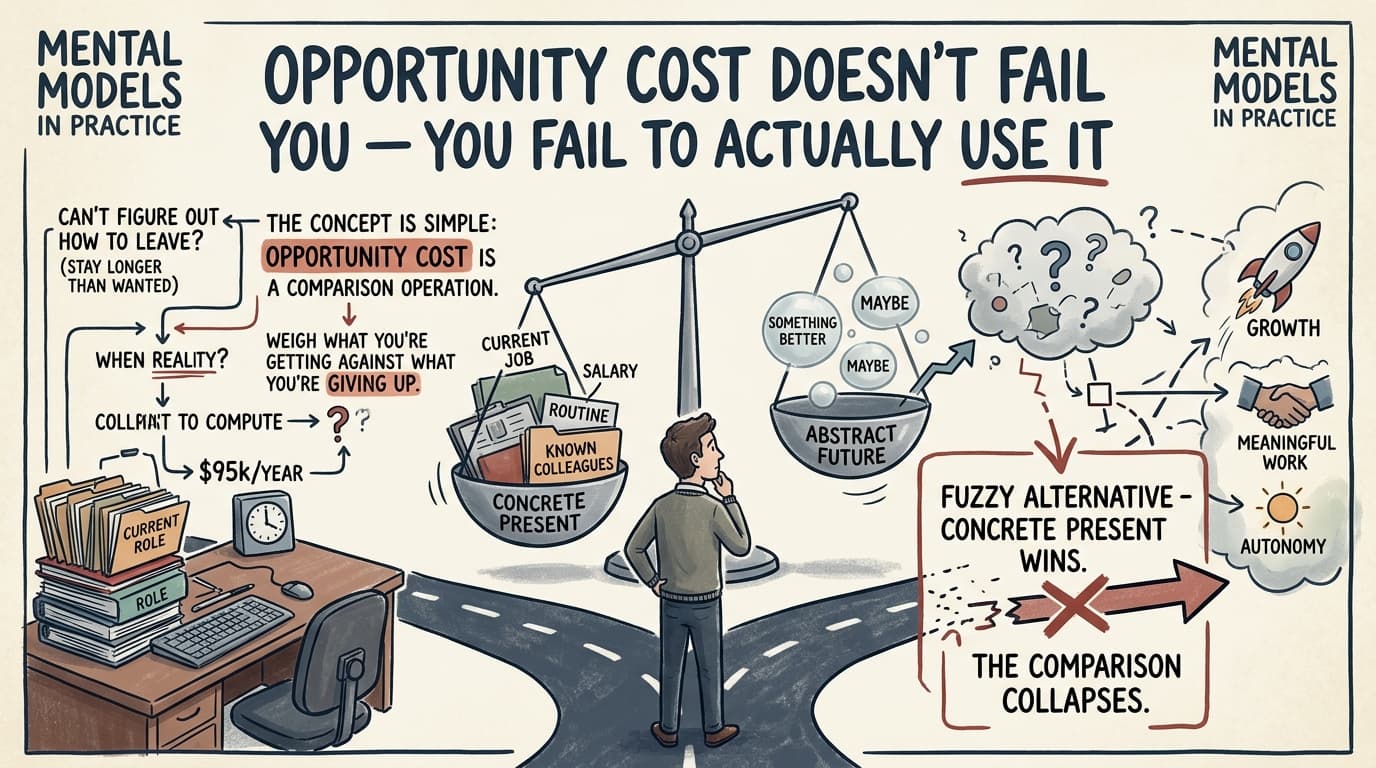
Opportunity cost, in theory, is a comparison operation. You weigh what you're getting against what you're giving up. In career decisions, this should be straightforward: staying in your current role costs you whatever the alternative path would have offered — growth, income, autonomy, meaning, time.
The problem is that the comparison requires you to clearly define the alternative. And most people never do. They treat "leaving" as a vague, undifferentiated option rather than a specific one. When the alternative is fuzzy, the comparison collapses. You end up weighing a concrete present (salary, routine, known colleagues) against an abstract future (something better, maybe). Concrete always wins that fight, not because it's actually better, but because it's specified.
This is why the framing of a decision matters as much as the framework you apply to it. Opportunity cost is a tool for comparing defined options. If you haven't done the work of defining the alternative, you're not actually using the tool — you're just holding it.
Where It Breaks Down: The Raise Problem
Here's a failure case that illustrates this precisely. Forbes recently flagged the counterintuitive case of accepting a raise without thinking through what you're trading away: a salary increase can lock you into a role, a company, or a lifestyle that forecloses options you actually value more. The raise feels like a gain. But if it comes with expanded responsibilities, higher visibility, and a new compensation floor that makes lateral moves feel like losses — you've just made your exit significantly more expensive.
This is opportunity cost operating in reverse, and most people miss it entirely. They evaluate the raise as an isolated event (more money = good) rather than as a choice that reshapes the entire decision tree going forward. The real question isn't "is this raise worth having?" It's "what does accepting this raise make harder to do?" Those are different questions, and only the second one is actually using the model.
The same logic applies to promotions, prestigious titles, and high-status projects. Each one can be genuinely valuable and quietly close off alternatives you'd have preferred if you'd seen them clearly.
The Social Pressure Multiplier
There's a compounding factor that the model doesn't account for on its own: other people's preferences distort your perception of your own options. Research from Southeastern Oklahoma State University found that 42% of workers said they'd been actively discouraged by family or friends from pursuing a career change. That's not a small rounding error. Nearly half of people considering a transition are getting social friction that makes the alternative feel riskier, less legitimate, or more selfish than it actually is.
This matters for opportunity cost because the model assumes you can evaluate options based on your own preferences. But if your sense of what's desirable has been shaped by what the people around you find acceptable, you're not comparing your options — you're comparing their options. The framework is intact; the inputs are corrupted.
Kahneman's work on reference points is useful here. We evaluate outcomes relative to a reference point, and that reference point is heavily socially constructed. Your current salary, title, and employer aren't just facts — they're anchors that make alternatives look like losses even when they're not. Opportunity cost tells you to look at what you're giving up. It doesn't automatically correct for the fact that your reference point is making the alternative look worse than it is.
When to Trust the Model, and When to Interrogate Your Inputs
Opportunity cost is most reliable when you've done three things: specified the alternative concretely, evaluated it on your own criteria rather than borrowed ones, and accounted for how your current position is anchoring your perception of loss.
It's least reliable when the alternative is vague, when social pressure is high, or when you're in the middle of a sunk cost spiral — already deep into a career path and treating past investment as a reason to continue. The model doesn't automatically protect you from any of these failure modes. It just gives you a structure that could protect you, if you use it rigorously.
The practical implication: before you decide to stay anywhere, write down the specific alternative you're not choosing. Not "something better" — an actual role, path, or version of your working life with enough detail that you could compare it honestly. If you can't do that, you're not yet in a position to make a real opportunity cost calculation. You're just rationalizing whatever you were already going to do.
The model is sound. The work is in making the comparison real.
Try This: Pick one career decision you've been deferring. Write two sentences describing the specific alternative you're not pursuing — concrete enough that someone else could understand what you'd actually be giving up by not choosing it. If you can't write those two sentences, that's your real problem, not the decision itself.


