



Here's a strange experiment. Researchers spin a roulette wheel — rigged to land on either 10 or 65 — then ask participants to estimate the percentage of African countries in the United Nations. The wheel is openly random. Everyone can see it's meaningless. And yet: people who saw 10 gave a median estimate of 25%. People who saw 65 answered 45%. A gap of twenty percentage points, from a carnival wheel.
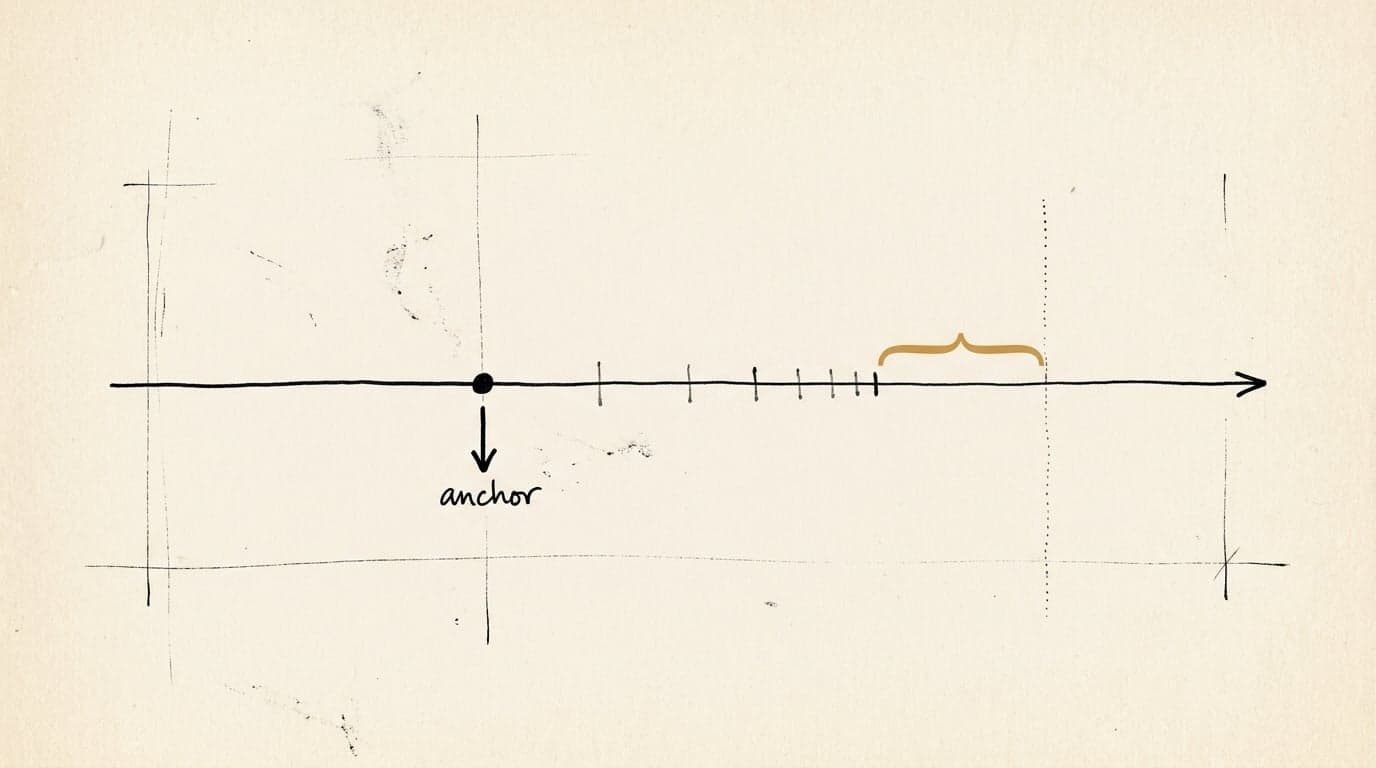
That's anchoring in its purest form. The first number doesn't inform your judgment. It becomes your judgment's gravitational center, and everything else orbits around it.
Now imagine that number isn't random. Imagine someone chose it deliberately, with full knowledge of this effect, before sitting down across from you.
The Adjustment That Always Falls Short
The mechanism is worth understanding, because it explains why anchoring is so hard to fight even when you know it's happening.
When you encounter an anchor, your brain doesn't ignore it and reason from scratch. It adjusts away from the anchor — but stops too soon. The technical term is "insufficient adjustment." You move in the right direction, but you don't move far enough. The anchor acts like a magnet: you can pull against it, but you can't fully escape the field.
What makes this particularly uncomfortable is that offering cash rewards for accurate answers doesn't reduce the bias. Motivation doesn't fix it. Awareness helps at the margins, but the pull operates below conscious control. You can know the anchor is irrelevant and still be dragged toward it.
In a negotiation, this means the person who names a number first doesn't just set a starting point. They define what "reasonable" looks like for the entire conversation. Every counteroffer, every concession, every sense of whether a deal is good or bad gets evaluated relative to that opening figure.
The Folk Wisdom Gets It Backwards
There's a piece of negotiation advice that spreads constantly — through LinkedIn posts, sales training decks, business school lectures. It sounds wise. It's usually wrong.
Never make the first offer.
An analysis of over 4,700 tweets on negotiation topics found that "never go first" content averaged 3,632 likes per post. One tweet on that theme alone pulled over 125,000 likes. Meanwhile, practitioner content arguing the opposite — anchor first — averaged 18 likes per post. And there was 22 times more of it.
The folk wisdom spreads because it feels cautious and strategic. The people who actually negotiate deals for a living say the opposite. And the research backs them up: the person who makes the first offer typically comes out ahead on price. The anchor doesn't just nudge the outcome — it constrains the entire range of the discussion.
When the Model Breaks Down
Here's where the mental model gets interesting — and where most anchoring advice stops too early.
Anchoring first is an advantage conditional on preparation. The logic inverts when you don't know what you don't know.
As negotiation practitioner Greg Williams frames it: when you're more prepared than your counterpart, anchor first — it's your advantage. When you're less prepared, anchor second — their number becomes your source of information.
This is the failure case that trips people up. They learn "anchor first" as a rule, then walk into a negotiation where the other side has done serious homework on comparable deals, constraints, and resistance points. They drop an aggressive anchor. And instead of shaping the conversation, they expose exactly where their preparation is thin. A well-prepared counterpart reads that specificity — or lack of it — and recalibrates in real time.
The anchor that was supposed to be a weapon becomes a tell.
Try This
Before your next negotiation — salary, contract, vendor pricing, anything — write down your anchor number before you research the other side's likely position. Then do the research. Notice how much your anchor shifts. That gap is a rough measure of how much you were about to leave on the table, or how much you were about to expose.
The goal isn't to anchor high and hope. It's to anchor specifically — a number precise enough to signal preparation, aggressive enough to shift the center of gravity, and grounded enough that you can defend the reasoning behind it.
The first number in a negotiation isn't just an opening bid. It's a claim about what reality looks like. Make sure you're the one who gets to define it.