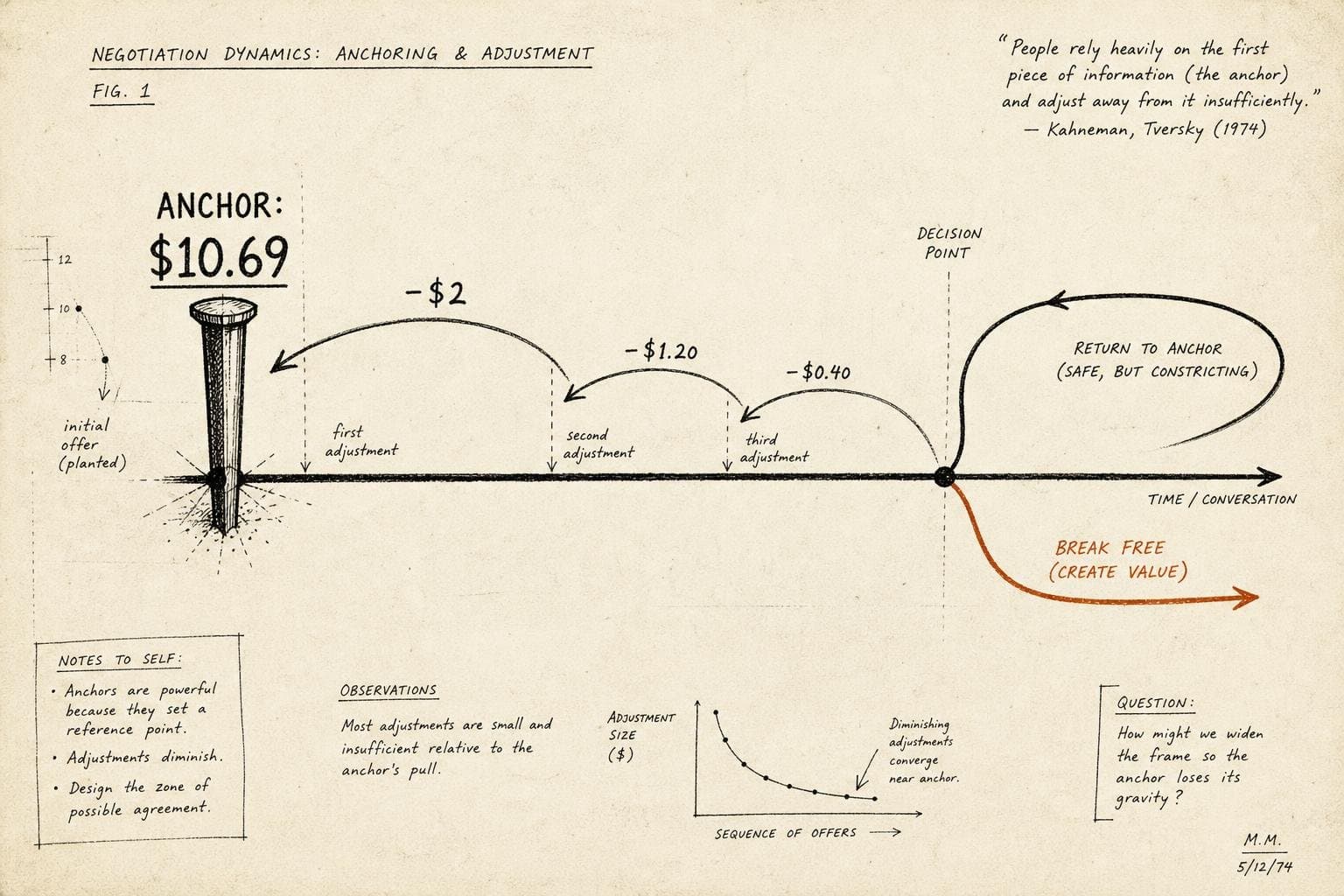

A student in a Harvard Business School negotiation simulation spent most of the exercise arguing, with genuine conviction, that a wage rate of $10.69 per hour was completely unreasonable. Couldn't happen. Wouldn't happen. And then, as HBS and Harvard Law faculty member Guhan Subramanian observed, the final deal landed exactly at $10.69.
The student didn't cave. They weren't outmaneuvered. They were anchored — pulled toward a number they'd been arguing against the entire time, without ever noticing the gravitational pull.
This is the thing about anchoring in negotiations that makes it so hard to defend against: the bias doesn't feel like a bias. It feels like you're doing the work. You're pushing back, you're countering, you're adjusting. But you're adjusting from the anchor, not away from it. And that starting point shapes everything that follows.
Why the Anchor Holds Even When You Know It's There
The mechanism isn't mysterious, but it is stubborn. When a number enters the room, your brain begins retrieving information consistent with that number being roughly correct — a process researchers call selective accessibility. You're not consciously accepting the anchor. You're unconsciously building a case around it.
What makes this particularly uncomfortable is that expertise doesn't protect you. A review of the anchoring literature spanning from Tversky and Kahneman's original 1974 work through a 36-country mega-replication found the effect holding up across real estate appraisers, judges making sentencing decisions, and salary negotiators — people operating in their professional domain, with real stakes. Offering cash rewards for accuracy didn't reduce it. Knowing the anchor was random didn't reduce it. The wheel-of-fortune experiment — where a rigged spin to 10 or 65 shifted people's estimates of African UN membership by roughly 20 percentage points — has replicated more cleanly than almost any other finding in behavioral economics.
A meta-analysis published in Organizational Behavior and Human Decision Processes drawing on 374 effect sizes from 90 studies and over 16,000 individuals put a number on the first-mover advantage: ambitious first offers correlated with agreement value at r = 0.62. That's not a nudge. That's a structural feature of how negotiations resolve.
The Trap Has a Specific Shape
The anchoring problem in negotiations isn't just that first numbers matter — it's that they matter asymmetrically. The same meta-analysis found that ambitious first offers increase economic value for the person making them, but also increase impasses and leave recipients feeling worse about the deal. Capital markets practitioners have a name for one version of this: the "predator's anchor," where allowing a lender or acquirer to issue the first term sheet establishes a fairness framework that embeds their preferred terms before any real negotiation begins. Every subsequent revision gets measured against that first proposal. Covenant rigidity becomes normalized not because it's reasonable but because it was introduced first.
The salary version is more personal. The PON example is almost painful in its clarity: you walk in expecting $75,000, get offered $45,000, and find yourself countering at $55,000 — a number you'd have rejected as insulting if you'd set the anchor yourself. The other party's opening offer didn't just start the negotiation. It quietly redrew the map of what felt possible.
The One Intervention That Actually Works
Most advice about anchoring is useless in practice. "Know your number before you walk in" doesn't help when the anchor lands and your brain starts adjusting anyway. "Do your research" is good hygiene but doesn't change what happens in the moment.
New research published in the Journal of Experimental Social Psychology, highlighted in MIT Sloan Management Review, identified something more actionable: adopting a choice mindset at the moment the first offer arrives. The simple act of reminding yourself that you can counter with any number — not just numbers near the anchor — expands the range of options your brain actually considers. It sounds almost too simple. But the mechanism makes sense: anchoring works by narrowing the cognitive search space. The choice reminder reopens it.
This is worth building into your pre-negotiation ritual, not just your post-mortem. Before the other side speaks, remind yourself explicitly: I can propose any number I want. Not as a pep talk. As a cognitive reset.
The student in Subramanian's simulation had all the motivation in the world to avoid $10.69. They just didn't have the right tool at the right moment. The anchor didn't win because they weren't trying hard enough. It won because trying hard, in the wrong direction, is exactly what anchors want you to do.
I wrote about anchoring in a different context — how first numbers shape estimates before anyone starts arguing — back in the May 14 issue. The negotiation setting is where the stakes get real.


