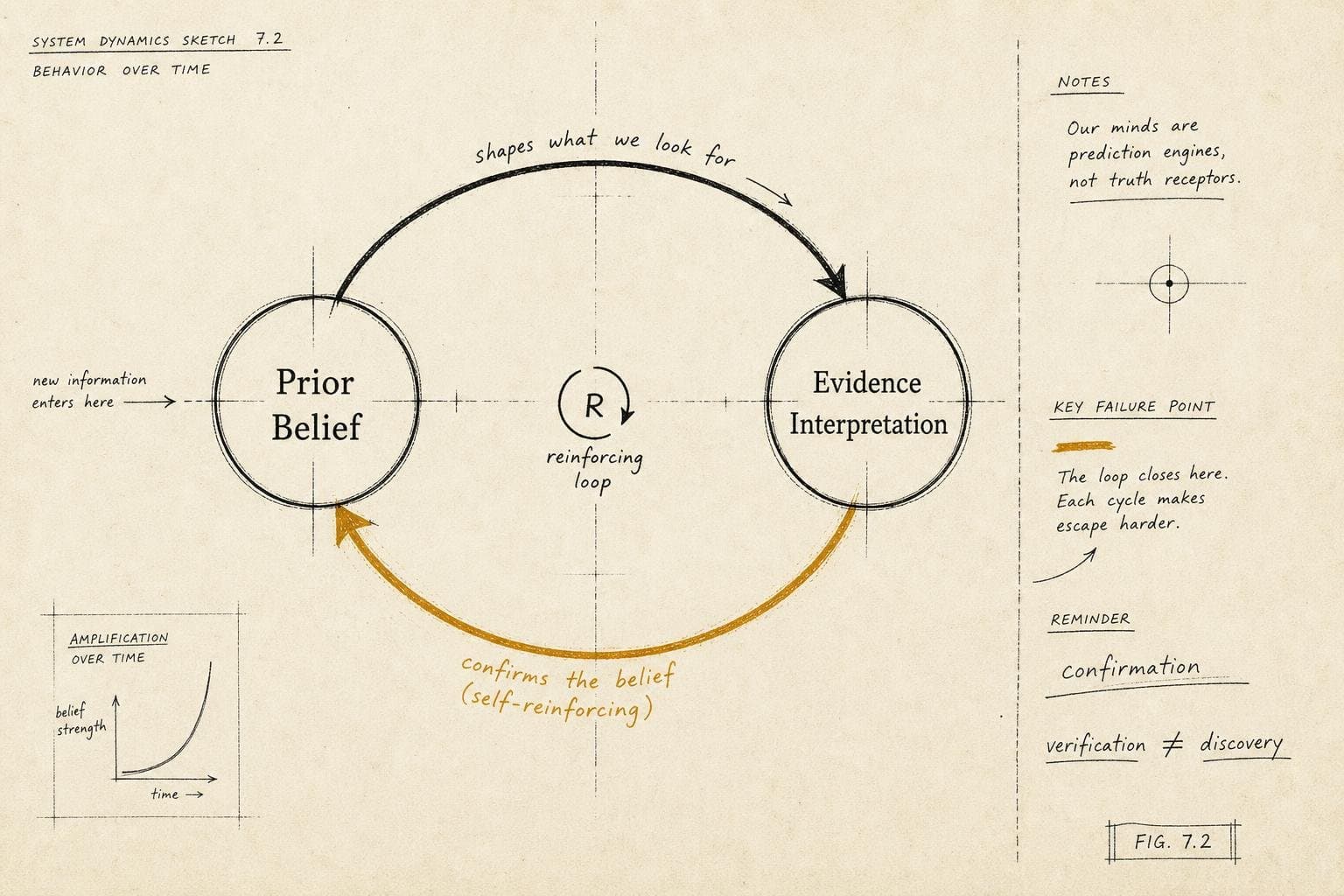

Here's a pattern that shows up in deal post-mortems with uncomfortable regularity: the red flags were visible in the data room. They were there in the financials, in the customer churn numbers, in the market assumptions. Smart, experienced investors walked right past them — not because they were hidden, but because by the time due diligence began, the investors had already decided they wanted the deal.
That's confirmation bias in its most expensive form. And it's structural, not accidental.
The Belief Comes First, Then the Evidence
Predicate Ventures describes the due diligence process with unusual honesty: "By the time a firm starts, it already believes the company could be a good investment. The work that follows checks whether the claims behind that belief hold up."
Read that again. Diligence is framed as verification, not discovery. The investor has already formed a view from the pitch and the deck. Due diligence is the process of confirming it.
This is where confirmation bias gets its foothold. When your job is to verify a belief you already hold, you will unconsciously weight evidence that supports it and discount evidence that doesn't. A high churn rate becomes "early-stage growing pains." A thin margin becomes "room for operational improvement." A founder who can't explain their unit economics becomes "a visionary who's delegated the details."
The M&A world has the receipts on what this costs. Knowledge at Wharton documents Bayer's $63 billion acquisition of Monsanto, which has erased over $50 billion in shareholder value — attributed in part to inadequate due diligence. General Electric's $10 billion purchase of Alstom's power business contributed to a $22 billion impairment three years later, with CEO Jeff Immelt later admitting he wouldn't do the deal again. Warren Buffett acknowledged that Berkshire "overpaid for Kraft" in the merger that generated over $28 billion in write-downs. These weren't unsophisticated buyers. They were some of the most experienced dealmakers in the world, running processes with armies of advisors.
The problem wasn't the process. The problem was what the process was designed to do.
Pattern Matching Makes It Worse
In venture capital, confirmation bias gets amplified by something called pattern matching — the cognitive shortcut where investors evaluate founders against a mental archetype of what success looks like. Research cited by sri360.com documents how this plays out structurally: investors who have internalized a particular founder profile will find evidence for it everywhere, and struggle to see capability that doesn't fit the template.
The insidious part is that pattern matching feels like expertise. When you've seen a hundred pitches, you develop intuitions. Some of those intuitions are genuinely useful. But they also create a prior belief that's hard to dislodge — which means due diligence becomes a process of finding the data that matches what your gut already said.
Ivan Kroshnyi, writing in The AI Journal about deploying capital across 30 businesses in 19 countries, puts it plainly: the decisive moments in an investment rarely happen in the data room. They happen in how a founder responds to a hard question, in the micro-signals that tell you whether someone genuinely understands their business. The problem is that those signals are also the ones most susceptible to confirmation bias — we interpret ambiguous human behavior through the lens of what we already believe about the person.
The Structural Fix Nobody Wants to Do
There's a version of this problem that's genuinely hard to solve, and a version that's just uncomfortable to solve.
The uncomfortable version: Marius Andronie, writing from inside the due diligence tooling industry, describes a recurring scenario where a searcher runs documents through an AI tool, gets a clean summary, and then re-reads the source documents anyway — and finds the summary was wrong. "Not catastrophically, not obviously. Just wrong in the quiet way that matters: a number smoothed over, a risk softened into a strength." The person caught it because they didn't trust the tool. Which raises the question: if confirmation bias is the problem, adding a tool that confirms your priors faster isn't a solution.
The harder structural fix is what David Cooper, CIO of Purdue's endowment, describes in a Purdue Business case study: when a peer offered him an allocation in a prominent tech company that was 10x oversubscribed, the catch was that no diligence was available. The books weren't open. Cooper declined — even though the company has continued to succeed at higher valuations since. His point is worth sitting with: "Some investment prospects that do not align with one's fiduciary duty will perform extremely well. No matter how convinced you are about the potential investment's prospects, it never excuses the dereliction of your ethical responsibilities."
That's the discipline confirmation bias actually requires. Not better tools. Not more data. The willingness to walk away from a deal you want, because the process that would change your mind wasn't available to you.
Most investors know this in the abstract. The test is whether you can do it when the deal is exciting, the round is oversubscribed, and everyone around you is saying yes.


