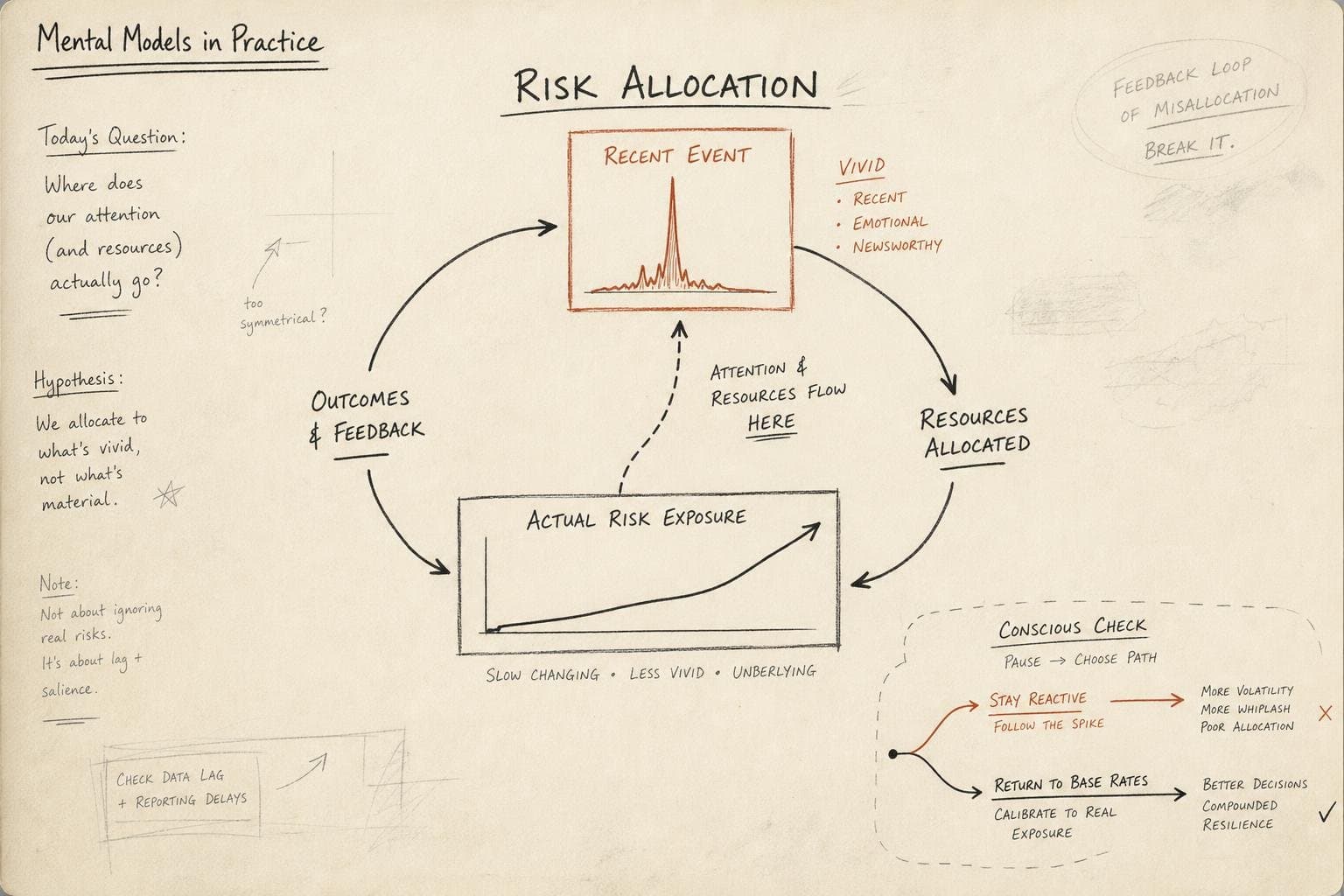

A competitor suffers a data breach. The story runs on LinkedIn for two weeks. Three executives testify before a parliamentary committee. A month later, your leadership team sits down for its quarterly review — and within an hour, everyone agrees: the cybersecurity budget should triple.
Nobody has pulled up a risk analysis of your own infrastructure. Nobody has asked whether the actual threat to your organization has materially changed.
Meanwhile, a burnout crisis has been spreading quietly through the organization for two years. The absenteeism data is there. The cost, conservatively estimated, is ten times higher than any realistic data breach scenario. But nobody talks about it. It's slow, it's invisible, and it lacks the dramatic charge of a cyberattack on the evening news.
This is the availability heuristic at work. And it's not an occasional glitch — it's the brain's default mode under time pressure.
The Shortcut That Feels Like Thinking
Amos Tversky and Daniel Kahneman identified the mechanism in 1973. When people estimate how likely something is, they don't calculate — they fall back on a simpler question: how easily can I think of an example? The speed of retrieval gets translated directly into "more frequent" and "more probable."
The classic demonstration: are there more English words that begin with the letter K, or words where K is the third letter? Most people say words starting with K. They're wrong — words with K in the third position (think, make, bike) are far more common. But words starting with K come to mind faster, and that speed feels like evidence.
Three things make an event feel available: recency, vividness, and emotional charge. What happened yesterday carries more weight than what you read a year ago. A dramatic story crowds out a slow-moving trend, even when the trend is statistically larger. The brain substitutes the hard question — "how likely is this?" — with the much easier one: "how quickly can I think of an example?" And that substitution doesn't feel like a shortcut. It feels like thinking.
This is worth sitting with, because it means your risk model is being quietly updated every time you read the news — whether you intend it to be or not.
Where Smart People Get Burned
I've written before about how the last disaster tends to run your risk model — the way organizations after 2008 rebuilt their risk frameworks around the specific failure they'd just survived, leaving them well-defended against the past and exposed to the future. The availability heuristic is the cognitive engine underneath that pattern.
Consider a leader assessing potential risks in a project. If recent instances of project failures are vivid in memory, they might overestimate the probability of failure — even if those failures were outliers. The bias doesn't just affect risk perception. It shapes hiring decisions, strategic planning, and resource allocation — anywhere that judgment about frequency or probability enters the picture.
The insidious part is that the bias runs in both directions. Vivid recent successes make you overconfident. Vivid recent failures make you overcautious. Neither response is calibrated to actual probability. Both feel completely rational in the moment.
And the organizational version is worse than the individual version, because the availability heuristic operates below the threshold of conscious awareness — which means a room full of smart people can collectively anchor to a salient recent event without anyone noticing that's what they're doing. The cybersecurity budget triples. The burnout crisis gets a task force. Nobody asks whether the resource allocation reflects actual risk exposure.
The Structural Fix (and Its Limits)
The standard advice is to slow down and seek out base rates — look at historical frequency data rather than relying on what comes to mind easily. That's correct, and it's also genuinely hard to do in practice, because the availability heuristic is System 1 in action: fast, automatic, and operating completely below conscious awareness. You can't just decide to stop using it.
What you can do is build structural checks into the decision process. The most useful one I've found: when a recent vivid event is driving a resource or strategy conversation, explicitly ask what the slow, invisible version of the same risk looks like. The dramatic data breach gets the room's attention. The burnout crisis doesn't. That asymmetry is a signal, not a conclusion.
A second check: when developing leaders, it's crucial to acknowledge and address the availability heuristic to foster better decision-making — which means naming the bias explicitly when you see it operating in a room. "We're reacting to the competitor's breach. Has anyone pulled our own infrastructure risk data?" That question doesn't feel heroic. It feels like slowing things down. But it's the difference between a risk budget that reflects reality and one that reflects last month's headlines.
The availability heuristic isn't going away. It's too fast and too automatic. The goal isn't to eliminate it — it's to notice when it's doing the driving, and decide whether you actually want it behind the wheel.


