
In 2001, a pair of economists studied what happened when a large employer stopped asking new hires to sign up for a 401(k) and started asking them to opt out instead. Participation went from 37% to 86% — a 49-point jump produced by nothing more than flipping a checkbox (Behavioral Strategy). It's the case study every behavioral economics class leans on, and for good reason. Madrian and Shea's finding is one of the cleanest demonstrations in social science that the path of least resistance determines outcomes more than preferences do.
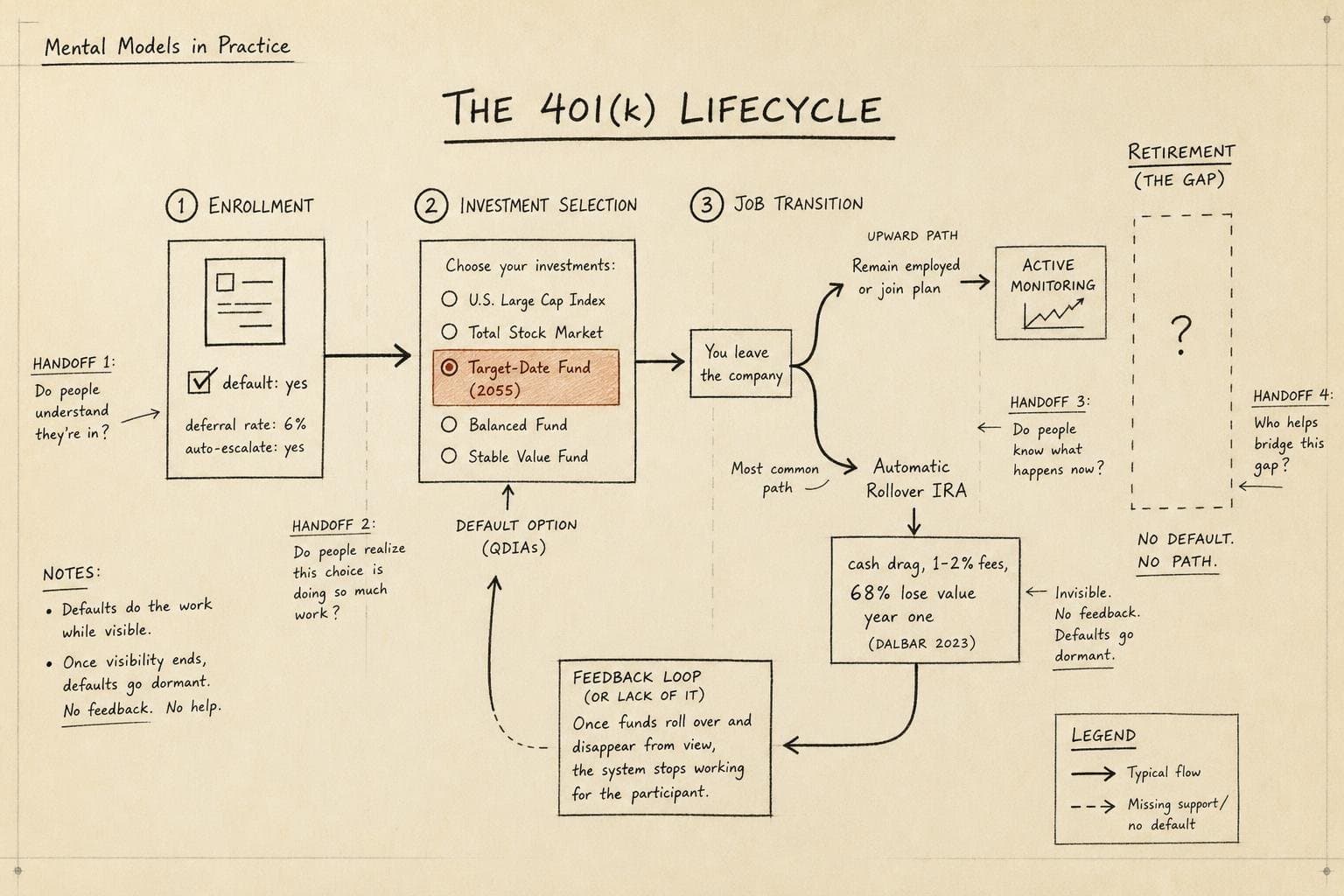
But I've noticed something about this story that doesn't get said enough: the version everyone remembers is the start of the pipeline, not the whole pipeline. Once a default gets someone into a plan, it keeps making decisions for them — what they're invested in, what happens when they change jobs, and eventually what happens to the money in retirement. Each handoff is a fresh default, and not all of them are configured as well as the first one.
The Default Keeps Choosing After You Stop Paying Attention
Auto-enrollment was never really about the enrollment checkbox. It was about removing the one effortful step — the paperwork — from a behavior people already wanted to do: save via payroll deduction, which is passive, automatic, and invisible once it's set up (Behavioral Strategy). That's the mechanism. Defaults don't manufacture motivation; they delete friction from behavior that was already viable.
The investment-selection default rode the same logic to even bigger numbers. Ninety-six percent of Vanguard-administered plans now offer target-date funds, and 98% of plans use one as the automatic investment choice when an employee doesn't pick anything (Investopedia). A record 69% of Vanguard's roughly 5 million plan participants used professionally managed allocations by the end of 2025, up from just 9% two decades earlier (Investopedia). Same mechanism, same payoff: remove the decision, and people stop making the mistake of not deciding.
Then the Job Ends, and the Default Stops Helping
Here's where it gets interesting — and where the framework starts to mislead you if you assume "default" always means "good for the person." When someone leaves a job with a small 401(k) balance, employers can move that money into an automatic rollover IRA without the worker's consent, a mechanism Congress created in 2001 specifically to stop companies from just cutting a check and triggering taxes and penalties (USA Today). Reasonable goal. But a new PensionBee white paper, drawing on EBRI account data, found that 68% of these automatic rollover IRAs lose value in the first year, parked as they are in cash-equivalent accounts earning 1-2% while fees chip away at the balance — and 39% are still underwater after eight years (USA Today). The number of these accounts is projected to double from 1.1 million a year in 2022 to 2.2 million by 2030 (USA Today).
Notice what changed between the enrollment default and the rollover default. The enrollment default configured an already-viable, passive, ongoing behavior — payroll deduction just kept happening. The rollover default configures a one-time event and then goes dormant. Nobody checks back in. The worker doesn't know the account exists, let alone that it's shrinking. A default that works brilliantly when it's embedded in a recurring, visible process can become a trap the moment it's set-and-forgotten with no one watching.
The Gap Nobody's Defaulted Yet
The same blind spot shows up at the other end of the savings pipeline. Most defined contribution plans auto-enroll you and default your investments, but almost none default what happens when you retire. Workers are left to choose on their own between lump sums, systematic withdrawals, or IRA rollovers, and only about 10% of plans even offer a guaranteed-income option as a payout choice (Brookings). The decision that arguably carries the most risk — how to turn a lump of savings into decades of income without running out — is the one point in the journey where the industry hasn't bothered to build a good default at all.
That asymmetry is the real lesson here. Defaults are powerful exactly where someone has already done the design work to make the default-following behavior safe and ongoing. They're dangerous or simply absent wherever that design work stopped. Before you trust "just set it and forget it" as a universal strategy, it's worth asking which parts of your financial life still have nobody tending the default at all.


