
Here's a thought experiment. You have $1,000 and you spend it on a conference ticket. What did that decision cost you?
The obvious answer: $1,000. But that's not the full answer. It also cost you whatever else you would have done with that $1,000 — the equipment you didn't buy, the course you didn't take, the month of runway you didn't preserve. That's the opportunity cost. And here's the uncomfortable part: you almost certainly didn't think about it.
This isn't a character flaw. It's a structural feature of how human cognition handles implicit information. Research on opportunity cost neglect shows that decision-makers systematically ignore costs that aren't explicitly placed in front of them, while giving disproportionate weight to whatever is salient in the moment. The conference ticket is real and visible. The foregone alternative is abstract and invisible. So the brain treats the invisible option as if it doesn't exist.
That asymmetry is where most bad decisions live.
Visible Losses Hit Harder Than Invisible Ones
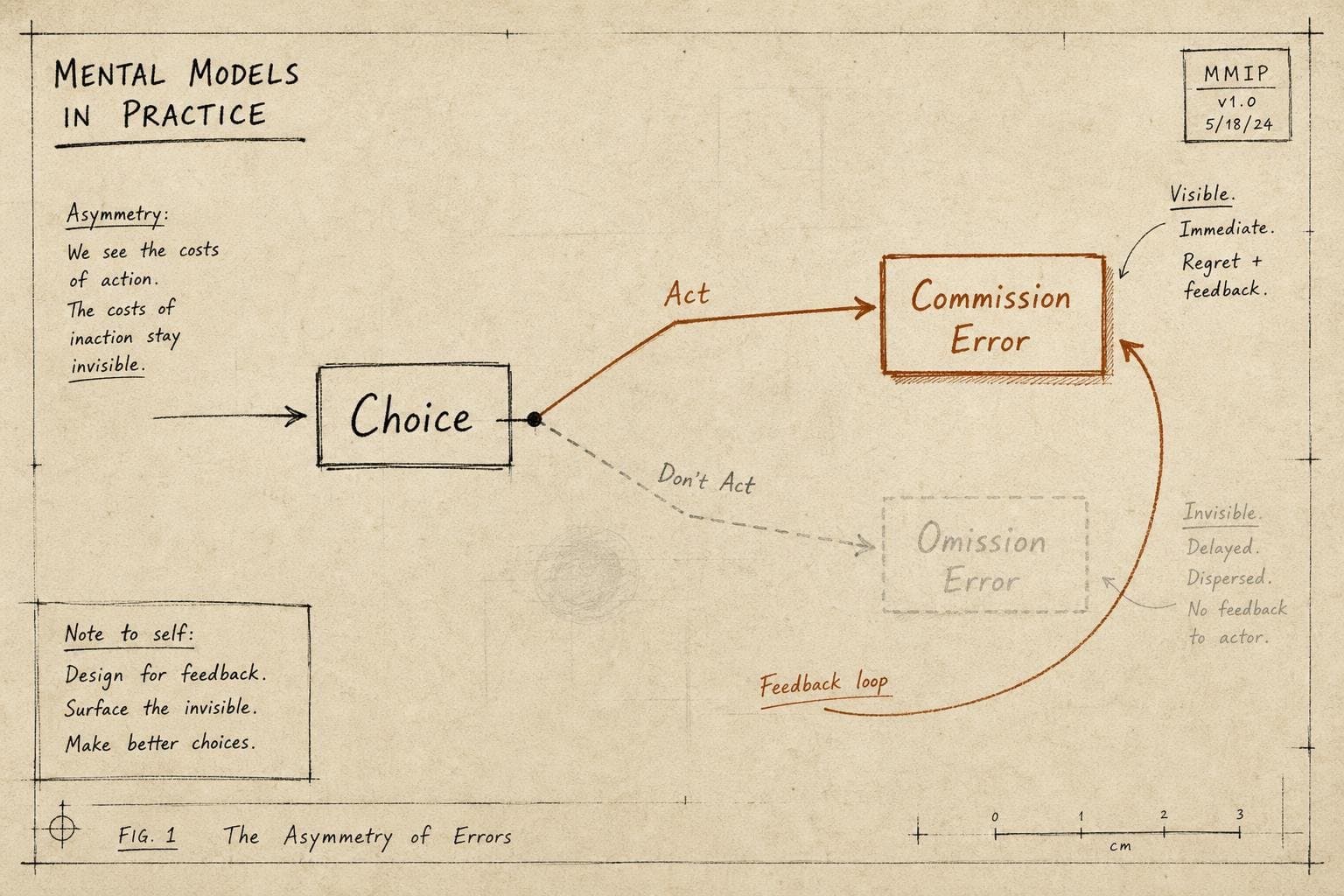
There's a useful distinction buried in recent research on how managers handle failure. A study published in the Journal of Product Innovation Management distinguishes between two types of errors: commission errors (you did something that didn't work) and omission errors (you failed to do something that would have worked). The finding is striking — managers who recently experienced a commission error became more risk-averse and more likely to abandon ongoing projects. Managers who experienced an omission error — a missed opportunity — became more willing to persist.
Think about what that means. The pain of a visible mistake makes you pull back. The pain of an invisible missed opportunity makes you push forward, as if trying to compensate. Both reactions can be wrong. But the deeper problem is the asymmetry itself: commission errors are legible and concrete, so they register emotionally. Omission errors — the things you didn't do, the paths not taken — are diffuse and abstract, so they don't hit the same way.
Opportunity cost lives in omission territory. It's always the thing you didn't choose. Which means it's always fighting against the cognitive grain.
Where the Framework Breaks Down
The standard advice for correcting opportunity cost blindness is to "make the alternatives explicit." Before committing to option A, force yourself to articulate option B. Write it down. Assign it a dollar value. Make the invisible visible.
This works — sometimes. The problem is that it requires knowing what the alternatives actually are, and in complex decisions, you often don't. A startup choosing between two go-to-market strategies has to consider not just those two paths but the entire space of paths it's foreclosing. MIT Sloan research on entrepreneurial strategy frames this as a core challenge: early strategic choices don't just determine what you're doing, they determine what you can't do later. The opportunity cost of choosing one path isn't just the other path you considered — it's the paths you didn't even think to consider.
That's the version of opportunity cost neglect that's hardest to fix. You can't make explicit what you haven't imagined.
There's also a timing problem. Research on cognitive biases in workplace decision-making finds that time pressure pushes people toward fast, heuristic processing — exactly the conditions under which implicit information gets ignored most aggressively. The moments when you most need to think carefully about what you're giving up are often the moments when you're least equipped to do it. Deadlines, urgency, and competitive pressure all conspire to make opportunity costs even more invisible.
A More Honest Use of the Tool
The mental model of opportunity cost is genuinely useful. But it's most useful when you treat it as a prompt for a specific question rather than a general reminder to "think about tradeoffs."
The question is: What would I have to give up that I'm not currently thinking about?
Not "what are the tradeoffs?" — that's too abstract. The specific version forces you to name something concrete that isn't currently in your field of view. It's the difference between knowing you have blind spots and actually turning your head.
A few places where this matters most:
Time allocation. Every hour you spend on one project is an hour not spent on another. The project you're working on is visible; the one you're not is invisible. The asymmetry is automatic.
Organizational resources. As the NYU Journal of Law & Liberty analysis notes, this dynamic plays out at scale in public policy — voters consistently underweight what government programs cost in foregone alternatives because those alternatives are never on the ballot. The same thing happens inside organizations when a new initiative gets approved without anyone naming what it displaces.
Persistence decisions. The Journal of Product Innovation Management findings suggest that rational thinkers don't escape bias here — they just shift their attention to specific project attributes rather than the broader opportunity cost of continuing. Even careful thinkers can miss the forest.
The model doesn't fail because people are careless. It fails because the thing it asks you to see is structurally harder to see than the thing in front of you. Knowing that is the beginning of actually using it.


