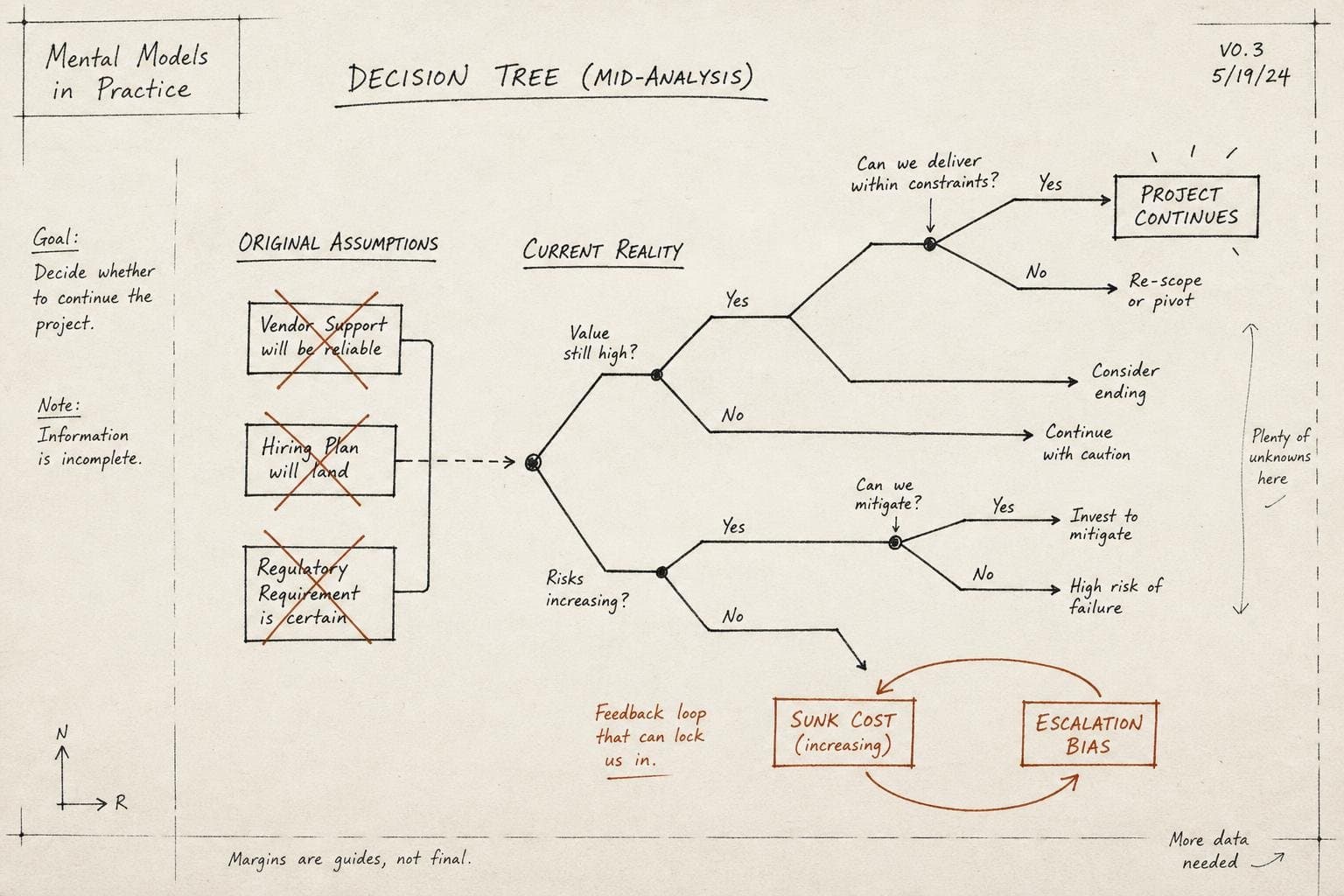

Here's a scene that probably sounds familiar. An engineering director is sitting in a quarterly review, looking at a slide showing a migration that's 72% complete. He asks a simple question: "Which of the assumptions behind this are still true?"
The answer, it turns out, is almost none of them. The vendor had extended support, hiring had stopped, and the certification requirement that originally justified the new platform had been routed around months earlier. Fourteen people were still assigned to the project. The dashboard still showed green.
What happened next is the part worth studying. The conversation didn't turn to customers or technology. It turned to the work already completed, what had been told to the board, and how cancellation might land with the teams. One executive said that changing course would damage their credibility. The project continued.
This is the sunk cost fallacy in its natural habitat — not as a textbook error, but as a fully rationalized organizational decision.
Why "Past Investment" Feels Like a Reason
The standard explanation for sunk cost thinking is that people are bad at ignoring irretrievable costs. Economic theory holds that past expenditures — money, time, resources already spent — should have zero bearing on forward-looking decisions. What matters is future costs versus future returns, full stop.
But that framing misses why the fallacy is so sticky. It treats sunk cost thinking as a calculation error, when it's actually an emotional one.
Daniel Kahneman and Amos Tversky's Prospect Theory offers a sharper account: the human brain doesn't evaluate outcomes in absolute terms. It evaluates them relative to a reference point, and losses hit roughly twice as hard as equivalent gains feel good. As long as you keep funding a failing project, the loss stays on paper. The moment you cancel it, the loss becomes real — final, undeniable, yours. Executives will do a lot to avoid that moment of finality.
This is why the sunk cost fallacy is so resistant to logic. Telling someone "ignore what you've already spent" is asking them to voluntarily experience a loss they've been successfully deferring. The rational advice is correct. It's also asking people to do something psychologically brutal.
The Organizational Version Is Worse
Individual sunk cost thinking is hard enough. Organizational sunk cost thinking has additional layers that make it nearly intractable.
Recent research in the Journal of Business Research distinguishes between two kinds of decision errors that shape how managers escalate commitment afterward. Commission errors — continuing with a project that's clearly failing — increase what the researchers call "anticipated keep regret": the dread of looking back and realizing you kept pouring resources into something you knew was broken. Omission errors — abandoning something too soon — generate the opposite fear. The study found that which error a manager has made previously predicts how they'll behave on the next decision, independent of the actual merits.
In other words, past mistakes don't just waste money. They warp the decision-making apparatus you use on future projects.
The leadership.garden account of the platform migration illustrates exactly how this plays out structurally. A decision that starts as a choice among alternatives quickly produces consequences that are hard to reverse: budgets shift, teams form, contracts get signed, roadmaps absorb dependencies. Someone gets promoted for leading the work. Another group is asked to wait because the organization has committed elsewhere. Within a few quarters, the original choice has become part of the organization's structure. Asking whether it still makes sense starts to sound less like management and more like an accusation.
The Assumption Audit as a Forcing Function
The most useful intervention I've seen described isn't about willpower or rationality training. It's about making the original assumptions visible before they quietly expire.
Research on project premortems — the technique of imagining a project has already failed and working backward to explain why — found that prospective hindsight increases the ability to correctly identify reasons for future outcomes by 30%. The mechanism matters: you're not asking "what might go wrong?" You're asking "what did go wrong?" That shift from hypothetical to assumed-real changes what people are willing to say out loud.
The engineering director's question — "which of the assumptions behind this are still true?" — is a version of the same move. It reframes the conversation from defending a decision to auditing a set of premises. Those are very different psychological tasks.
A forward-looking analysis should only consider future costs and benefits — but it needs somewhere to start. Documenting the specific assumptions that justified a project at launch (the growth forecast, the vendor timeline, the regulatory requirement, the competitive threat) gives you a concrete checklist to revisit. When those assumptions change, the decision is back on the table — not because someone failed, but because the world moved.
The project that engineering director was reviewing had fourteen people assigned to it and a green status on the dashboard. The original reasons for doing it had been gone for six months. The question that finally surfaced this wasn't "should we cancel?" It was just: which of the assumptions are still true?
Ask that question earlier. Ask it on a schedule. The answer will tell you everything the dashboard won't.


