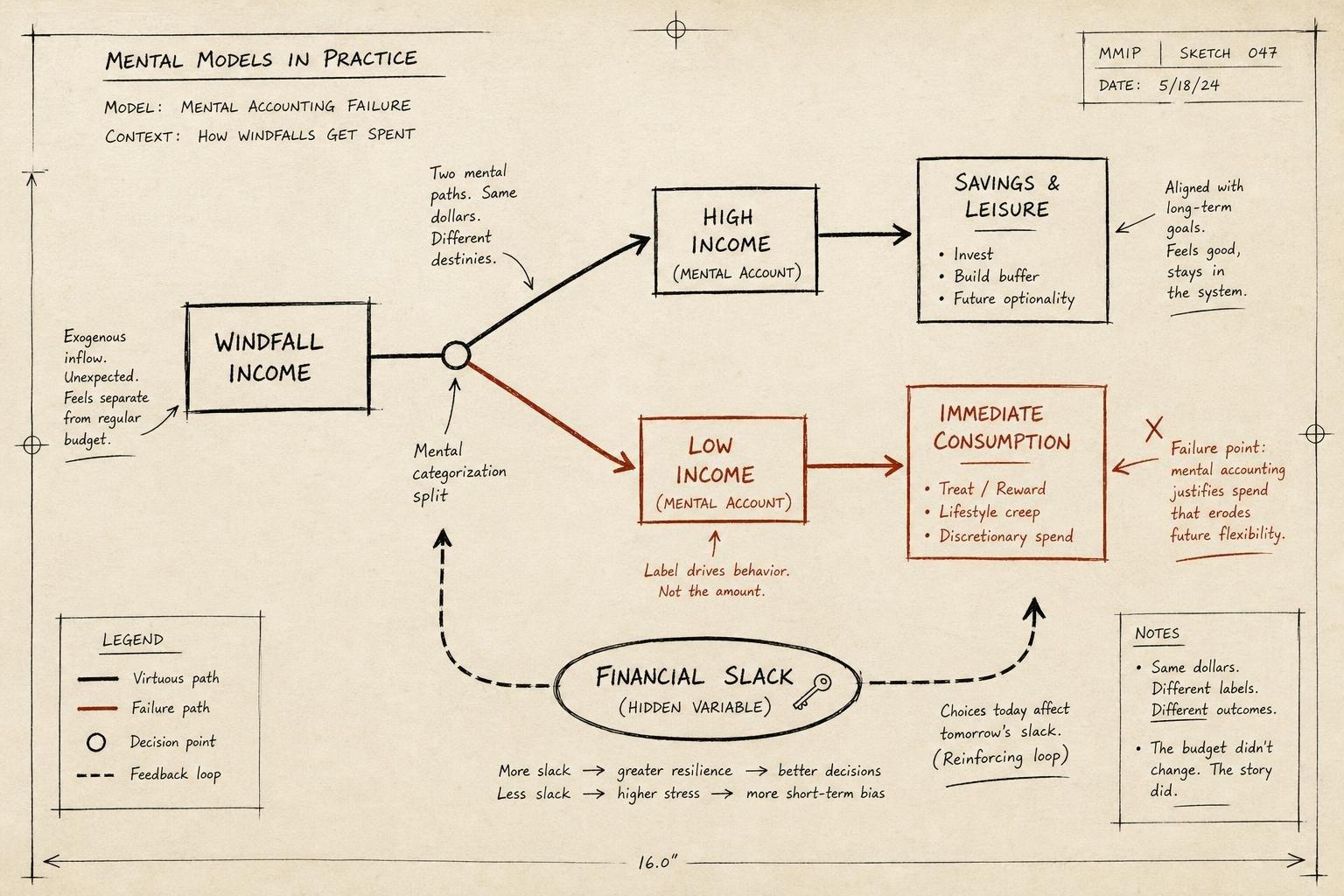

In 1985, two couples got a check from an airline for $300 after it lost their luggage. They spent it that same night on the most expensive dinner of their lives — $225 worth of food, more than two-thirds of the payout, gone in one sitting (Resident). Richard Thaler used that story to make a simple point: the money hit two mental accounts at once — "windfall income" and "food" — and that double-labeling decided how it got spent. If the same $300 had shown up as a slightly bigger paycheck, it probably would have paid down a credit card or disappeared into groceries over a month. Same dollars. Totally different fate. That's mental accounting, and four decades later the data keeps confirming Thaler was onto something real, not just a clever anecdote.
Your Brain Keeps Separate Books, and the Labels Change the Math
A 21-country study of 5,589 adults recently retested the classic mental-accounting experiments and found the pattern holds up almost everywhere, not just in the WEIRD countries where behavioral economics usually gets tested (Earth.com). People in the study were more willing to drive 20 minutes to save $5 on a $15 speaker than to save the identical $5 on a $125 jacket — even though the drive, the savings, and the total bill were all the same. They treated a lost $40 event ticket as more expensive to replace than $40 in lost cash, because the ticket money was already filed under "entertainment" and the cash wasn't filed anywhere yet. And a missed gym session hurt less when it came out of a $1,000 annual membership than when it came out of a $20 per-visit fee, because the annual number smeared the loss across fifty-two invisible installments.
None of this is about math. It's about which drawer the money is sitting in when you decide whether to spend it.
Daniel Bartels and Lin Fei's research adds a wrinkle to this: when people overspend in one mental category, they don't rebalance by cutting the nearest convenient expense — they cut within the same category, even when that's financially nonsensical (Resident). Bartels got hit with a $90 burger bill instead of the $50-60 he expected, and his instinct wasn't to trim the clothing budget or skip a gift — it was to cancel Friday delivery. The overspend happened in "dining out," so the correction had to happen there too, as if money were earmarked rather than fungible. That's the part of mental accounting that should make you nervous: it's not a one-time quirk, it's a standing policy your brain runs without asking you.
Where the Windfall Model Actually Breaks
Here's where it gets interesting for anyone who's ever gotten a bonus, an inheritance, or a lucky stock gain. A large study of Canadian lottery winners, using linked tax and credit bureau records, found that windfalls don't get treated uniformly even within the "windfall" account — the effect splits hard along income lines (NBER). High-income winners put a larger share of their winnings into savings and leisure. Low-income winners spent a bigger share immediately on consumption. Same windfall label, same "free money" framing, completely different behavior depending on what else is going on in someone's financial life (New York Fed).
That's the failure case for the tidy version of mental accounting you usually hear — "windfalls get spent, earned income gets saved." It's true on average, but it hides a second variable doing a lot of the work: how much slack a person already has. If you're living close to the edge, a windfall isn't really a separate account at all — it's the only account, and it gets spent closing gaps that earned income never covered in the first place. Mental accounting predicts the labeling instinct; it doesn't predict how much pressure is already bearing down on the label.
Fidelity's wealth management team has started calling the more extreme version of this "sudden wealth syndrome" — the stress and identity confusion that hits people after a large inheritance or business sale, often pushing them into permanent lifestyle commitments before they've built any actual plan (TheStreet). The mental account isn't just a spending category in that scenario. It's a identity crisis wearing a budget's clothing.
The Practical Fix Isn't Fighting the Labels — It's Choosing Them on Purpose
You're not going to out-rationalize mental accounting. Trying to treat every dollar as perfectly fungible, the way economic theory says you should, isn't how human brains actually run — it's a nice idea for a textbook and a bad plan for a Tuesday. The more useful move is to hijack the labeling instinct instead of fighting it: decide the category before the windfall lands, not after. Earmark the bonus for debt before it touches your checking account. Route the inheritance straight into an account you never see on a daily basis. The mental account is going to form one way or another — you might as well be the one who names it.


