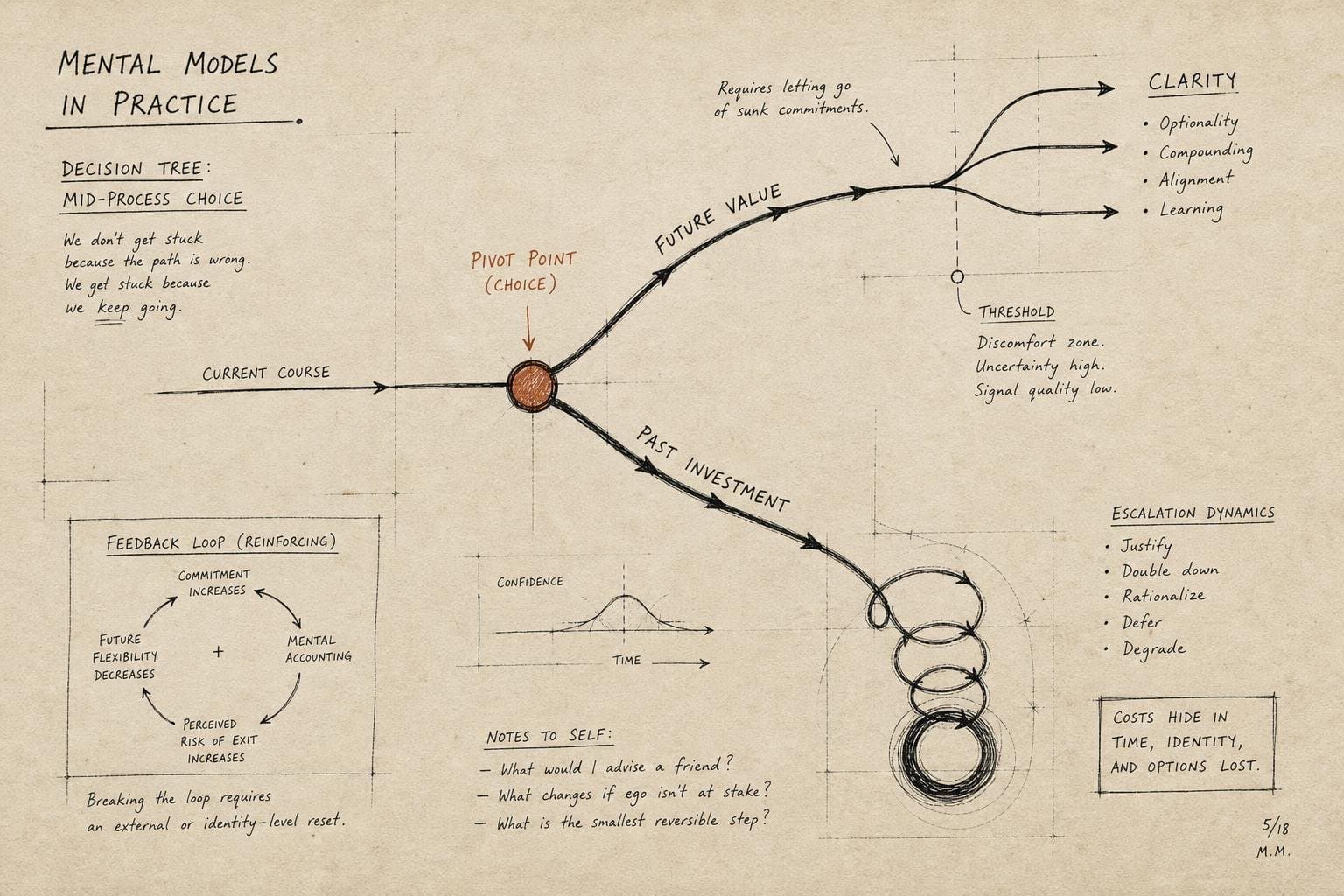

(A note before we start: I wrote about sunk cost briefly in the June 18 issue — specifically how the model breaks down when building costs collapse. That was about when the framework stops applying. This issue is about when it applies all too well, and why we keep ignoring it anyway.)
You've spent $200,000 on a product feature. It's not working. Every signal says users don't want it. Your best engineer quietly suggests killing it and redirecting the team.
You approve another sprint instead.
This is the sunk cost fallacy in its natural habitat — not in a textbook scenario about ski trips, but in a product review meeting where smart people with good intentions decide to keep going because stopping feels like admitting the $200,000 was a mistake. As The Behavioral Scientist explains, the mechanism is Richard Thaler's mental accounting: we maintain psychological "accounts" for our expenditures and feel compelled to avoid closing one at a loss. The pain of formally writing off a past investment overrides a clear-eyed look at what comes next.
The rational move is obvious. The emotional move wins anyway.
The Trap Isn't Stupidity — It's Self-Protection
Here's what makes this bias so sticky in product decisions specifically: continuing feels like courage, and quitting feels like failure.
DEV Community's breakdown of the pattern puts it plainly. Your brain is running a story-protection algorithm. If you quit after $200K, you're the person who lost $200K on a bad call. If you invest another $50K and it works, you're the person who had the guts to stick with it. If you invest another $50K and it fails — well, at least you tried everything. The one story your brain won't allow: "I should have quit earlier." That story requires admitting you were wrong and kept going anyway.
So the brain keeps investing. Not because the math changed, but because the narrative needs protecting.
In product teams, this plays out with particular force because the sunk cost often has faces attached to it. Someone championed this feature. Someone's career is partially defined by it. Killing it means telling that person — and everyone watching — that the thing they built doesn't matter. The social cost of stopping gets bundled into the financial cost of stopping, and suddenly the decision feels even heavier than it is.
What the Research Actually Shows
The empirical picture here is more complicated than the textbook version suggests, which is worth knowing if you're trying to apply this framework carefully.
A 2026 study in the Journal of Economic Behavior & Organization ran two pre-registered experiments — one online with over 1,800 participants, one a field experiment on YouTube with more than 11,000 videos — specifically to measure the sunk cost effect. The online study found a moderate effect: varying the sunk cost by $2 produced roughly 1.3 additional minutes of engagement. But the YouTube field experiment showed something more interesting. Extending the time before a pre-roll ad became skippable (forcing more investment before the video started) actually increased the share of users who left before the video began — about 28% more relative to the shortened treatment. More forced investment, more abandonment.
The researchers' conclusion: the sunk cost effect is real in controlled environments, but its application in real-world policy settings is genuinely difficult to predict.
What this tells you about product decisions: the fallacy is real, but it's not a simple dial you can turn. Context matters enormously. The same psychological mechanism that keeps a team pouring resources into a failing feature might, in a different configuration, cause users to abandon a product entirely when the onboarding friction gets too high. The framework is a map, not a territory — and the territory has surprises.
The Question That Cuts Through It
The most practical intervention I've found — and DevGENT's project exit framework formalizes this well — is what they call zero-base thinking: If no money had been invested yet, would I start investing now?
If the answer is no, the justification for continuing almost certainly depends on sunk costs rather than future value.
This question works because it forces a separation between the past account and the forward decision. It doesn't ask you to pretend the $200K didn't happen — it asks you to evaluate the next dollar independently of the ones that are already gone. The Concorde governments couldn't do this, as The Behavioral Scientist notes — they kept funding a project that would never be commercially viable because neither side wanted to be the one to write off the investment. The phenomenon became so iconic that economists sometimes call the sunk cost fallacy the "Concorde fallacy."
The harder discipline is building this question into your process before you need it — not as a crisis intervention when a project is visibly failing, but as a standing checkpoint at defined intervals. When the question is routine, it loses some of its sting. It stops feeling like an accusation and starts feeling like maintenance.
That's the difference between a team that kills projects well and one that doesn't. Not smarter people. Just a process that makes the right question easier to ask.


