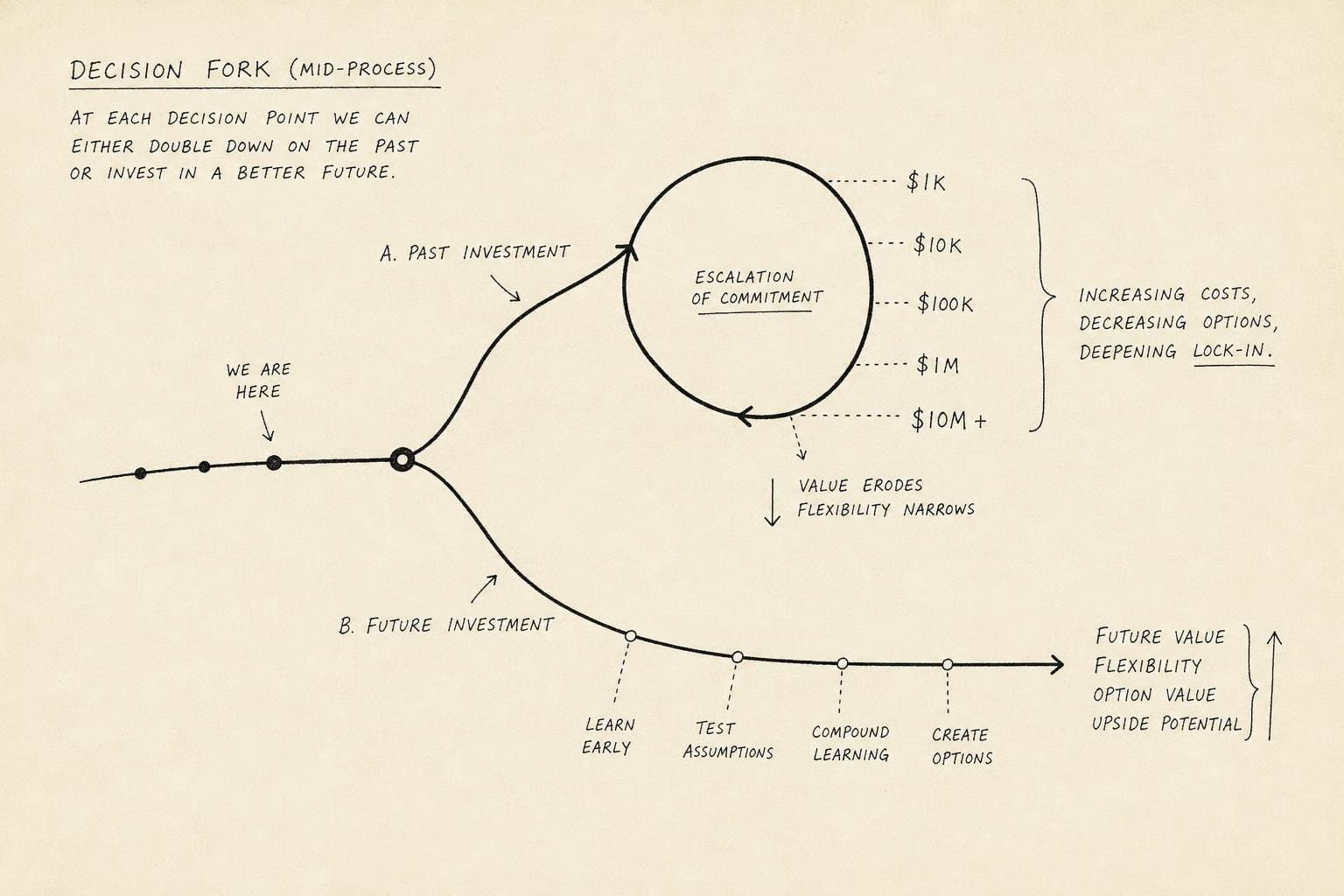

Meta spent over $80 billion building a virtual world that peaked at 300,000 monthly active users — and then kept spending. Reality Labs lost $19.2 billion in 2025 alone on $955 million in revenue. The math on that is not complicated. What's complicated is why it took so long to stop.
The answer isn't that Meta's leadership was stupid. It's that they were human. And humans have a deeply wired tendency to treat money already spent as a reason to spend more.
The Feeling Has a Name, But Naming It Doesn't Fix It
The sunk cost fallacy is one of those concepts everyone nods along to in a workshop and then promptly ignores in a meeting. The definition is clean: a sunk cost is any investment already made that can't be recovered, and it should have zero bearing on future decisions. What matters is what happens next, not what happened before.
The reason we ignore this in practice is that abandoning a project doesn't just feel like a strategic pivot — it feels like admitting you were wrong. Cognitive dissonance makes changing course uncomfortable because it forces you to confront the error directly. And loss aversion compounds this: our brains feel losses roughly twice as intensely as equivalent gains, so as long as we keep going, we can maintain the fiction that recovery is still possible.
Richard Thaler's classic example — cited in that same Psychology Today piece — captures it perfectly: a man pays $300 for a tennis club membership, develops tennis elbow two weeks in, and keeps playing through the pain because he's already paid. The membership fee is gone either way. The only question is whether he wants to add a wrist injury to the loss. He keeps playing.
Product teams do this constantly, just with higher stakes and more PowerPoint slides.
Why Product Decisions Are Especially Vulnerable
Product managers are particularly exposed to this trap because their job literally requires evangelizing ideas and motivating teams around them. Passion is a feature of the role — until it becomes a liability. The more you've championed a feature, the harder it is to be the person who says it isn't working.
Escalation of commitment — the tendency to double down after negative feedback — compounds automatically over time. Each sprint you invest in a failing feature makes the next honest evaluation harder. You've now got engineers who've built it, designers who've refined it, and stakeholders who've been briefed on it. The social cost of reversing course grows with every passing week, even as the evidence for reversal accumulates.
This is what makes the Meta case instructive rather than just embarrassing. Horizon Worlds wasn't a rogue project that slipped through the cracks — it was the company's stated strategic direction, announced by the CEO on a virtual stage, with the corporate name changed to match. By October 2022, active users had dropped below 200,000. The signal was there. The investment made it nearly impossible to read clearly.
The Counterargument Worth Taking Seriously
Here's where I want to push back on the clean version of this lesson, because there's a real tension worth sitting with.
Research from IESE Business School argues that honoring sunk costs isn't always irrational — that sticking with a past decision can create stability and signal commitment in ways that have genuine value. The framing matters: we call it "sunk cost fallacy" when someone keeps funding a failing project, but we call it "perseverance" when an artist keeps writing after two books that didn't sell. John le Carré's first two novels had modest sales; his third was The Spy Who Came in From the Cold. Was he throwing good effort after bad, or building toward something real?
The distinction — and this is the part that actually requires judgment — is whether the underlying conditions have changed. Le Carré's craft was improving. Horizon Worlds' user numbers were collapsing. Past investment is irrelevant to both cases. What matters is the honest read of the forward trajectory.
The problem is that loss aversion makes that honest read almost impossible from the inside. Research on escalation of commitment suggests that one structural fix is building explicit abandonment options into project planning from the start — not as a sign of pessimism, but because making "we could stop here" cognitively accessible changes how decision-makers evaluate negative feedback when it arrives.
The Question to Ask Before the Next Review
The practical move isn't to become trigger-happy about killing things. It's to separate two questions that usually get tangled together: What have we invested? and What does the evidence say about what happens next?
The first question is a historical fact. The second is the only one that should drive the decision. When you feel resistance to stopping something, it's worth asking whether that resistance is coming from a genuine read of the forward case — or from the discomfort of acknowledging that the past investment is truly gone.
Those are very different feelings. They just tend to show up wearing the same coat.


