


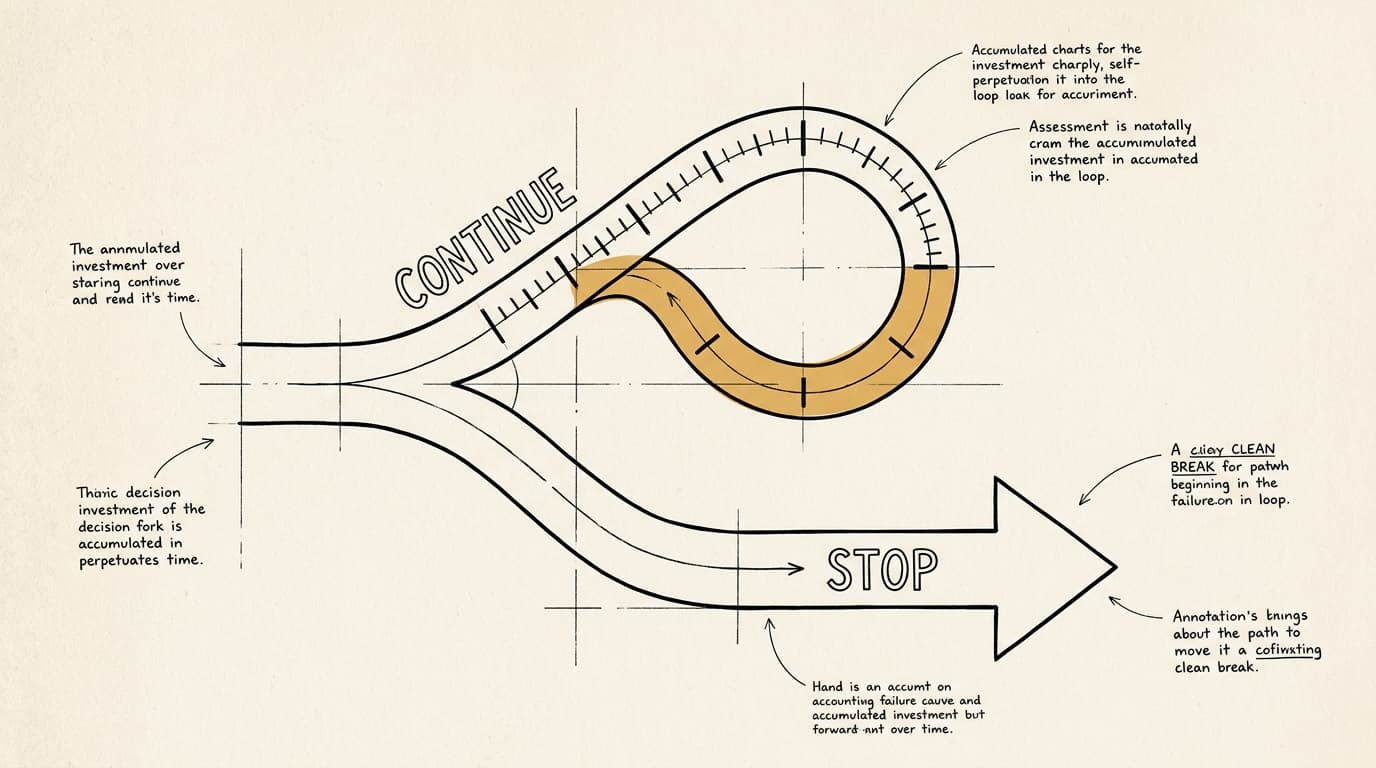

You've been working on this for eight months. The team is good. The original idea was sound. You've spent real money — maybe a lot of it. And now the data is telling you something you don't want to hear.
So you schedule another review meeting.
This is the sunk cost fallacy in its natural habitat: not dramatic, not obviously irrational, just a quiet refusal to let the past stay in the past. And it's expensive. Leadership IQ estimates that sunk cost thinking contributes to 66% of IT projects ending in partial or total failure, and that managers spend roughly 17% of their time managing underperforming employees they should have let go months earlier. The Concorde — the supersonic airliner that kept flying toward completion despite clear evidence it would never turn a profit — gave behavioral economists a name for it: the Concorde Fallacy.
The pattern is almost always the same. The more you've invested, the harder it is to stop.
The Bias Isn't Stupidity. It's Identity.
Here's what makes sunk cost thinking so sticky: it's not really about the money. It's about what stopping means.
Greater Good Science Center at Berkeley cites Snow College psychologist Veronika Tait, whose research found that the more people had given up to pursue a course of action, the more likely they were to stay on it — even when it was clearly failing. Her explanation: "Humans want to be seen as consistent. Changing course feels like we have to admit we've made a mistake. It's easier sometimes to double down."
That's the mechanism. Killing a project isn't just a resource decision. It feels like a verdict on your judgment. So instead of asking "what should we do now?", you unconsciously ask "how do I avoid looking like I was wrong?" Those are very different questions, and they produce very different decisions.
Meta's metaverse bet is the high-profile version of this. Leadership IQ reports that the company lost an estimated $70–77 billion on the initiative before announcing significant budget cuts in late 2024 — and only after sustained investor pressure. The company had renamed itself around the concept. When your identity is fused with a strategic bet, the sunk cost fallacy doesn't just warp your thinking. It colonizes it.
The Blank-Slate Test (And Why It's Hard to Actually Use)
The standard advice for escaping sunk cost thinking is the "blank-slate inquiry": ignore what you've already spent, and ask what you'd decide if you were starting fresh today. It's correct in theory. It's genuinely difficult in practice.
The problem is that you're not starting fresh. You have a team that's been working on this for months. You have stakeholders who've been briefed. You have a version of yourself that publicly championed this project. The blank-slate test asks you to mentally subtract all of that — and human psychology is not built for that kind of selective amnesia.
What actually helps, I'd argue, is changing the question you're asking in the room. Instead of "should we kill this project?" — which triggers defensive reasoning — try: "If we were starting this today, with what we know now, would we fund it?" That's a subtly different frame. It acknowledges the learning without treating the past investment as a reason to continue.
The other move is structural: build kill criteria into the project before it starts. Decide in advance what signals would cause you to stop. When you set those criteria before you're emotionally invested, you're reasoning clearly. When you hit the criteria later, you're not making a judgment call — you're following a prior commitment made by a clearer version of yourself.
When Stopping Is the Skill
The hardest part of project management isn't starting things. It's knowing when a project has taught you everything it's going to teach you — and stopping before it teaches you something expensive.
The sunk cost fallacy is most dangerous not in the obvious disaster cases, but in the slow-bleed projects that are almost working. The ones where you can always find a reason for one more quarter. The ones where the team is talented and trying hard, which makes stopping feel like a betrayal rather than a decision.
It isn't. Stopping a failing project isn't a verdict on the people who worked on it. It's a recognition that the past is fixed and the future isn't — and that the only question worth answering is what to do with the resources you still control.
Try This: Pick one ongoing commitment — a project, a process, a tool your team uses — and apply the blank-slate test honestly. Not "should we stop?" but "would we start this today?" If the answer is no, that's worth sitting with.