


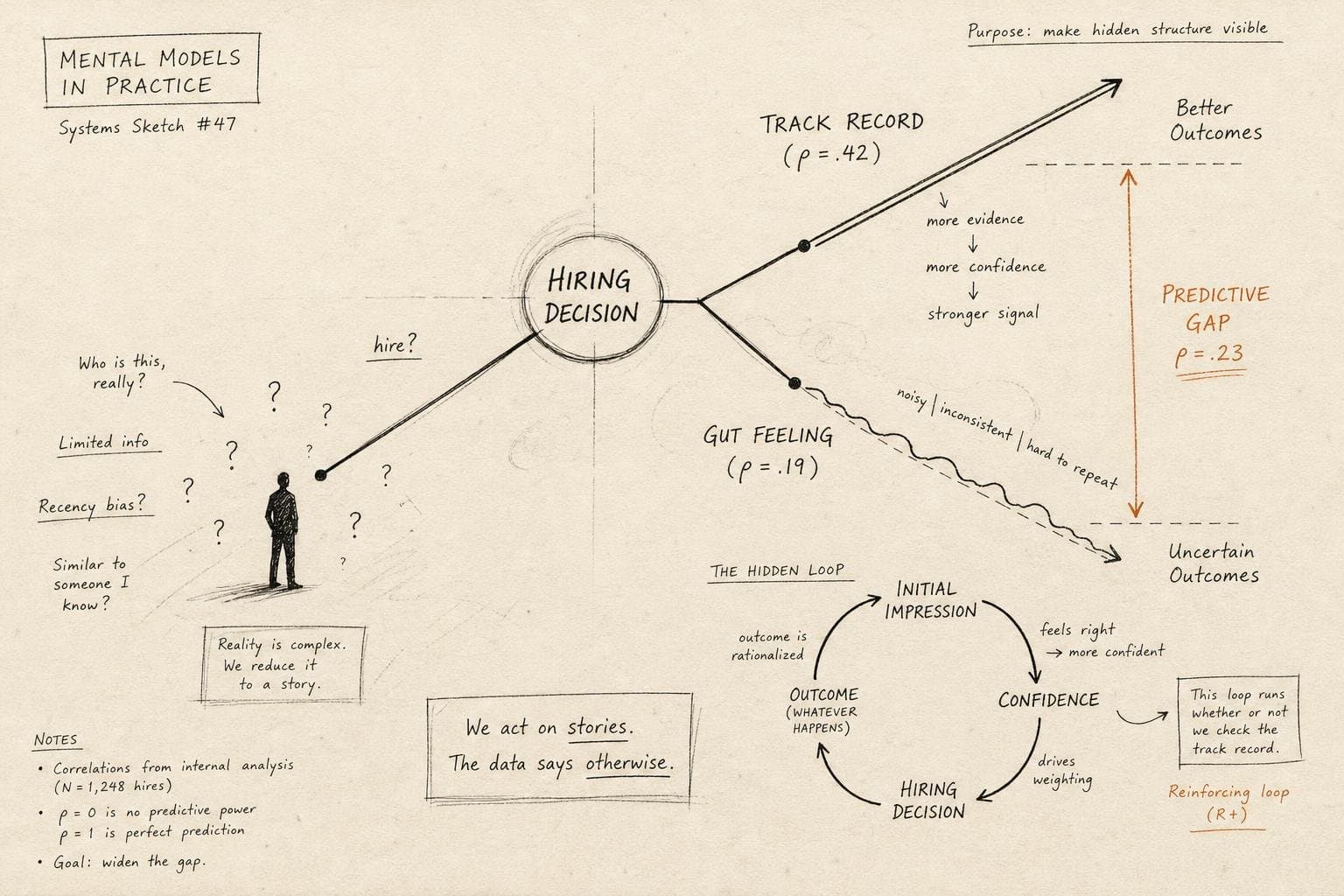

Here's a strange result from a study published this October. Give a professional recruiter accurate advice that contradicts their initial read on a candidate, and they'll often throw the advice out — even when they later admit, on a trust survey, that they rate algorithmic advice lower than human advice, yet behave as if they trust the algorithm more. Researchers Alain Lacroux and Christelle Martin Lacroux call this a "trust–reliance paradox": recruiters say one thing about what they trust and do another thing with what they actually use, and in both directions the common thread is that their own initial judgment is the hardest thing to dislodge (Wiley Online Library).
That's base rate neglect wearing a different outfit. The base rate here isn't a disease prevalence or a crime statistic — it's the track record of hiring methods themselves. We have decades of data on what actually predicts job performance. Interviewers routinely act like that data doesn't exist.
The Track Record Is Sitting Right There
The most recent large-scale meta-analysis on selection methods, from Sackett, Zhang, Berry, and Lievens, ranks the predictors employers actually rely on. Unstructured interviews — the "let's have a chat and see how I feel about them" format most hiring still runs on — predict performance at about ρ = .19. Years of experience does even worse, at .07. Structured interviews, where every candidate gets the same questions scored against the same rubric, hit .42 (Sapia.ai). That's not a marginal gap. It's the difference between a coin flip with a thumb on the scale and something you could actually build a process around.
And yet structured interviewing remains the exception, not the default. The base rate of "what predicts performance" and the base rate of "what hiring managers actually do" have been pointing in opposite directions for years, and the gap hasn't been closing just because the evidence is public.
Why the Gut Feels More Reliable Than It Is
Part of the answer is that interviewers aren't actually measuring the candidate as much as they think they are. A frequently cited rater-variance study found that 62% of the variance in one set of performance ratings came from characteristics of the person doing the rating — how harsh they are, what they pay attention to — while the actual performance of the person being rated explained only 21% (Full Stack Recruiter). Carry that logic into a hiring interview, where the rater has two pages of resume and maybe ninety seconds of real attention, and the signal-to-noise ratio gets worse, not better. The interviewer isn't ignoring the base rate because they've weighed it and found it wanting. They're ignoring it because their own impression doesn't feel like a guess — it feels like direct observation of the truth, when it's largely a reading of their own tendencies.
This is where base rate neglect gets dangerous as a mental model: it's easiest to spot when someone is explicitly shown a number and discounts it, like the advice-discounting recruiters above. It's much harder to spot when the base rate never even enters the room, because the interviewer never asked what the method's track record actually is. You can't neglect a rate you never looked up.
The Fix Isn't "Trust the Algorithm Instead"
The obvious overcorrection is to hand the decision to an algorithm and assume the base-rate problem is solved. It isn't. A 2026 analysis of roughly four million applications scored by a single hiring-algorithm vendor found that 4% of candidates who applied to ten different positions were marked "do not recommend" at all ten — a rate higher than chance would predict, because employers reusing the same underlying models can produce correlated rejections without any of them coordinating or even knowing it's happening (GitHub). Swap one unexamined base rate — "my gut is usually right" — for another — "the model is usually right" — and you've just moved the blind spot, not closed it.
The discipline base rate neglect actually demands is more tedious than either extreme: know the track record of your method, structured interview or algorithm alike, and update your confidence to match it rather than to match how the decision felt in the moment. The feeling of certainty and the accuracy of the judgment are measuring two completely different things, and the studies above suggest most of us still can't tell which one we're reading.