


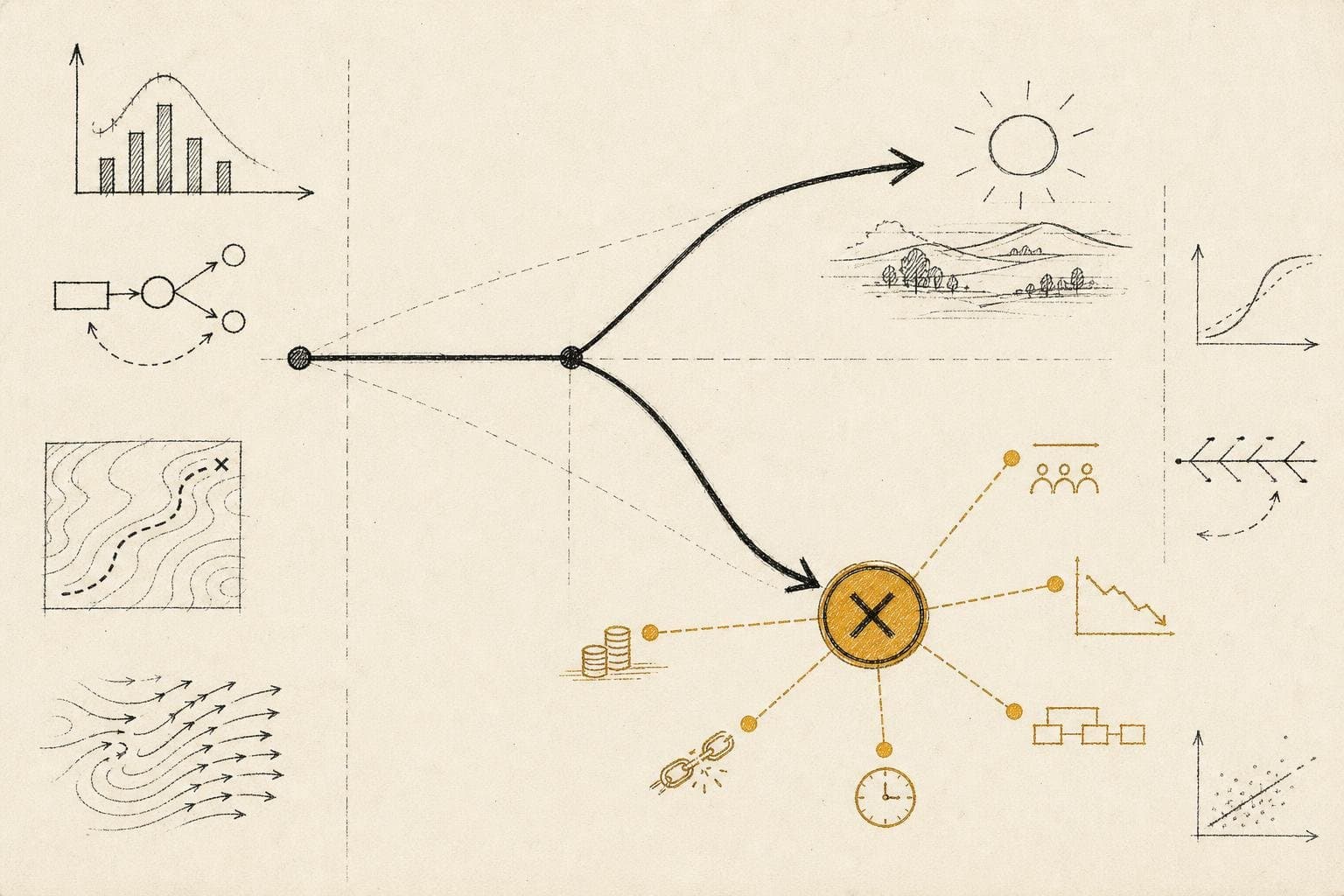

Most strategy sessions start with a question like "How do we make this succeed?" It sounds rigorous. It isn't. It's optimism wearing a whiteboard.
The more useful question — the one most teams never ask — is: "Assume this already failed. What happened?"
That grammatical shift is doing more work than it appears.
Why "What Could Go Wrong" Is the Wrong Question
When you ask a team what could go wrong, you get the sanitized list. The risks everyone already knows. The ones safe to say in front of the boss. You get the iceberg's tip, not the mass underneath.
The pre-mortem technique, formalized by psychologist Gary Klein in a 2007 Harvard Business Review article, exploits a documented cognitive phenomenon called prospective hindsight. The underlying research — from Mitchell, Russo, and Pennington — found that imagining an event has already occurred (rather than imagining it might occur) improves the ability to correctly identify failure reasons by roughly 30%. That's not a rounding error. That's the difference between the list you'd write and the list you actually need.
The mechanism is almost embarrassingly simple. Klein's protocol runs in 20-30 minutes: announce the project has definitively failed, have each participant write independently and silently every reason the failure happened, then share round-robin. No discussion until the list is complete. No editing in real time.
What you get is the private risk register — the things people suspected but wouldn't raise. Which brings us to the single most common way teams ruin the exercise.
The Mistake That Kills the Exercise Before It Starts
Run a pre-mortem with senior executives in the room, and you've already lost. Klein's own guidance is explicit on this: their presence collapses the candor the exercise depends on. Participants self-censor anything that might implicate leadership decisions — which are, reliably, the most important risks to surface.
The fix is structural, not cultural. If executives must attend, they write privately first, like everyone else, and share last. They don't lead the discussion. The hierarchy gets temporarily suspended so the information can flow.
This is inversion thinking's central insight applied to the exercise itself: the thing that looks like leadership (having the senior people guide the conversation) is actually what prevents the exercise from working.
Inversion at Scale: When Organizations Use It Seriously
The pre-mortem isn't just a team warm-up exercise. The Federation of American Scientists recently applied the technique to OPM's HR 2.0 initiative — a large-scale federal IT modernization effort — explicitly framing their analysis as a pre-mortem: assume the initiative did not achieve its intended outcomes, then ask why. Their reasoning was direct: large-scale IT modernization projects fail with remarkable regularity, in private companies and governments alike, and optimism is not a plan.
The value wasn't pessimism for its own sake. It was surfacing structural vulnerabilities early, when they could still be addressed — before a GAO report or congressional hearing explained what went wrong after the fact.
That's the real purpose of imagining failure first. Not to predict doom, but to buy time. The pre-mortem converts future regret into present action.
Annie Duke frames a related version of this as setting kill criteria before a project starts: commit in advance to the early warning signs that would trigger a reassessment. The pre-mortem generates the list of those signs. The kill criteria turn them into a decision rule. Together, they close the loop that most project planning leaves open.
The Inversion Habit, Not Just the Inversion Meeting
Charlie Munger's version of this — quoted in behavioral strategy writing as "Invert, always invert" — is less a technique than a posture. Instead of asking how to grow, ask how you'd systematically ruin the business. Map the path to failure, and you discover the landmines you're already standing on. As The Hunting Dynasty's behavioral science framing puts it: it's far easier to avoid clear stupidity than to seek elusive brilliance.
That's the version of inversion thinking worth building into a habit, not just a quarterly offsite exercise. Before a major decision, before a product launch, before a negotiation — spend ten minutes writing the obituary first. What does the failure look like? Who saw it coming? What did they know that the optimists didn't?
The pre-mortem works because it treats the future like the past. And it turns out we're much better at explaining what already happened than predicting what might.
Schedule the lesson before you need it.