



Picture a jar of pasta sauce. The price stays the same, the label looks the same, the size on the shelf is identical. But inside, a few less tomatoes, a little more water. Nobody notices for a while. Then somebody does — and the backlash is worse than if the company had just raised the price in plain sight.
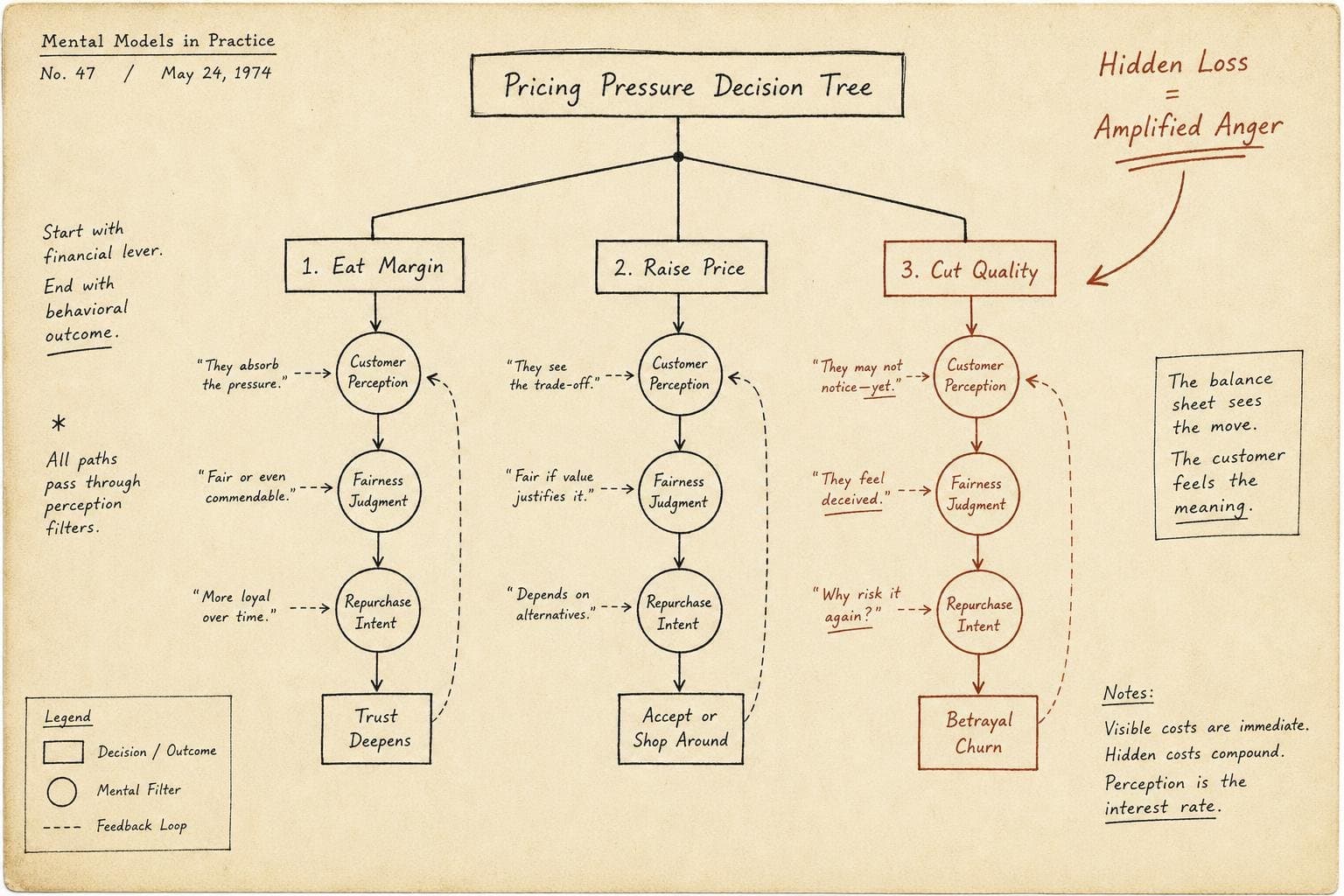
That's the finding at the center of new research covered by Harvard Business Review: across a large experimental program, once consumers detect a quality cut, they judge it as more unfair than either a straight price increase or a shrunken package size, and they're less willing to keep buying. Managers facing rising costs have three levers — eat the margin, raise the price, or quietly reduce what the customer gets. The research suggests the third option, often chosen because it seems the least visible, is actually the most dangerous one once it's caught.
Why the Quiet Cut Feels Like Theft
This is loss aversion doing exactly what it's supposed to do, just in a place managers don't expect it. The core idea, going back to Kahneman and Tversky's original framing experiments, is that losses register roughly twice as intensely as equivalent gains — Snowball Invest puts the commonly cited ratio at about 2 to 2.5. A price increase is a loss you can see coming and reason about. A quality cut is a loss that arrives disguised as nothing — you paid the same, got less, and didn't know it. When you find out, the loss isn't just financial anymore. It feels like you were tricked out of something you'd already mentally banked as yours. That's a steeper, angrier version of the same asymmetry, and Harvard Business Review found it shows up as reduced repurchase intent, not just reduced satisfaction.
It's worth noting loss aversion isn't confined to money and ingredients. A peer-reviewed lab study out of the University of St Andrews found that people who experience a drop in social ranking — not a financial loss, a reputational one — are more willing to lie to recover it than people who experience an equivalent gain are willing to risk honesty to extend it (St Andrews Research Portal). Same asymmetric shape, totally different domain. If you're building a mental model of how loss aversion operates, that's the useful part: it's not a pricing trick, it's a shape the brain imposes on almost any reference point.
Where the Model Misleads You: Paying More Can Make People Use More
Here's where I think the simple version of loss aversion starts to mislead pricing managers. The intuitive extension is: higher price equals bigger perceived loss equals fewer buyers, full stop. New research out of Texas A&M's Mays Business School complicates that. Dr. Rajiv Mukherjee and coauthors modeled subscription and prepaid digital services — the kind sold by AI tools and cloud platforms — and found that while higher prices do shrink the pool of people willing to sign up, the people who do sign up often use the service more, not less (Mays Business School).
The mechanism isn't loss aversion exactly — it's mental accounting, a close cousin. Paying a steep price creates what Mukherjee calls a "mental account deficit," and customers work to close it by extracting more value, which the researchers term consumption bias. For a flat-fee gym membership that's harmless. For an AI product where every query burns real compute, it can quietly erase the margin gain the price increase was supposed to protect, as the same researchers note in earlier coverage of the study (Digital Information World). The naive application of "higher price deters demand" misses that demand has two dimensions — who buys, and how hard they use what they bought — and loss aversion only cleanly predicts the first one.
The Practical Takeaway for Anyone Setting a Price
If you're a manager weighing cost increases, the research points toward making the loss visible and bounded rather than hidden and open-ended. A clear price increase lets customers register one discrete loss and move on. A quality cut registers as an ongoing, discovered betrayal every time they notice it again. And if you're pricing anything metered — API calls, compute, storage — remember that the loss aversion story only covers the sign-up decision. The usage decision runs on a different psychology entirely, one where people who feel they overpaid go looking for ways to feel they got their money's worth.
The frameworks aren't wrong here. They're just answering different questions, and the costly mistake is assuming one of them is answering both.