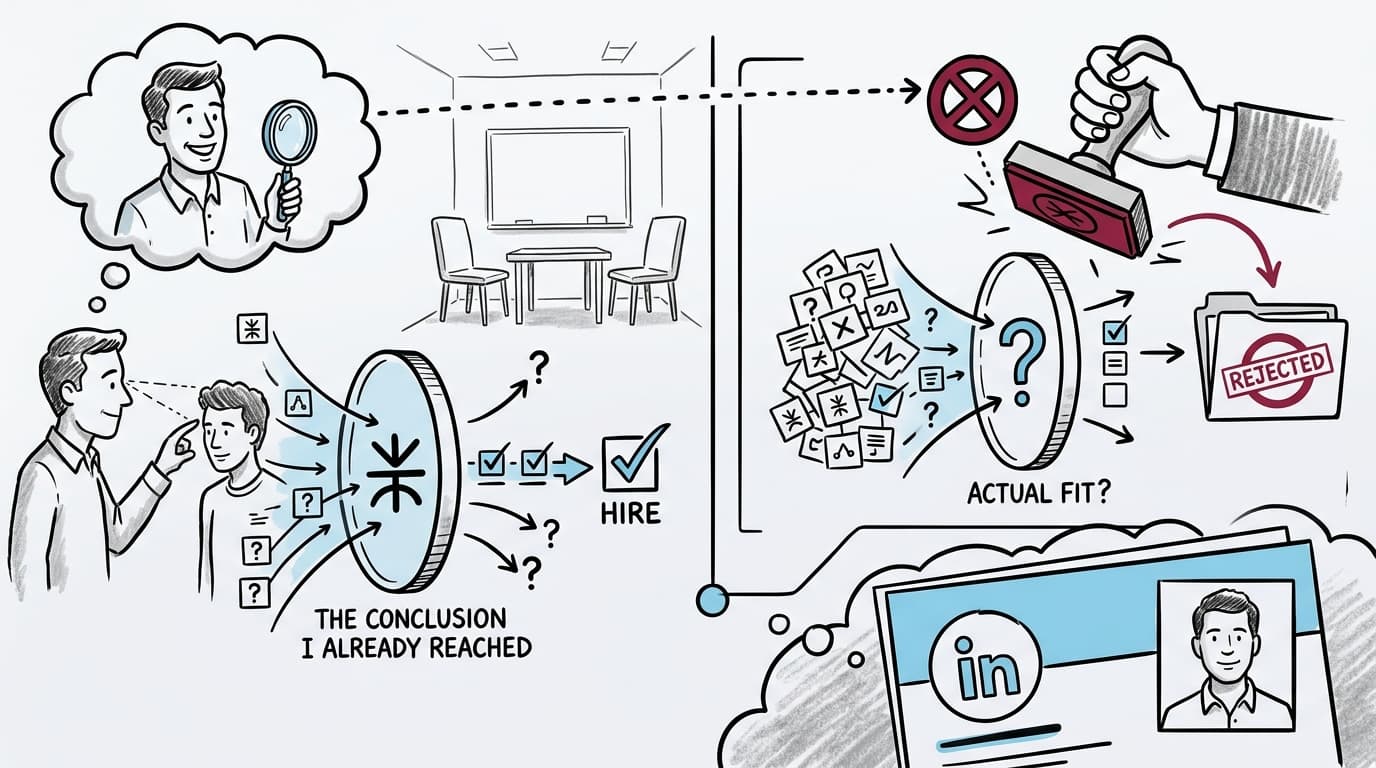

Setup: The Interview That Was Already Over
Picture a hiring panel debriefing after a final-round interview. The candidate was technically strong — maybe the strongest in the pool. But someone says, "I just don't know if she's really us." Heads nod. The offer goes elsewhere.
What just happened? On the surface, a judgment call. Underneath, a textbook case of confirmation bias running the whole show — and "culture fit" providing the vocabulary to make it feel principled.
Confirmation bias is the tendency to search for, interpret, and remember information in ways that confirm what you already believe. In hiring, the belief forms fast — often in the first few minutes of a resume screen or the opening exchange of an interview. Everything after that becomes evidence collection for a conclusion you've already reached.
The "culture fit" frame makes this worse, not better, because it gives the bias a legitimate-sounding name. You're not rejecting someone because they reminded you of a difficult colleague, or because they were quieter than your extroverted team, or because their background was unfamiliar. You're protecting the culture. That's responsible leadership.
Except it usually isn't.
Mechanism: How the Bias Runs the Process
Confirmation bias in hiring doesn't operate as a single moment of prejudice. It runs as a system, touching every stage.
It starts at resume review, where a shared alma mater or a recognizable employer triggers a positive prior. From that point, the interview becomes a search for confirmation. Questions get softer. Silences get filled with charitable interpretation. The same answer that reads as "confident" from one candidate reads as "arrogant" from another — depending on which way the prior is pointing.
Structured interviews were designed precisely to interrupt this. When every candidate answers the same questions in the same order, and responses are scored against defined criteria before discussion, the bias has fewer entry points. The research consensus on this is solid enough to be considered established knowledge in organizational psychology: unstructured interviews are remarkably poor predictors of job performance, in part because they're so easily colonized by interviewer expectations.
But most hiring processes aren't structured. They're conversational, intuitive, and — critically — social. Interviewers talk to each other before the debrief. They signal enthusiasm in the hallway. By the time the panel sits down to "discuss," the group has often already converged, and what looks like deliberation is actually ratification.
That's where "culture fit" enters as the mechanism's final gear. It's the shared language that lets a group confirm a bias collectively without any individual having to own it explicitly. Nobody says "she reminded me of someone I don't like." They say "I'm not sure she'd thrive here." The bias becomes institutional.
Tension: When the Model Turns Against Itself
Here's the uncomfortable part: culture fit isn't entirely wrong as a concept. Teams do have working styles. Some people genuinely do struggle in environments that clash with how they operate. Ignoring fit entirely in favor of pure credential-matching produces its own failures — the technically brilliant hire who makes every meeting worse, or the experienced executive who can't adapt to a startup's pace.
The mental model breaks down not when you care about fit, but when fit becomes the primary filter rather than one input among several — and when it's evaluated impressionistically rather than against specific, observable behaviors.
The failure case tends to look like this: a company hires for fit through several cycles, each time selecting people who feel comfortable to the existing team. The team gets tighter, more cohesive, better at finishing each other's sentences. And gradually, less capable of noticing what it's missing. The range of perspectives narrows. Dissent becomes socially costly. The team starts making decisions that feel obvious internally and look baffling externally.
This is groupthink's entry point — and it arrives through the front door, welcomed as culture preservation. The irony is that the teams most committed to protecting their culture are often the ones most efficiently destroying their capacity to adapt it.
I'd argue the real tell is what happens when a strong candidate challenges something in the interview. Does the panel read that as intellectual confidence — a good sign — or as not being "a team player"? If it's reliably the latter, the culture fit filter has already become a conformity filter.
Signal: What to Actually Watch For
The practical question isn't whether to care about culture — it's whether your process can distinguish between "this person shares our values" and "this person is like us." Those feel identical from inside the bias. They're not.
A few signals that the process has drifted from the former to the latter:
Fit judgments arrive before evidence does. If interviewers are forming strong impressions in the first ten minutes and spending the rest of the interview confirming them, the structure isn't doing its job. Pre-commitment scoring — writing down your assessment of each answer before the group debrief — is a simple intervention that's harder to implement than it sounds, because it requires admitting that conversation corrupts judgment.
The team can't define fit in behavioral terms. Ask the panel: what specific behaviors would tell you someone fits this culture? If the answers are vague ("they just get it," "you know it when you see it"), the criterion isn't culture — it's familiarity. Familiarity is a bias, not a value.
Rejected candidates cluster demographically. This is the downstream signal that something upstream has gone wrong. Confirmation bias and groupthink don't announce themselves; they show up in patterns. If the people who "don't fit" consistently share characteristics that have nothing to do with the job, the fit filter is doing something other than what it claims.
The fix isn't to abandon culture as a hiring consideration. It's to treat "culture fit" the way you'd treat any other unverified claim — with some skepticism, a demand for specifics, and a healthy suspicion of how convenient it is when the evidence lines up too cleanly.
Try This: Before your next hiring debrief, write down your overall assessment of the candidate — and your single strongest piece of evidence for it — before anyone else speaks. Then notice how much the group discussion moves you, and in which direction. You're not trying to be unmovable. You're trying to see how much of your final judgment was actually yours.


