


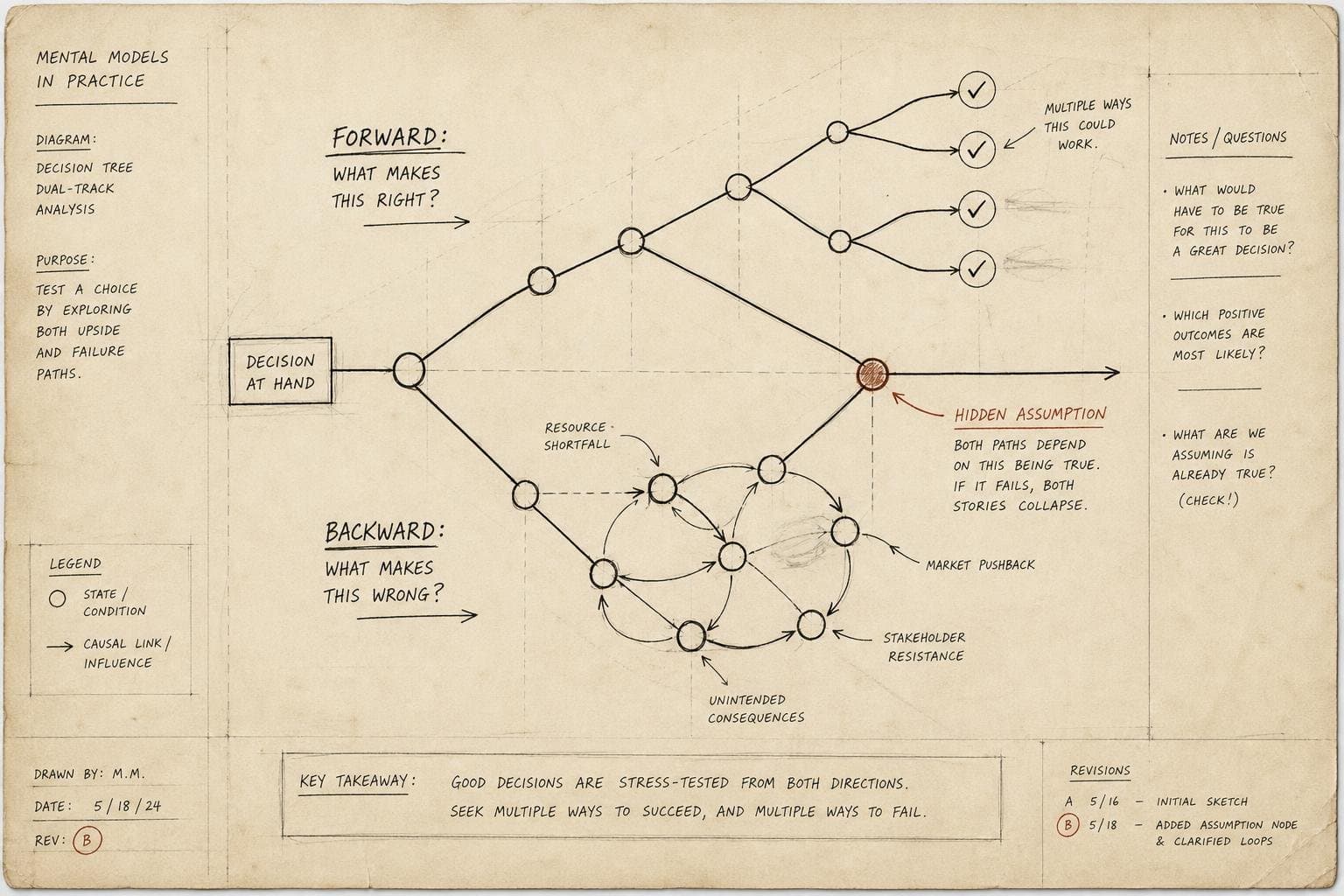

Here's a thinking habit that sounds almost too simple to be useful: before you figure out how to solve a problem, spend time figuring out how you'd guarantee failure.
This is inversion — the practice of working backward from the outcome you don't want. And the reason it's worth a full issue isn't that it's clever. It's that it reliably surfaces assumptions you didn't know you were making.
The Asymmetry Between Forward and Backward Thinking
Most problem-solving runs in one direction. You start with a goal, generate options, evaluate them, pick one. This feels natural because it mirrors how we experience time — forward, from now toward then.
The trouble is that forward thinking tends to inherit your existing assumptions without examining them. You're building on the foundation you already have. The options you generate are shaped by what you already believe is possible, relevant, or worth considering.
Inversion forces a different question: What would have to be true for this to fail?
That question is harder to dismiss with optimism. When you're imagining success, motivated reasoning is your silent co-author — it quietly filters out the uncomfortable possibilities. But when you're actively constructing a failure scenario, you have to populate it with something. And the things you reach for first are usually the assumptions you've been carrying without inspection.
Think about how this plays out in a meeting. Someone proposes a strategy. The room debates whether it will work. Everyone is, more or less, arguing about the same set of visible variables. Inversion asks a different question: what's the thing we're not arguing about because we all assume it's fine? That's usually where the problem is hiding.
Where Forward Thinking Leaves the Assumptions Intact
Research on organizational workload offers a useful illustration of this dynamic. Most leaders track employee performance through hours logged, deadlines met, and output metrics. Those are forward-facing measures — they tell you whether the visible work is getting done. What they don't capture is the mental load: the invisible coordination, anticipation, and cognitive overhead that doesn't show up in any dashboard.
The result, as the research describes, is that leaders genuinely believe they understand their team's workload because they're measuring the right things. The assumption — that tracked work equals total work — goes unexamined precisely because it's built into the measurement system itself.
This is what unexamined assumptions look like in practice. The forward-thinking question ("Are people hitting their targets?") returns a satisfying answer. The inversion question ("What would have to be true for our best people to quietly burn out while appearing productive?") points directly at the gap.
You can apply the same move to almost any decision. Planning a product launch? Instead of asking how to maximize adoption, ask: what would guarantee that early users churn within 60 days? You'll find yourself naming things like onboarding friction, unclear value proposition, and support gaps — things that are easy to deprioritize when you're focused on the exciting forward problem of getting people in the door.
The Failure Cases That Reveal the Framework's Limits
Inversion is genuinely useful, but it has a failure mode worth naming: it can become a sophisticated form of paralysis if you're not careful.
The problem is that generating failure scenarios is cognitively easier than evaluating their probability. Once you've vividly imagined a way something could go wrong, that scenario tends to feel more likely than it is — which is the availability heuristic doing its thing. (We covered this dynamic in an earlier issue.) You can end up with a long list of plausible-sounding failure modes and no way to distinguish the ones that actually matter from the ones that are technically possible but vanishingly unlikely.
The fix is to treat inversion as a diagnostic step, not a decision step. Its job is to surface assumptions and failure modes for examination — not to produce a final verdict. Once you've run the inversion and named the hidden assumptions, you still have to do the work of evaluating which ones are load-bearing.
A useful test: after running the inversion, ask yourself which of the failure modes you identified would have been invisible to your forward-thinking process. Those are the ones worth taking seriously. The failure modes that your original analysis already accounted for aren't new information — they're just the same risks in a different frame.
The Practical Move
The next time you're evaluating a significant decision, add one question to your process before you start building the case for your preferred option: If this fails in 18 months, what's the most likely reason?
Write the answer down before you do anything else. Not a list of every possible risk — just the one or two most likely culprits. Then look at your plan and ask whether it actually addresses those things, or whether it's optimized for a version of the problem that doesn't include them.
The goal isn't to become a professional pessimist. It's to make your assumptions visible enough to examine. Most bad decisions aren't made by people who ignored the evidence — they're made by people who never noticed what they were assuming.