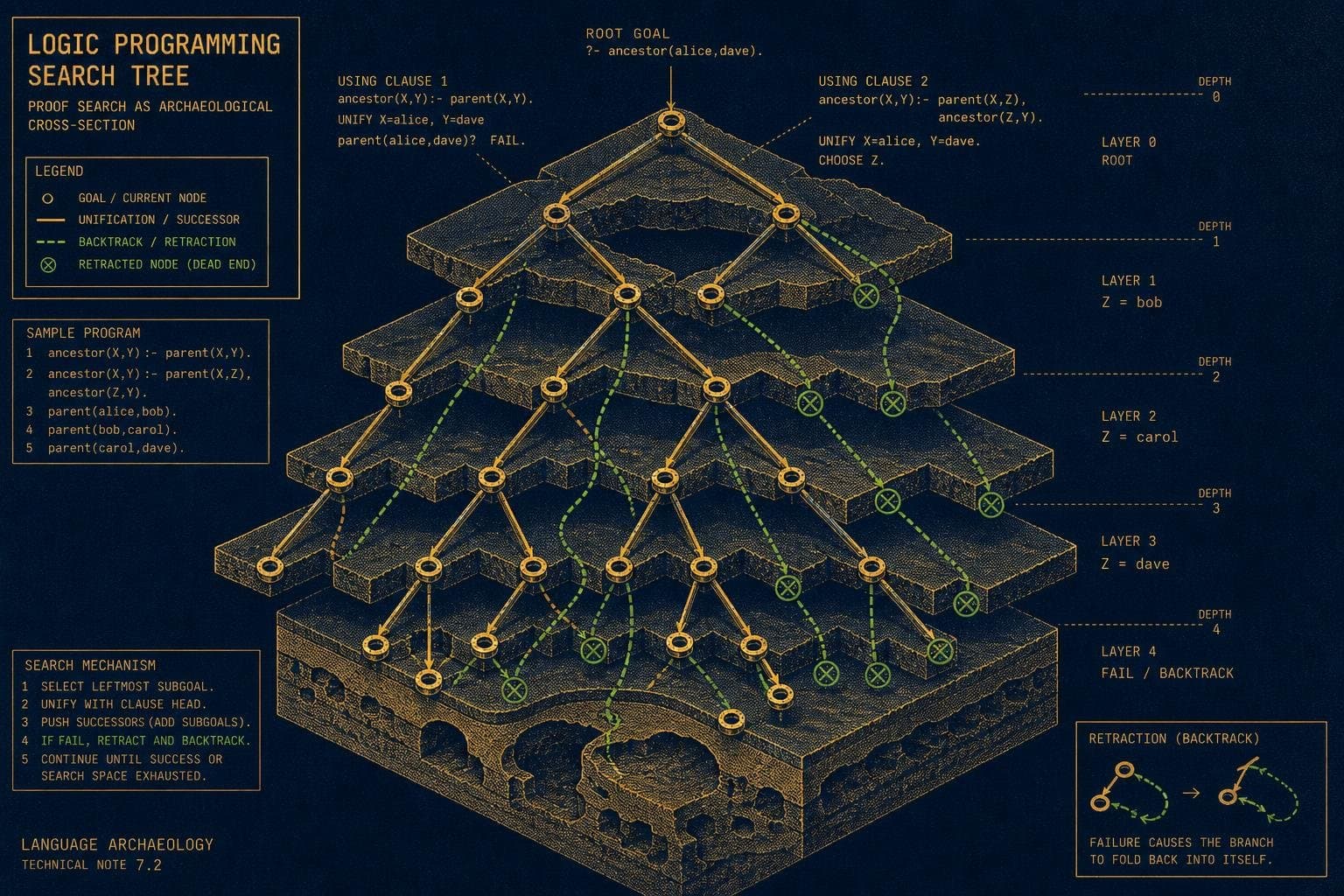

Ask a Prolog programmer what makes the language different and you'll usually get "backtracking" or "it's declarative." Both true, both incomplete. The real trick is quieter: unification and backtracking aren't two separate features bolted together. They're one mechanism — logical inference — split into a matching half and a search half, and 2026 is turning out to be a decent year for remembering why that split still matters.
I wrote in April about how Prolog gets you to describe a problem instead of solving it. What's new this year is watching that description mechanism get reused, almost accidentally, by people who aren't trying to write Prolog at all — they're trying to fix graph databases and stop language models from hallucinating.
One Operation, Two Jobs
The core move in logic programming is deceptively small. A clause like A :- B1, ..., Bn can be read two ways at once: declaratively, "A is true if B1 through Bn are true," or procedurally, "to solve A, solve B1 through Bn," as the logic-programming overview at Edgepedia lays out. That dual reading is the entire trick. You write logic; the machine treats it as a recipe.
Unification is what makes the declarative side computable — it's the algorithm that finds the substitutions that make two terms equal, which is how a query like ?- parent_child(X, william) gets bound to a concrete answer against a fact base (Edgepedia). Backtracking is what happens when that binding doesn't pan out: the interpreter retracts the guess and tries the next clause. Neither half does anything interesting alone. Unification without backtracking is just template matching. Backtracking without unification is blind brute force. Together they're a resolution proof, running clause by clause, undoing its own work whenever a branch dead-ends.
The Binding Problem Prolog Solved Fifty Years Early
What's striking about the current neuro-symbolic AI conversation is that it's rediscovering, from the vector-math side, the exact problem unification exists to solve. A recent chapter from Models from First Principles walks through why adding concept vectors for "cat," "chase," and "dog" can't distinguish "cat chases dog" from "dog chases cat" — vector addition is commutative, so the roles get lost even though the contents survive (Programmer.ie). The chapter calls this the binding problem: how do you encode not just which things are present, but where each one belongs?
Prolog's terms answer that question by construction. chase(cat, dog) and chase(dog, cat) aren't the same fact with the roles scrambled — they're structurally distinct terms, and unification only succeeds when both the predicate and the argument positions line up. The paper is careful not to claim any hidden Prolog interpreter lives inside a transformer, and it shouldn't — that's not the evidence. But the fact that researchers are now hunting for role-filler structure inside neural networks is a tell: the problem logic programming solved in the 1970s never went away, it just moved into a representation that has to earn structure rather than assume it.
The Search Engine Discipline Never Left
The other place this is resurfacing is less philosophical and more load-bearing. A 2026 paper on Logica-TGD, published in Transactions on Graph Data and Knowledge, uses a Datalog-family logic language to run graph transformations directly on engines like PostgreSQL, DuckDB, and BigQuery, benchmarking it against Datalog engines Soufflé and Nemo and against SQL/PGQ (Dagstuhl). None of that is Prolog exactly — Datalog drops full unification's variable-binding generality for guaranteed termination — but the lineage is direct: declarative clauses, a resolution-style evaluation strategy, and the same bet that logical inference over relations scales better than hand-written traversal code.
Meanwhile, on the more speculative end, a project called DeepClause is pairing Prolog-style deterministic logic with LLM-driven "judge" predicates, explicitly betting that pure LLM agents are too slow or too nondeterministic for tasks like customer-message routing, and that deterministic rule clauses should make the final call once the model has classified the input (DeepClause). It's an early-stage, self-promotional post, worth treating as a signal rather than proof — but the instinct behind it tracks the same pattern: when you need an answer you can actually explain, you reach for something that backtracks through a search space instead of sampling one.
None of this makes Prolog cool again in the way a listicle would claim. It suggests something more useful: unification and backtracking were never a historical curiosity waiting to be replaced by better search heuristics. They were a specific answer to the question of how to bind meaning to structure and recover from bad guesses without losing your place. Watch whether Logica's benchmark numbers against Soufflé and DuckPGQ hold up under wider adoption — that's the test of whether this generation of engineers rediscovers the tool or just the term.


