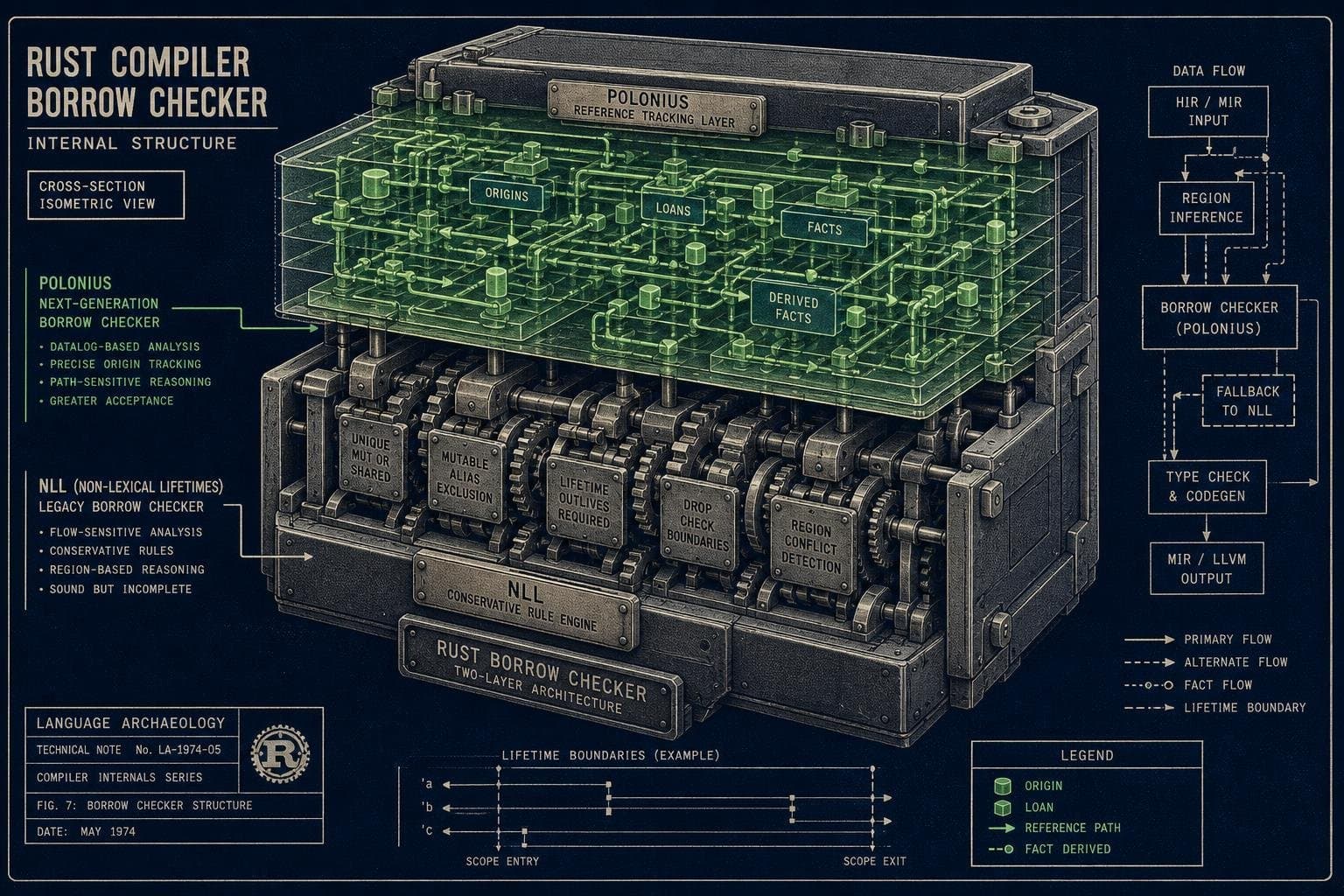

Lesson 24: What Polonius teaches us about the original design bet
There's a specific kind of frustration that Rust programmers know well: the compiler rejecting code that you know is safe. You've traced the logic. No two references overlap. No memory gets freed twice. The program is correct — and yet the borrow checker says no.
This wasn't a bug. It was a deliberate tradeoff, baked into Rust from the beginning. And the fact that the Rust team is now fixing it — with a new borrow checker called Polonius — tells us something important about what the ownership system was always trying to prove, and what it cost to prove it conservatively.
The Original Bet: Safety Through Restriction
To understand why Polonius matters, you need to understand what Rust's ownership model was solving in the first place.
Technically puts it cleanly: when it comes to memory management, you've historically had to choose between speed and safety. Garbage-collected languages like Python handle memory for you — but the garbage collector is computationally expensive and introduces latency. Low-level languages like C give you full control — but require you to manually allocate and release memory, which is where entire categories of bugs live: use-after-free, double-free, buffer overflows.
Rust's answer, as Technically describes, was to build a system where the compiler enforces memory safety at compile time, with no runtime overhead. No garbage collector. No manual memory management. The ownership model — where every value has exactly one owner, and borrowing is governed by strict rules — lets the compiler prove, statically, that your program won't corrupt memory.
The borrow checker is the enforcement mechanism. InfoWorld explains what it actually checks: that variables are initialized before use, that values aren't moved twice, that a value isn't accessed while mutably borrowed, that a place isn't mutated while immutably borrowed. These rules, taken together, make an entire class of memory errors structurally impossible to express.
That's the bet. And it mostly works. But it came with a cost.
The Cost: Conservative Rejection
The current borrow checker — called NLL, for Non-Lexical Lifetimes — tracks reference lifetimes, but imprecisely. It sometimes extends the lifetime of a mutable reference further than necessary, which causes it to reject code that is actually safe.
DEV Community's Francesco Ciulla describes a concrete case: a reborrow function with a conditional branch. The stable compiler throws "cannot borrow as mutable more than once at a time." Polonius compiles it cleanly. The code was always safe — NLL just couldn't see that the initial reference was no longer alive in the None branch.
This is the tradeoff that Rust's designers accepted early on: a borrow checker precise enough to be useful, but conservative enough to be sound. If you can't prove something is safe, reject it. Better to frustrate a programmer than to allow a memory bug.
Maximilian Oliver, writing about building a backend service in Rust, captures what this feels like from the inside: "Every tutorial introduced borrowing rules almost immediately and the compiler kept complaining about moved values, borrowed references and conflicting mutable references." The compiler errors weren't wrong — they were the system working as designed. But they were also, sometimes, more restrictive than they needed to be.
Polonius: More Precise, Same Guarantee
Polonius fixes the precision problem without relaxing the guarantee. InfoWorld reports that the Rust team announced Polonius Alpha being enabled on nightly releases for testing on August 4, with full stabilization expected later in the year. The new formulation — proposed in 2023 — required a minimal re-architecture of the existing NLL implementation.
The key improvement: Polonius tracks when references actually overlap, rather than making conservative assumptions about lifetime extent. Daily.dev summarizes the result: testing on 20,000 popular crates showed an average compile-time increase of just 1.4%, with 75% of cases seeing under 2% regression. More valid code compiles. The safety guarantee holds.
What's worth sitting with is what this upgrade reveals about the original design. The ownership model was never claiming to be a perfect oracle — it was claiming to be a sound one. It would rather reject valid code than accept invalid code. Polonius doesn't change that commitment; it just makes the analysis precise enough that fewer valid programs get caught in the net.
What This Teaches Every Programmer
The Polonius story is a good lens for thinking about what type systems and static analysis tools are actually doing. They're not trying to understand your program the way you do. They're building a formal model of what your program could do, and checking that model against a set of safety properties.
When that model is imprecise, you get false rejections. When it's unsound, you get false approvals — which is far worse. The history of Rust's borrow checker is a story of incrementally improving the model's precision while keeping soundness non-negotiable.
That's a design philosophy worth carrying into any system you build. The question to ask about any safety mechanism — a type system, a linter, an access control policy — isn't just "does it catch the bad cases?" It's "how conservatively does it model the good ones, and is that conservatism still worth the friction?"
Rust's answer, for fifteen years, has been: yes. Polonius is the first time the answer is also: and we can do better.


