
Lesson 24: What Clojure's persistent data structures reveal about the real cost of shared mutable state
There's a moment every programmer hits when they first encounter functional data structures: the realization that "copying" a large vector on every update sounds catastrophically expensive. Your instinct, trained by years of in-place mutation, screams that this can't possibly work at scale.
That instinct is wrong — and understanding why it's wrong is one of the more useful things you can do for your thinking about concurrent systems.
I've written about Clojure's immutability philosophy before, and about the O(log n) performance characteristics of its persistent data structures in more detail here. What I want to dig into today is the mechanism underneath — structural sharing — and why it matters specifically for concurrent programming, not just for functional purity.
The Naive Copy Is a Strawman
When Rich Hickey designed Clojure's persistent data structures, the goal wasn't academic elegance. It was practical: make immutability cheap enough that programmers wouldn't feel compelled to break the functional paradigm for performance reasons. As one early Clojure adopter described it after watching Hickey's introductory talks, the cost of creating a copy of a vector with a new value is "so low as to seem free" — the incremental cost offset by reduced bookkeeping elsewhere.
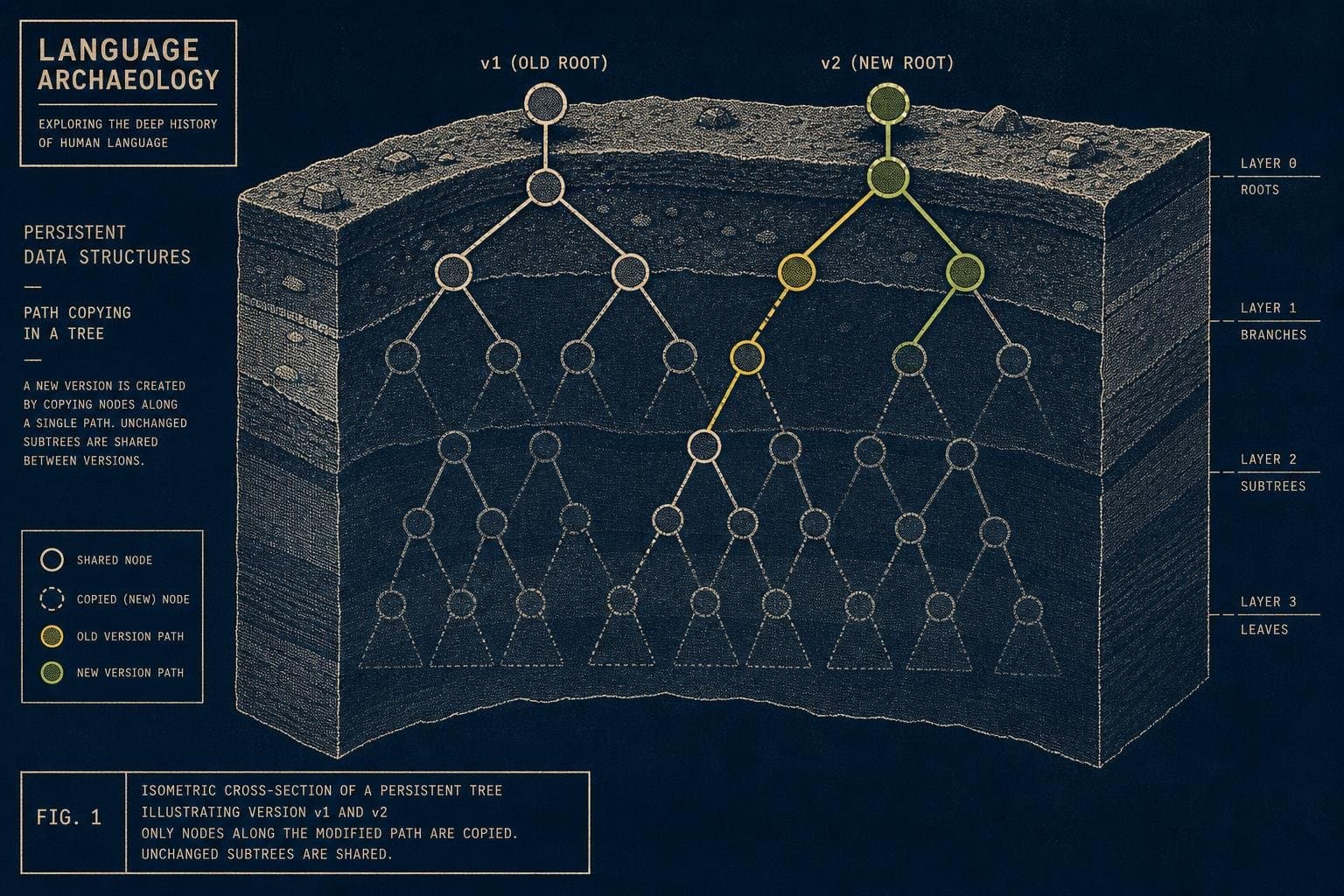
The mechanism that makes this true is structural sharing, and it works the same way across persistent data structures generally: when you update a structure, you don't copy the whole thing. You copy only the nodes along the path from root to the changed element, and the new version shares every untouched subtree with the old one. As a technical breakdown of persistent segment trees puts it: "Each update thus adds only O(log n) nodes and takes O(log n) time, while both versions remain fully queryable — the old root sees the old data, the new root sees the update."
Each version gets its own root. The rest is shared. Old versions are never invalidated, because nodes are never modified in place.
This is the key constraint that makes everything else work: immutability is not a consequence of the design, it's a precondition of it. If you modified nodes in place, older versions pointing to those nodes would silently see corrupted data. The whole structure depends on treating nodes as permanent once created.
Why This Matters More for Concurrency Than for Correctness
Here's where the design decision earns its keep. In a concurrent system, shared mutable state requires coordination — locks, semaphores, critical sections. The traditional approach forces you to choose between coarse-grained locking (which kills parallelism) and fine-grained locking (which is error-prone and expensive). As Wikipedia's treatment of non-blocking algorithms notes, blocking a thread creates cascading problems: deadlock, livelock, priority inversion, and the fundamental issue that a blocked high-priority thread simply stops making progress.
Persistent data structures sidestep this entirely. If a data structure can never be modified in place, there's nothing to lock. Two threads can read the same version simultaneously without coordination. One thread can "update" the structure — producing a new version via structural sharing — without invalidating what the other thread is reading. The old version remains valid, permanently, because its nodes were never touched.
This is what Hickey was actually solving. The concurrency problem in most languages of the mid-2000s wasn't that programmers lacked good locking primitives — Java had java.util.concurrent, after all. The problem was that the underlying model, shared mutable state, made correct concurrent code genuinely hard to reason about. A 2012 discussion on parallelism and language limits frames it well: to provide better parallelism, you need to "sacrifice unrestrained side-effects." Clojure made that sacrifice structural — baked into the data model itself, not left as a discipline for programmers to maintain.
The Lesson That Travels
You don't have to write Clojure to absorb what this design teaches. The insight is transferable: the cost of immutability is much lower than it appears when you have structural sharing, and the benefit is much higher than it appears when you're thinking about concurrency rather than just correctness.
Most programmers, when they think about immutability, think about it as a testing and reasoning aid — pure functions are easier to test, easier to understand. That's true, but it undersells the case. The deeper payoff is that immutable data structures make a whole class of concurrency bugs structurally impossible, not just less likely. You can't have a data race on data that nobody can modify.
The System Crafters community discussion on persistent data structures in Scheme captures the practical gap well: even in Lisp-family languages, proper persistent structures with correct performance characteristics aren't automatic. Clojure's contribution was making them the default — not a library you reach for, but the thing you get when you type {} or [].
That's the design decision worth sitting with. Hickey didn't make immutability available. He made mutability the thing you have to opt into.


