


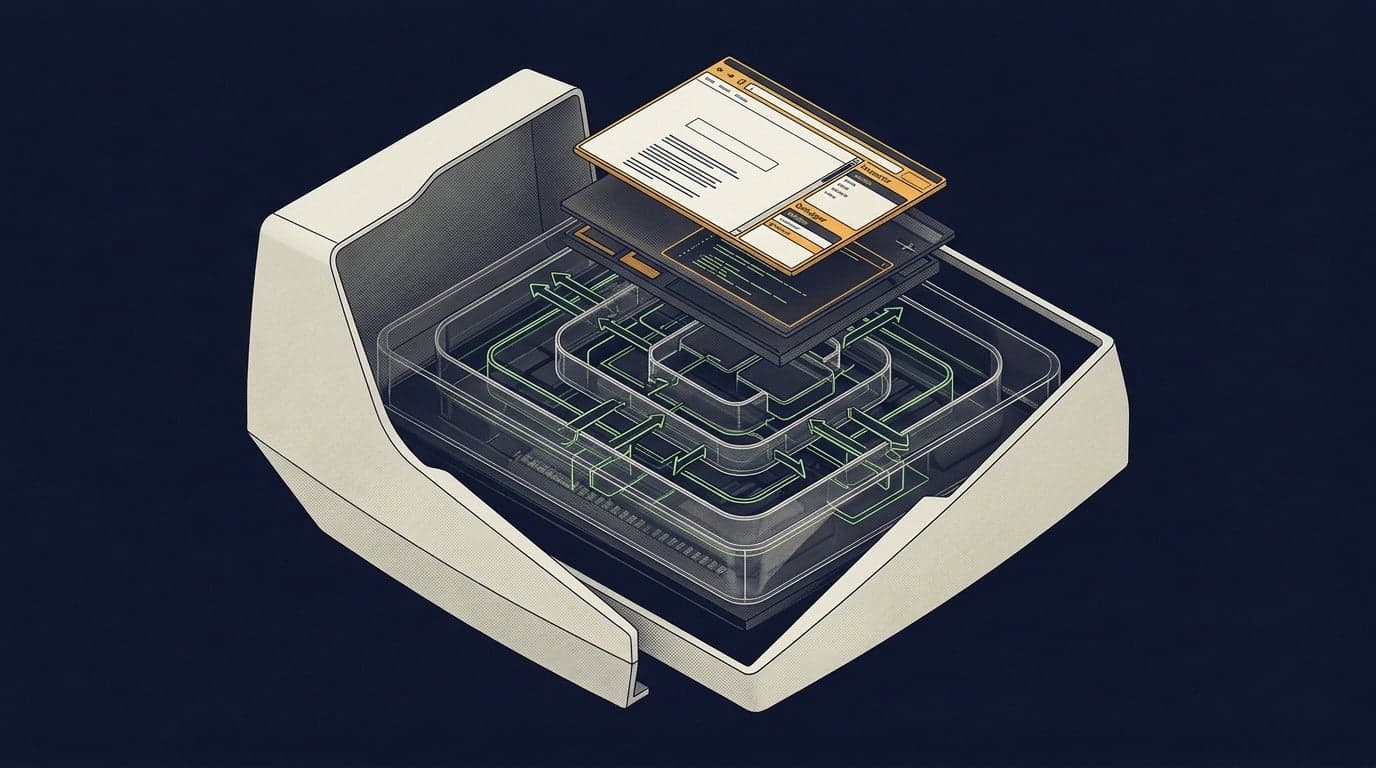

Ask a working programmer where the IDE came from and you'll probably hear about Visual Studio or Eclipse, something bolted onto a language after the fact to make editing less miserable. That's backwards. The browser, the inspector, the live debugger — the whole apparatus we now call an IDE — existed because Smalltalk's object model couldn't function without them. You didn't get message passing and then add tooling. The tooling was the only way message passing could be observed, tested, and trusted at all.
The Cells Only Talk Through Messages
Alan Kay's own account of this, written in 1993 and still the clearest primary source on the matter, describes the founding insight plainly: instead of dividing a program into "weak data structures and procedures," divide it into "protected universal cells interacting only through messages that could mimic any desired behavior" (lunaticoin.blog). That's a strange design to commit to in the early 1970s. Procedural languages let you trace execution by reading the text top to bottom. A world made of opaque cells sending each other messages gives you no such guarantee — you can't tell what an object will do just by staring at its source, because its behavior depends on what messages arrive and in what order. Kay had traced this pattern back through the Burroughs B5000's segmented storage, Ivan Sutherland's Sketchpad, and Ole-Johan Dahl and Kristen Nygaard's Simula, all systems he encountered at the University of Utah in 1966 (php-net.pro). Each of those systems hinted at the idea that complex behavior could come from components with much of the power of the whole. None of them had solved how a human being was supposed to understand that behavior once it was running.
You Can't Debug What You Can't See Live
That's the gap the Learning Research Group at Xerox PARC had to close once Dan Ingalls, Adele Goldberg, and others started building real Smalltalk systems in 1972. If the system is made of message-passing objects, the only honest way to understand one is to watch it respond to messages while it's alive — not to read a static listing and imagine the execution in your head. Signal Titans' recent summary of this period puts it well: the system "encouraged programmers to inspect and alter a running world" rather than treating program creation as "a long cycle of editing text, compiling, linking, and restarting" (signaltitans.com). The browser that let you navigate classes, the inspector that let you poke at an object's internal state, the debugger that dropped you directly into a live stack frame — these weren't convenience features layered on top of a finished language. They were the instruments required to make a message-passing world legible to a human at all. Diana Merry's work on overlapping windows and Steve Purcell's bitblt routine, which made modern bitmap graphics practical, both emerged directly out of this same push to make the running system visible and manipulable on the Alto hardware that arrived in 1973 (news.lavx.hu).
The Image Was the Environment, Not a File
This is also why Smalltalk's "image" — the saved, running snapshot of the entire object world, code and live data together — has always been such an odd fit for how we now think about source control and deployment. The image wasn't a build artifact. It was the environment itself, persisted. Decades later, that design choice is still generating friction and fresh engineering work: a recent paper on the Zag Smalltalk system describes efforts to divorce Smalltalk's syntax from the image entirely, translating code between Zag's abstract syntax trees and languages like Python so that Smalltalk's semantics can be used without committing to the full live-image model (zenodo.org). That a 2026 research paper is still wrestling with how to unbundle the image from the language tells you how deeply the two were fused from the start — and how much was actually load-bearing in that original PARC design rather than incidental.
What This Should Change About How You Read Tooling
The lesson generalizes past Smalltalk. When you see a language ship with unusually opinionated tooling — a REPL that's central rather than optional, a debugger that assumes live inspection, an editor that's inseparable from the runtime — it's worth asking whether that's convenience or necessity. Sometimes the tool exists because the underlying computational model would be unintelligible without it. Smalltalk's answer to "how do opaque objects talk to each other" was never just a language feature. It was an entire development environment, built because nothing less could make the idea legible to the people writing it.