
Lesson 26: What a 50-year-old mathematical idea teaches us about memory
For five decades, systems programmers lived with a deal that felt non-negotiable: you could have control over memory, or you could have safety — not both. C and C++ gave you the first. Java and the JVM gave you the second, via a garbage collector that traded throughput and predictable latency for freedom from use-after-free bugs. Rust broke the deal. The interesting question is how, because the answer isn't engineering cleverness. It's formal logic.
The Compromise That Defined Systems Programming
The traditional split is worth naming precisely, because it's easy to treat it as ancient history now that Rust exists. Manual memory management gives you deterministic deallocation and zero runtime overhead — you decide when memory is freed, and the hardware does exactly what you say. The cost is that you can get it wrong: use a pointer after the memory it points to has been freed, free the same allocation twice, or write past the end of a buffer. These aren't edge cases. They're behind roughly 70% of serious security vulnerabilities, which is why governments and trillion-dollar companies have started caring about this problem in ways they didn't a decade ago.
Garbage collection solves the vulnerability problem by removing the decision from the programmer entirely — a runtime janitor tracks what's still reachable and frees the rest. But that janitor has overhead. It causes latency spikes, consumes extra heap memory, and introduces non-deterministic pauses at the worst possible moments for latency-sensitive systems.
Rust's answer was to move the janitor into the compiler and fire it before the program ever runs.
The Mathematical Idea Rust Borrowed
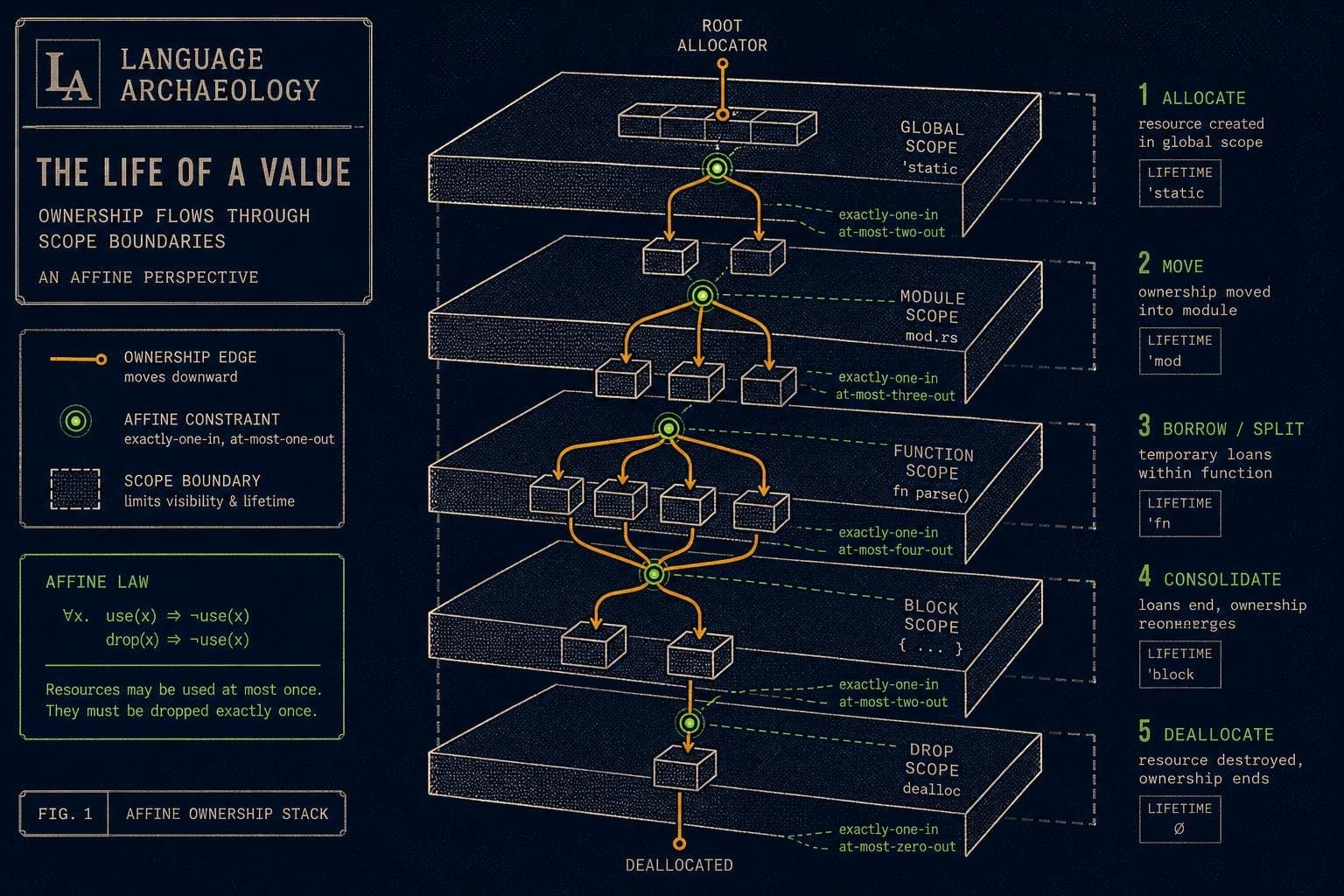
The borrow checker rests on a branch of logic called substructural type systems — specifically, affine logic. The key insight is deceptively simple: in classical logic, you can use a fact as many times as you like. In affine logic, each resource can be used at most once. Apply that to memory, and you get ownership: every value has exactly one owner, and when the owner goes out of scope, the value is dropped. No runtime needed. The compiler just enforces the rule.
This is why the borrow checker feels like it's arguing with you. It's not being pedantic — it's enforcing a mathematical invariant. When you try to use a value after moving it, or hold a mutable reference while an immutable one exists, you're violating the affine constraint. The compiler's job is to prove, before emitting a single machine instruction, that no such violation occurs.
Worth saying plainly, because Rust's fan club rarely does: Rust invented almost none of this. The borrow checker draws on Cyclone's region-based memory management from the early 2000s, welded to affine types from linear logic — ideas that predate Rust by decades. The Result and Option types for error handling are Haskell's Maybe and Either in work boots. What Rust did was synthesize these ideas into something that compiles to native code and ships production software.
What the Guarantees Actually Cover
The ownership model eliminates an entire category of bugs at compile time. But the guarantee has a precise shape, and understanding that shape matters. A 2020 study of 186 real-world Rust memory-safety bugs — covering every Rust CVE through that year — found that all memory-safety bugs required unsafe code to trigger. Safe Rust kept its promise. The unsafe keyword is an explicit escape hatch for low-level operations that the compiler can't verify: raw pointer arithmetic, foreign function interfaces, certain hardware interactions.
The catch is that unsafe blocks are common in real codebases, and the bugs that live inside them can leak through safe APIs. Recent work on a static analysis tool called UnsafeChecker found 114 previously unknown soundness bugs across crates on crates.io by tracking ownership, object validity, and memory layout through unsafe blocks — bugs where safe client code could trigger undefined behavior because an unsafe abstraction violated the invariants that Safe Rust enforces. The borrow checker is a proof, but it's a proof about the safe subset. The unsafe boundary is where the proof ends and human judgment begins.
This is the honest picture of what the ownership system delivers: a mathematically grounded guarantee over a well-defined region of your code, with a clearly marked exit for when you need to step outside it.
Why This Matters Beyond Rust
The deeper lesson here is about what it means to take a formal idea seriously in a production language. Microsoft recently elevated Rust to a "Tier 1" internal language, placing it alongside C++, C#, and TypeScript for internal development — with the explicit goal of addressing memory bugs in Windows code. The Rustls TLS library has spent a decade demonstrating that memory-safe systems code can compete on performance in production environments.
The ownership model's real contribution isn't Rust specifically. It's the demonstration that a compiler can carry the burden of memory reasoning — that the choice between control and safety was never fundamental, just a failure of imagination about what type systems could do. That idea is already migrating: C#'s Span<T> and ref struct borrow from the same principles, and the pressure on other languages to adopt similar guarantees is only growing.
The borrow checker didn't solve memory safety. It proved it — and that's a different kind of achievement entirely.


