
A production system written in Pony was producing data corruption five times a day. Three producer actors fed updates into a shared aggregation object, and the bug hid in a single accessor marked with the wrong permission. According to an account of the fix published by a Pony-focused development shop, the object's type was ref — mutable, aliasable within an actor, but not meant to be shared across a callback path the way it was. The fix wasn't a lock. It was changing the object's capability annotation to iso and routing every update through a single behaviour that consumed ownership instead of borrowing it. Corruption went from five a day to zero (HourTab).
That story is a useful entry point, because it shows what Pony is actually betting on: that if you encode who is allowed to hold a reference to what, and under what conditions, in the type system itself, you don't need runtime machinery to catch the mistake. You need a compiler that refuses to build the program.
The Old Answer Was Locks, or Shared-Nothing, or Both
The conventional story of concurrent correctness runs through synchronization primitives. Read-write locks are the textbook refinement: let multiple readers in, but make writers exclusive, with explicit rules about what a reader is guaranteed to see once a writer releases (Level Up Coding). It works, but it depends on every piece of code remembering to take the right lock, in the right order, every single time.
The actor model offered an escape hatch: give each actor private state nobody else can touch, and force all interaction through messages, so there's nothing left to lock (DEV Community). That solves races between actors. It says nothing about races inside one actor's mutable state, which is exactly where the HourTab bug lived — a box-aliased field being mutated through two code paths within the same actor, no cross-actor sharing involved at all.
Reference Capabilities Close the Gap Actors Leave Open
This is the gap Pony's type system was built to close. Academic work on Pony's garbage collector, ORCA, describes the language's core move precisely: pair an actor runtime with a type system that statically guarantees the absence of data races, then let the collector exploit that guarantee to skip read/write barriers and stop-the-world pauses entirely (ResearchGate). The same research line frames this as part of a broader pattern — Pony, L42, and related research languages all use reference capabilities and object capabilities to enforce deterministic parallelism and race freedom through the type checker rather than through runtime arbitration.
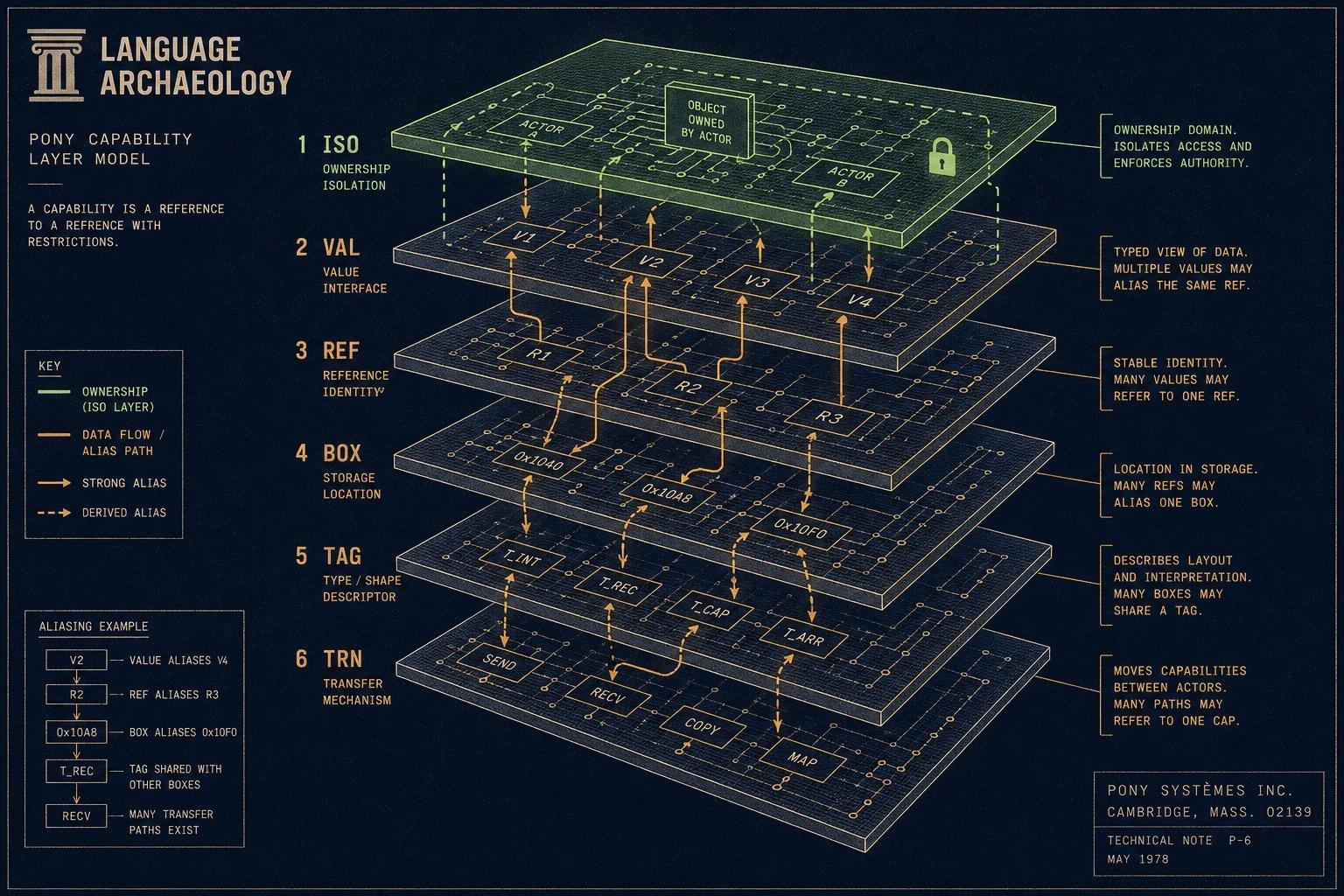
The mechanism, per the HourTab breakdown, is a lattice of six capabilities: iso for unique ownership that can be sent between actors, val for globally immutable and freely aliasable data, ref for ordinary mutable access confined to one actor, box for read-only views, tag for pure identity with no read or write access, and trn as a transitional write-unique state on its way to becoming val (HourTab). Each capability is really an answer to one question: what else, if anything, is allowed to be looking at this reference right now? Because the compiler tracks that answer at every assignment, a race isn't something you catch with a thread sanitizer after the fact — it's something the program literally cannot express if it type-checks.
A Different Lane Than Swift's Actor Isolation
It's worth placing this against Swift's recent concurrency model, which tackles the same symptom — nondeterministic crashes from unsynchronized shared state — through actor isolation and a strict, opt-in compiler mode layered on top of structured concurrency (ITNotes). Swift's answer still leans on the actor boundary as the unit of protection; Pony's reference capabilities reach inside that boundary and regulate aliasing at the level of individual objects and fields. Different granularity, same instinct: push the race detection work to compile time so the 2 a.m. crash never ships.
Correctness as a Design Default, Not a Patch
A recent interview with Antithesis engineer Sean Allen, who contributes to Pony, frames this as part of a larger argument: software should be built around invariants that make invalid states hard to express in the first place, rather than validated solely through late-stage testing (Toksick Magazine, reporting on an interview originally published by The Pragmatic Engineer). Pony's capability lattice is that philosophy applied narrowly and rigorously to one problem — aliasing — rather than asserted as a general principle.
The lesson worth carrying into other languages isn't the specific syntax of iso and trn. It's the idea that a race condition is, at bottom, an aliasing problem wearing a concurrency costume — and that if your type system can see every alias, it can see every race before your program ever runs.


