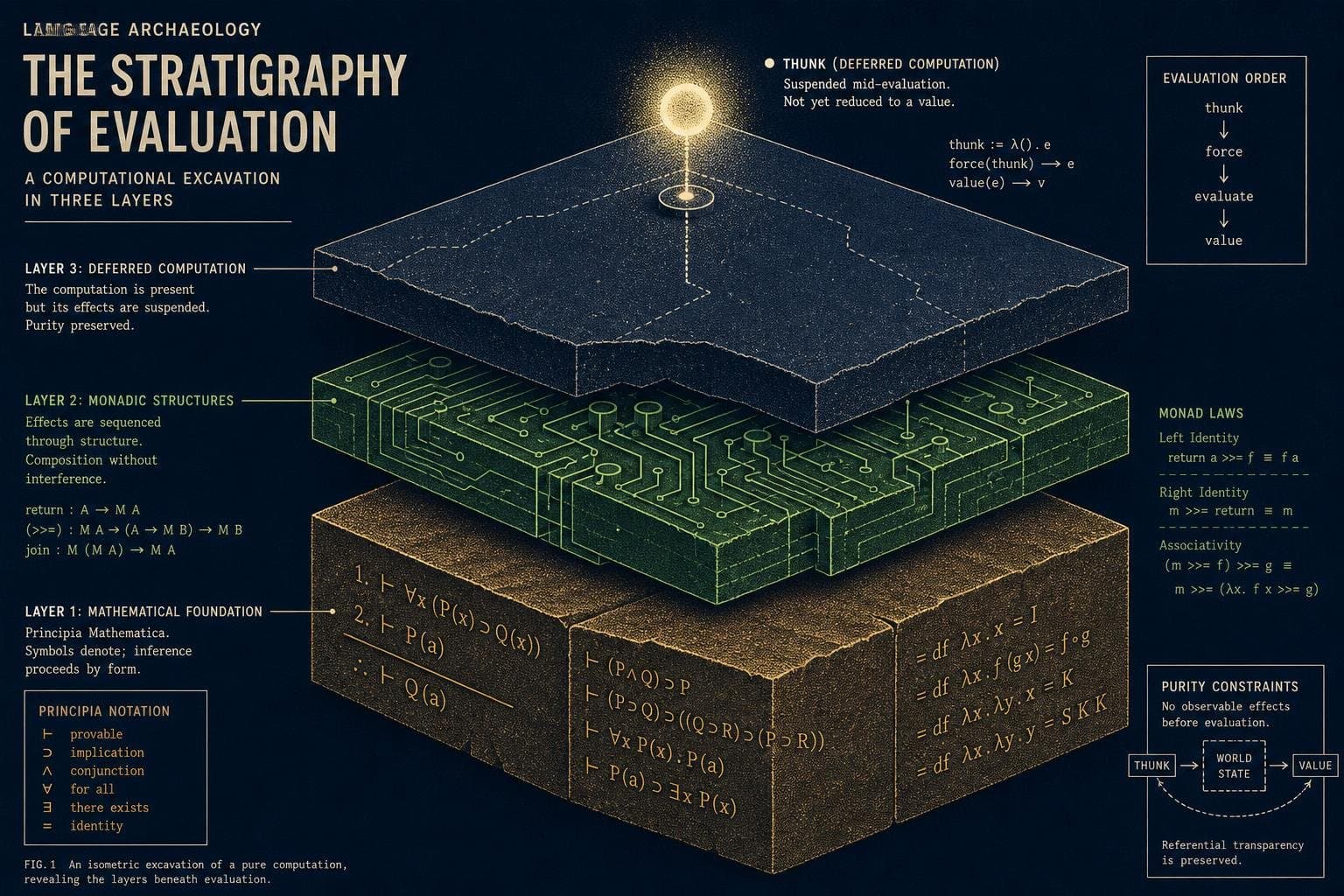

Lesson 25: Why Haskell's design forces a different theory of computation
There's a moment every programmer hits when learning Haskell where something feels genuinely wrong. You write a function, it looks correct, and then you realize you have no idea when it runs. Not in the sense of performance profiling — in the sense that the runtime hasn't decided yet.
That disorientation is the point. Haskell's lazy evaluation isn't a performance optimization bolted onto a conventional language. It's a commitment to a different idea about what a program fundamentally is.
Pure Functions Created the Problem That Laziness Solved
To understand why Haskell evaluates lazily, you have to understand the constraint that made it necessary. Haskell is a pure functional language — functions have no side effects, and the same inputs always produce the same outputs. This property, called referential transparency, has roots going back further than most programmers realize. As a reading of Whitehead and Russell's 1910 Principia Mathematica documents, the formal statement appears on page 8: "if p≡q we shall have f(p)≡f(q)." The idea that substituting equal values always produces equal results is ancient. Haskell just enforced it absolutely.
Absolute purity creates a practical problem: how do you handle I/O? How do you write a program that reads from a file, talks to a database, or prints to a screen, when every function must be side-effect-free? The Haskell community's answer — monads — is well-documented. But the other answer, the one that shaped the language's evaluation strategy, is laziness.
In a pure language, the order of evaluation doesn't affect the result. If f(x) and g(y) are both pure, it doesn't matter which one runs first. This means the runtime can defer evaluation until a value is actually needed. And if a value is never needed, it never gets computed at all.
The Monad Connection Runs Deeper Than It Looks
Simon Peyton Jones and Philip Wadler, two of Haskell's co-creators, wrote a 1993 paper called "Imperative Functional Programming" — a title that sounds like a contradiction. As a recent analysis on DEV Community documents, Jones and Wadler noticed that programs written in the monadic style "look rather similar to imperative programs." They were explicit about this. Haskell has imperative structure. The monadic pattern sequences operations, controls execution order, and manages state — it just does so through a type system rather than through mutation.
This is where lazy evaluation and pure functions snap together. Laziness lets you build infinite data structures — a list of all prime numbers, an endless stream of sensor readings — because the list only gets evaluated as far as you consume it. Purity guarantees that this deferred evaluation is safe: nothing changes between when you define the computation and when you force it. The type system, meanwhile, tracks which computations are pure and which involve effects, keeping the two worlds from bleeding into each other.
The result is a language where the type signature of a function tells you something profound: not just what type of value it returns, but whether it touches the outside world at all. A function returning IO String is categorically different from one returning String. The first interacts with the world; the second is a pure transformation. Java Code Geeks' plain-language guide to monads traces how this pattern leaked into mainstream languages — Java's Optional, Rust's Result, JavaScript's Promise chains — usually rebuilt from scratch by engineers solving the same sequencing problem and arriving at the same shape.
What This Means for How You Think
The practical lesson isn't "use Haskell." It's that Haskell's design forces you to confront a question most languages let you ignore: what is the difference between describing a computation and executing it?
In most languages, writing readFile("data.txt") and calling readFile("data.txt") are the same act. In Haskell, you can construct an IO action that describes reading a file and pass it around as a value, compose it with other actions, and only execute it at the program's entry point. The computation is a first-class citizen. Execution is something that happens to it later.
The DEV Community piece frames this as a terminology problem with real consequences: the industry conflates "functional" with "declarative" when they're actually independent dimensions. You can write functional code that's deeply imperative in structure — Haskell's monadic I/O is exactly that. Recognizing this distinction matters more now that AI tools amplify whatever patterns programmers establish in their codebases.
Haskell's type system, lazy evaluation, and monadic I/O aren't three separate features. They're three facets of a single design commitment: make the computer's behavior legible in the code's structure. When you force a value in Haskell, you know it. When a function touches the world, the type says so. When a computation is deferred, that deferral is part of the design, not an implementation detail.
Most languages hide these distinctions. Haskell insists you see them. That insistence is uncomfortable at first — and then it becomes hard to unsee.


