
Lesson 14: What Clojure's persistent data structures reveal about the nature of change
There's a moment every developer hits when working with shared mutable state: you're debugging a value that shouldn't be wrong, and you realize the problem isn't what changed it — it's that anything could have. The value exists in time, and time is the enemy. Rich Hickey built Clojure around a specific answer to this problem, and it's more philosophical than technical.
The answer isn't "make things immutable so bugs are easier to find." It's something sharper: most of what we call "state" in software is actually the conflation of two separate things — a value and the time at which we observed it. Persistent data structures are how Clojure keeps those two things from getting braided together.
The Problem Wasn't Concurrency. It Was Confusion About Identity.
Hickey's critique of mainstream OO languages isn't that they're slow or verbose. It's that they complect identity with state. When a Java object changes, the old version is gone. The object is its current state, which means there's no clean way to say "what was this thing a moment ago?" You can't hand someone a reference to a value and trust that it won't mutate under them. You have to copy defensively, lock aggressively, or accept that your program is reasoning about a moving target.
His framing, drawn from his "Simple Made Easy" talk, is that complecting — braiding together concerns that should be separate — is the root cause of most software complexity. Mutable objects complect the identity of a thing (its name, its reference) with its current value and the time at which you're looking at it. Disentangle those, and a lot of the machinery you built to manage the chaos becomes unnecessary.
Clojure's persistent data structures are the mechanical expression of that disentanglement. When you "update" a map in Clojure, you don't modify the original. You get a new value back. The old one still exists, unchanged, and anything holding a reference to it sees exactly what it always saw. Identity and value are separate. Time is explicit.
Persistent Doesn't Mean Copied
The obvious objection: if every update produces a new data structure, doesn't that mean copying the entire thing every time? That would make the philosophy correct but the language unusable.
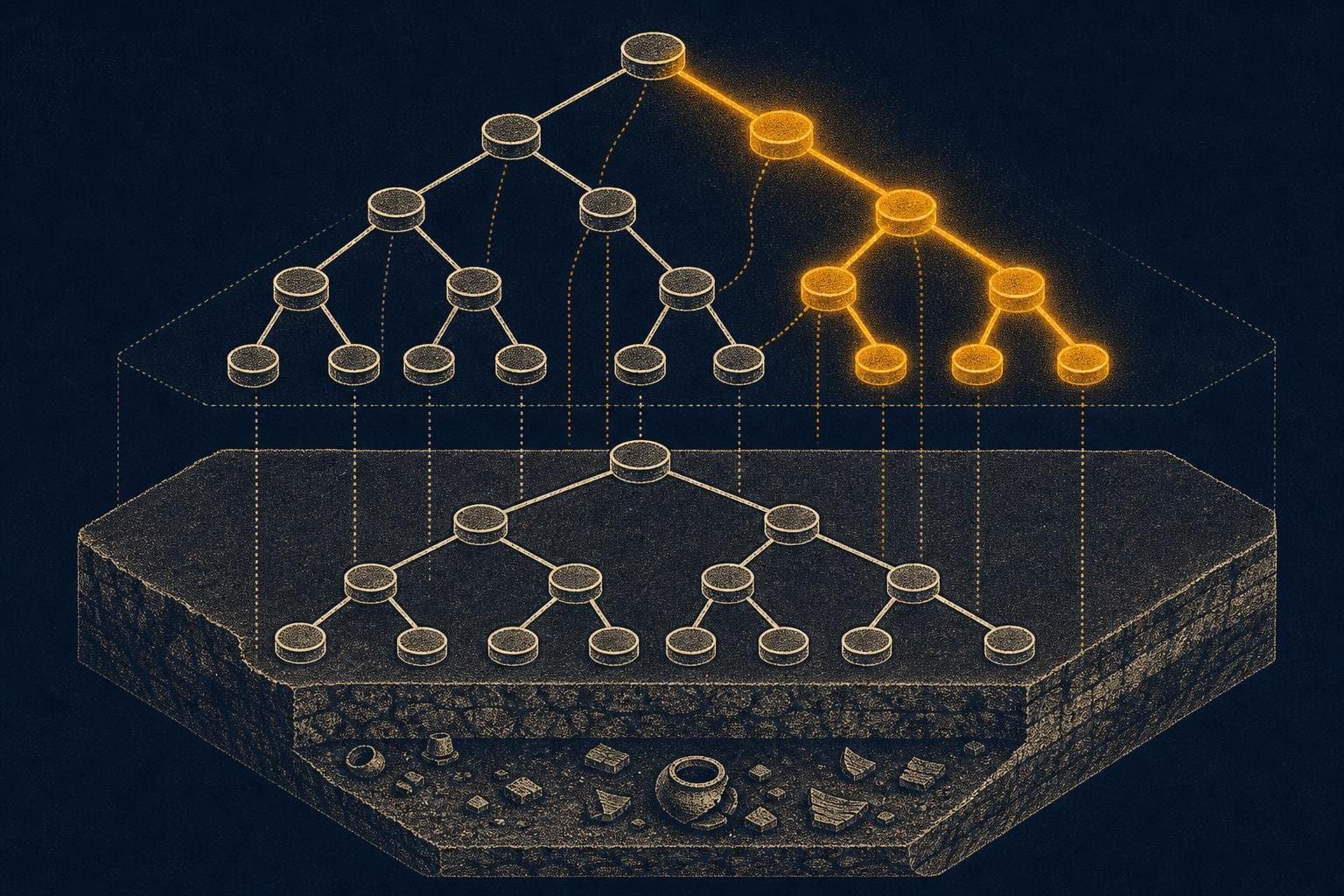
This is where the implementation catches up to the idea. Clojure's persistent data structures use structural sharing — new versions share as much of their internal tree structure as possible with the old version. Only the path from the root to the changed node gets new nodes; everything else is a shared reference. The result is that creating a "new" version of a large map is cheap — proportional to the depth of the tree, not its size.
As the Clojure for Java resource explains, immutability and state management in Clojure aren't in tension — they're designed together. The language gives you immutable values by default and then provides explicit, controlled mechanisms (atoms, refs, agents) for the cases where you genuinely need a mutable reference to a changing value. The mutation is visible and intentional, not ambient.
The Zipper pattern illustrates this elegantly. Clojure's zipper implementation lets you navigate and "edit" deeply nested immutable structures by maintaining a focus (the current node) and a context (the path back to the root). When you make a change, you're not mutating the tree — you're constructing a new path through it. The original remains intact. The zipper gives you the ergonomics of in-place editing without abandoning the guarantees of immutability. It's a good example of Hickey's broader point: simplicity isn't about removing capability, it's about removing the hidden entanglements.
Why This Still Matters in 2026
Clojure isn't a thought experiment. As of May 2026, Nubank — the world's largest digital bank by customer count — runs its backend almost entirely in Clojure, processing billions of transactions daily across more than 5,000 microservices. The immutability-first philosophy isn't a liability at that scale; it's arguably what makes that scale tractable. When your data structures don't change under you, reasoning about concurrent systems becomes dramatically simpler.
The same source notes that REPL-driven development — evaluating one expression at a time and inspecting the result — maps naturally onto how developers now work with LLM-generated code. Immutable values help here too: when you evaluate a function in isolation, you don't have to worry about what ambient state it might be reading or writing. The expression means what it says.
The deeper lesson isn't "use Clojure." It's that the design decision to make immutability the default forced every other design decision to be honest about change. When mutation is the exception rather than the rule, you have to name it, contain it, and reason about it explicitly. That discipline — what Hickey calls choosing simplicity over ease — is available in any language. Clojure just makes it very hard to avoid.


