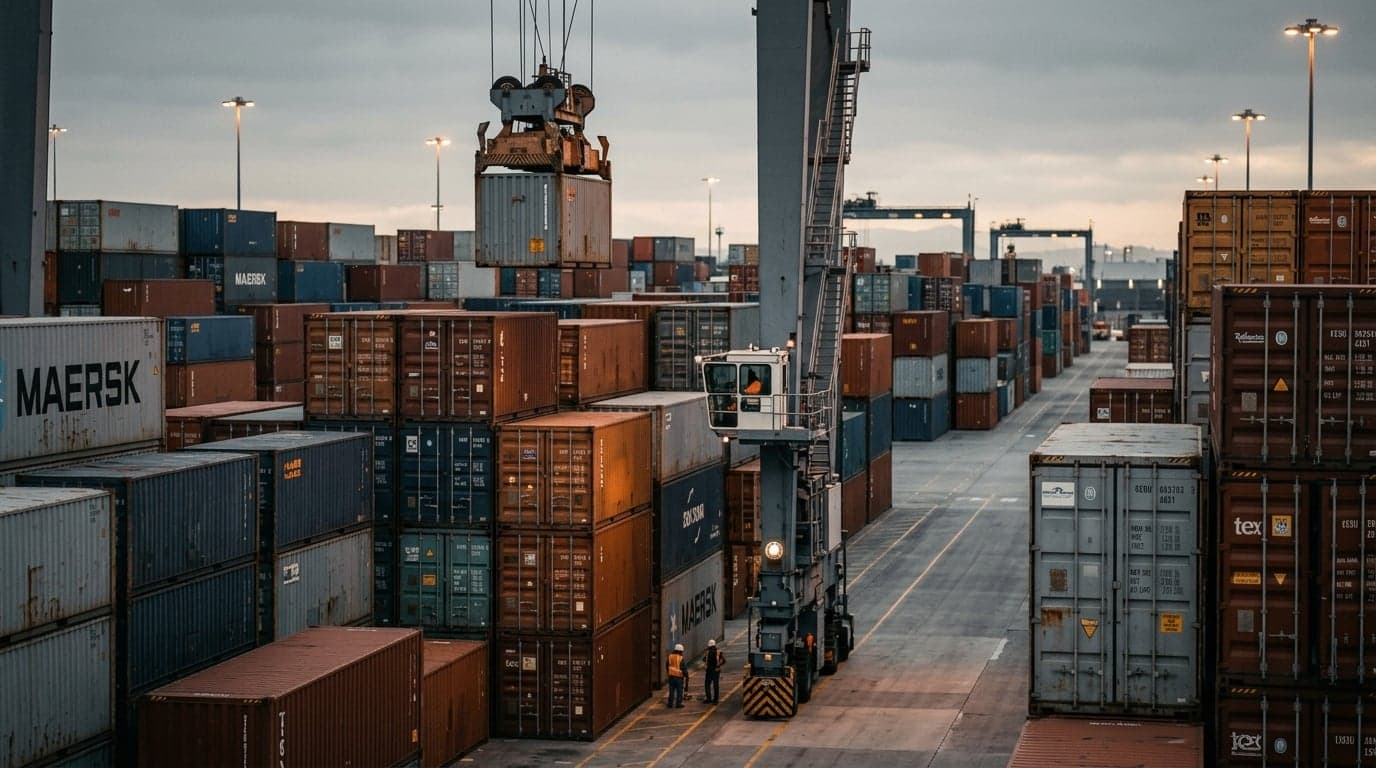

The Port of Los Angeles just had its best June in 118 years. 1,002,734 TEUs processed in a single month — only the third time in the port's history it has crossed the million-TEU threshold. Long Beach wasn't far behind, posting 779,000 TEUs for June, a 10.6% year-over-year increase and its third-busiest June on record. Combined, the two ports handled more inbound cargo last month than at almost any point in their histories.
This is the worst possible moment for labor uncertainty to enter the picture.
The assigned topic — West Coast port labor negotiations threatening peak season throughput — doesn't have a specific contract crisis I can point to in the current source pool. What the sources do show is something arguably more useful for operational planning: a system running at near-maximum inbound capacity, with structural vulnerabilities that any labor friction would detonate at the worst possible time.
The Front-Loading Surge Has Compressed the Margin for Error
The volume story isn't a traditional peak season. Retailers have essentially abolished the concept. Importers have been pulling fall and holiday merchandise forward since spring, driven by the July 24th expiration of temporary 10% tariffs and persistent uncertainty about what trade policy looks like on the other side. The National Retail Federation, per the same source, continues to forecast record import volumes at major U.S. container ports.
What this means operationally: the system has no off-peak buffer. Traditionally, a labor slowdown in July or August would bite into elevated but manageable volumes. Right now, loaded imports at LA climbed 12.8% year-over-year to 530,558 TEUs in June alone, while exports were essentially flat. The inbound pipeline is full. Ocean carriers have responded by deploying additional vessel capacity while aggressively repositioning empty containers to keep terminals fluid — which tells you terminals are already managing tight space to stay ahead of the inbound wave.
Any friction that slows gate moves, crane cycles, or vessel turns doesn't hit a system with slack. It hits a system already running hot.
Rail Is the Pressure Valve — and It's Already Under Pressure
The other variable that makes labor risk particularly acute right now is intermodal. Roughly 28% of containers are now leaving Long Beach by rail, up from recent norms, as the volume surge pushes more cargo onto Class I networks. Port officials note that close coordination with railroads has helped avoid pandemic-era congestion — but that coordination depends on consistent terminal throughput feeding the rail ramp at a predictable rate.
I wrote in June about containers moving but getting stuck at the port exit (/p/containers-are-moving-getting-them-off-the-port-is-the-problem), and again in late June about the rail capacity cushion thinning (/p/the-rail-surge-is-real-the-capacity-cushion-wont-last). Both dynamics are still live. What's changed is the volume context: the inbound numbers are now materially higher than they were when I wrote those pieces, which means the rail system is absorbing more, not less.
A labor disruption that slows terminal throughput — even a partial slowdown, not a full work stoppage — would back up the rail ramp, which would back up the terminal, which would delay vessel turns. The cascade is predictable. The question is how fast it moves.
What Procurement and Operations Teams Should Be Watching
The July 24th tariff deadline is the immediate pressure point. Shippers front-loaded specifically to beat that date, which means a significant volume of cargo is either already at port or in transit with tight delivery windows. Any disruption to West Coast throughput in the next two to four weeks hits goods that shippers already paid to expedite.
Beyond the immediate window, American Shipper flagged that Iran conflict has driven Asia-US container rates up 276% on some lanes, with rates near $9,000 per container as of recent reporting. That's the external rate environment into which any West Coast disruption would land. Shippers diverting to East Coast or Gulf ports — the standard contingency — would be doing so at elevated spot rates, not the pre-crisis rates that made diversion economically tolerable in 2022-23.
Meanwhile, Lloyd's List has noted that restoring confidence in disrupted shipping markets takes far longer than ending the underlying conflict — a dynamic that applies equally to labor disputes. The operational damage from a West Coast slowdown wouldn't unwind the moment a contract is signed; vessel schedules, repositioned equipment, and rail bookings all carry inertia. And the Journal of Commerce has been tracking overcapacity concerns building toward 2027 — but that's a next-year problem. The 2026 problem is the opposite: too much cargo, not enough operational buffer, and a labor environment that procurement teams should be stress-testing now rather than after a slowdown starts showing up in dwell time data.
Watch the dwell numbers at LA and Long Beach over the next three weeks. If they start climbing while vessel calls remain steady, that's the early signal — not the press release.


