


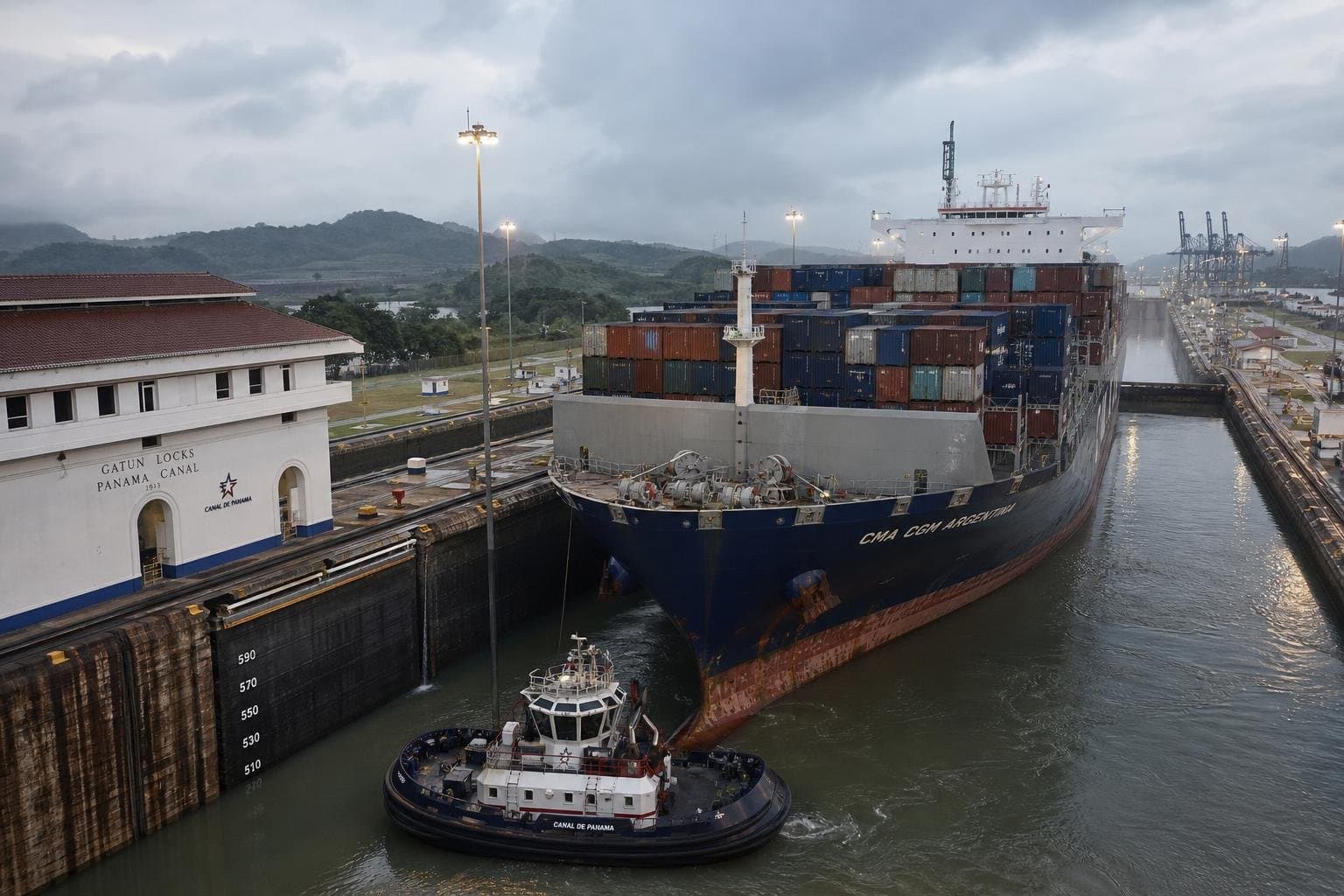

If you've been told ocean carrier surcharges are climbing because of new IMO bunker fuel regulations, check your invoice again. The line items showing up on Asia-US routing this fall trace back to something more mundane and more consequential: water levels in a canal and crude tankers fleeing the Strait of Hormuz. Neither has much to do with sulfur caps.
What's actually on the surcharge line
Carriers have introduced Panama Canal-related surcharges specifically on Asia-US inbound routing, and the driver is new low-water restrictions imposed by the Panama Canal Authority, not a fuel-standard change, according to Transmodal's September trade update. That restriction is forcing some carriers into longer routing decisions — East Coast service via the Cape of Good Hope or through the Suez Canal instead of the canal shortcut — and longer routes mean more bunker burned per voyage, which is the real cost carriers are passing through. Maersk indicated in August that only about half of its Suez-routed services have returned to that canal, meaning the majority of its relevant fleet is still running the longer, costlier Cape passage, per the same update. That's an operational capacity constraint, not a regulatory bunker-fuel mandate, and the distinction matters for anyone budgeting Q4 landed costs on Asia-US East Coast lanes.
Meanwhile the inbound Transpacific market is firming on its own terms. Shanghai to Los Angeles rose 5% week-on-week and Shanghai to New York rose 3% as of the September 3 Drewry reading cited in the Transmodal update — modest, route-specific moves, not a blanket "rates are spiking" story. Asia-Europe is moving in the opposite direction: Shanghai to Genoa fell 10% and Shanghai to Rotterdam fell 5% over the same week. One global headline index — the Drewry World Container Index holding flat — was masking two different markets running in opposite directions on different trades. If your procurement team is looking at a composite rate index instead of lane-specific numbers, you're missing the actual signal.
A Separate, Bigger Fire: Tankers
The sharper and more dramatic cost story this cycle isn't containers at all — it's crude tankers, and it's downstream of the Strait of Hormuz disruption, not bunker regulation. US-Europe suezmax rates jumped 150% week-on-week to $577,792 per day, and West Africa-Europe suezmax rose 145% to $567,138 per day, according to Lloyd's List. West Africa-China VLCC rates climbed 43% week-on-week to $697,160 per day, and US Gulf-Europe aframax rates rose 44% to $313,794 per day over the same window. Lloyd's List attributes this to a "cascade" effect — crude exiting the Strait of Hormuz and rippling through every other tanker segment as owners reposition tonnage. This is energy logistics, not container logistics, but it belongs in the same conversation because it's pushing up the marine fuel cost baseline every container carrier prices against. When crude and bunker-adjacent fuel markets convulse this hard, container carriers have more room to justify broad-based surcharges even when the specific trigger is someone else's crisis.
UNCTAD's framing backs this up at the macro level: rising shipping, insurance, and logistics expenses are being driven by conflict-linked energy shocks and rerouting, not by a single regulatory event, per Lloyd's List's coverage of the UNCTAD report. That's a qualified association, not a quantified causal claim, but it's consistent with what the rate data above shows.
Carriers Aren't Just Reacting — They're Managing Supply
None of this is happening to carriers; they're actively managing it. Drewry has 47 blank sailings scheduled across major East-West trades between weeks 37 and 41 — late August through early October — representing roughly 6% of scheduled capacity, according to Transmodal. Asia-US East Coast capacity fell about 9% in August versus July while Asia-US West Coast capacity held roughly flat. That's a deliberate outbound-from-Asia capacity cut on the East Coast leg specifically — the same leg now carrying Panama surcharges — layering a supply restriction on top of a routing cost increase. Whether that's coincidence or coordinated pricing discipline, procurement teams booking East Coast-bound Asia freight are facing both at once.
Watch the Panama Canal Authority's draft restriction schedule and Bimco's order book outlook, which the Journal of Commerce reports will shape how much of the current Suez-avoidance capacity gets reabsorbed into 2027 planning — that's the real lever determining whether these surcharges are temporary routing costs or a structural feature of next year's Asia-US East Coast pricing.