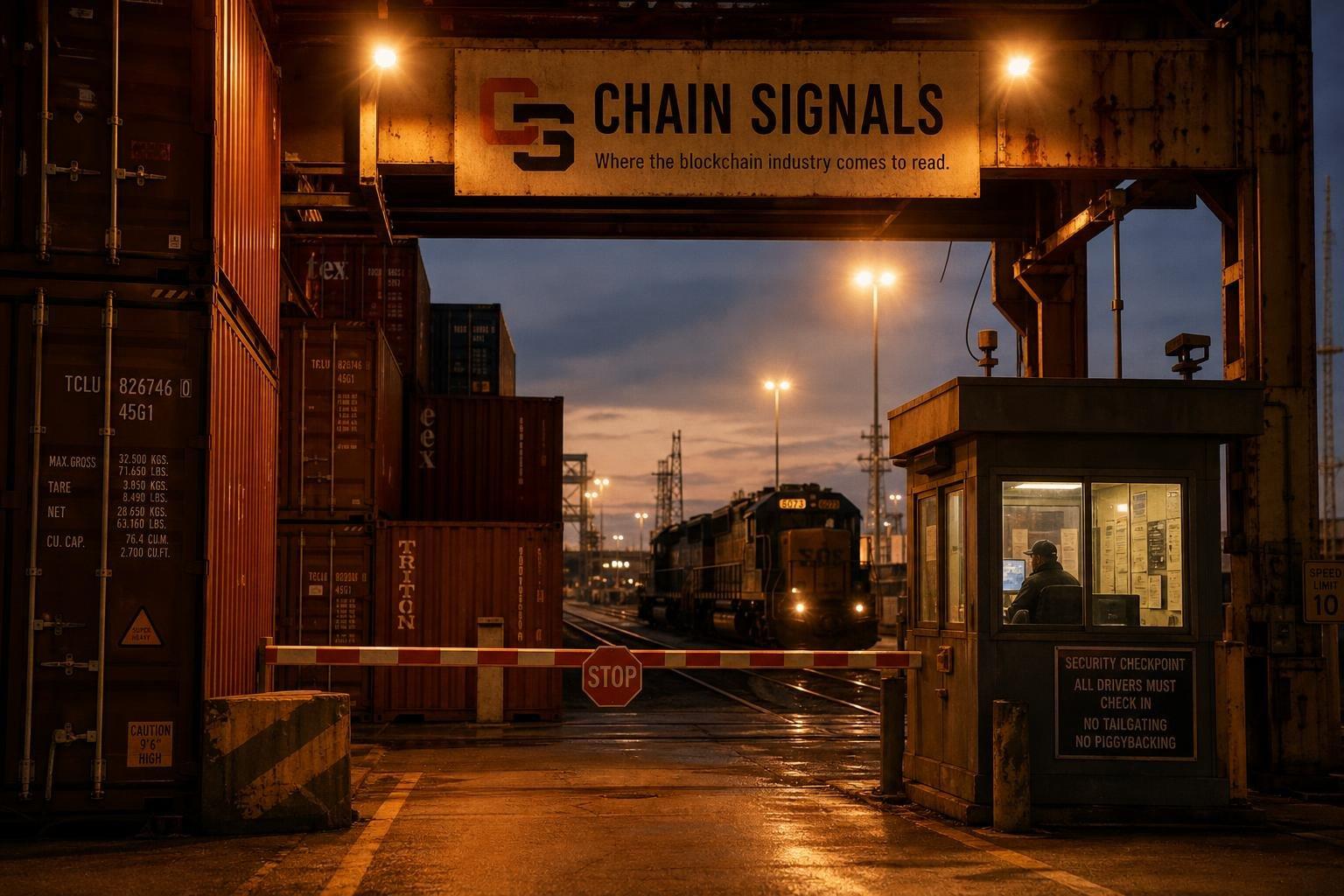

Tonight at midnight, a contract covering roughly 250 security watchmen at the Port of Los Angeles and Long Beach expires for the fourth time since November 1 — and this time, there's no indication it gets extended again (Tradlinx; gCaptain). That's the actual bottleneck story at the nation's busiest container complex right now — not a generic shortage of drayage drivers, which the available data doesn't support. What the data does support is a terminal gate problem layered on top of a rail problem, both hitting at the worst possible moment for holiday-season inbound freight.
Six Terminals, 2% of the Workforce, Outsized Leverage
ILWU Local 26 represents just 2% of the dockworker headcount at the LA-Long Beach complex, but its members control security and gate access at six container terminals handling roughly 85% of Long Beach's cargo and 33% of Los Angeles' cargo, according to the Pacific Maritime Association (gCaptain). That list includes APM Terminals at Pier 400, Long Beach Container Terminal, Total Terminals International, and three SSA Marine berths (Tradlinx). If watchmen walk, thousands of longshore workers, marine clerks, and foremen under separate agreements are expected to honor their picket lines — which means a dispute involving 250 people could stop truck and rail access at terminals that move more than half the complex's volume (gCaptain).
This is an internal terminal-operations risk, not a trucking-capacity story. A drayage fleet with plenty of trucks and drivers still can't move a box if the gate it needs is closed. PMA's latest offer — a $3,200 bonus, wages that would push average full-time watchman pay from over $170,000 to $198,000, and pension benefits up to $93,200 for senior workers — gives a sense of how much is on the table to avoid exactly that outcome (gCaptain). Whether that's enough, we'll know by tomorrow.
Rail Dwell Is Already Failing Before Any Strike
Set the labor question aside and the port complex has a separate, slower-burning problem: containers can't get off the dock onto trains fast enough. As of a November 13 media briefing, Port of Los Angeles Executive Director Gene Seroka said rail dwell times — how long containers designated for rail sit at the port — had climbed past nine days, up from 7.19 days in September (Supply Chain Dive). About 9,500 containers were sitting in that queue, three-quarters of them BNSF's responsibility, with half of that share stuck at a single facility, the Fenix Terminal (Supply Chain Dive).
That dwell problem is a direct product of volume. The port processed close to 5 million TEUs between June and October — its strongest five-month stretch on record — and just over 1 million TEUs in October alone, the second-highest monthly total ever (Supply Chain Dive). Seroka attributed the surge to continued consumer spending, inventory restocking, and shifting trade policy — and said rail car and crew power had been ramped up on the westbound side over the prior two weeks to clear the backlog (Supply Chain Dive). Nine days of dwell is a real, quantified operational failure — the kind of number procurement teams should be plugging into transit-time assumptions right now, not a vague "congestion" talking point.
What This Means for Anyone Routing Inbound Freight This Week
Zoom out and the macro backdrop makes both problems harder to absorb. Transborder freight between the US, Canada, and Mexico hit $161.1 billion in September, up 23.4% year over year, with truck freight alone up 27.6% (BTS). Transportation equipment producer prices rose 2.6% year over year through October (BTS). Meanwhile, tight capacity across the broader trucking market has been pushing more truckload freight toward LTL carriers for two straight quarters, per one logistics provider's internal index (Journal of Commerce). None of that is a Southern California drayage crisis on its own, but it's the kind of system-wide tightness that turns a single terminal gate closure or a rail dwell spike into something that cascades fast.
If Local 26 walks tonight, importers should assume both the gates and the rail yards feeding those six terminals go dark simultaneously — not sequentially. Watch Friday's PMA-union meeting outcome and next week's PMSA dwell-time update; either one tells you whether the complex is managing its record volume or losing the fight to it.


