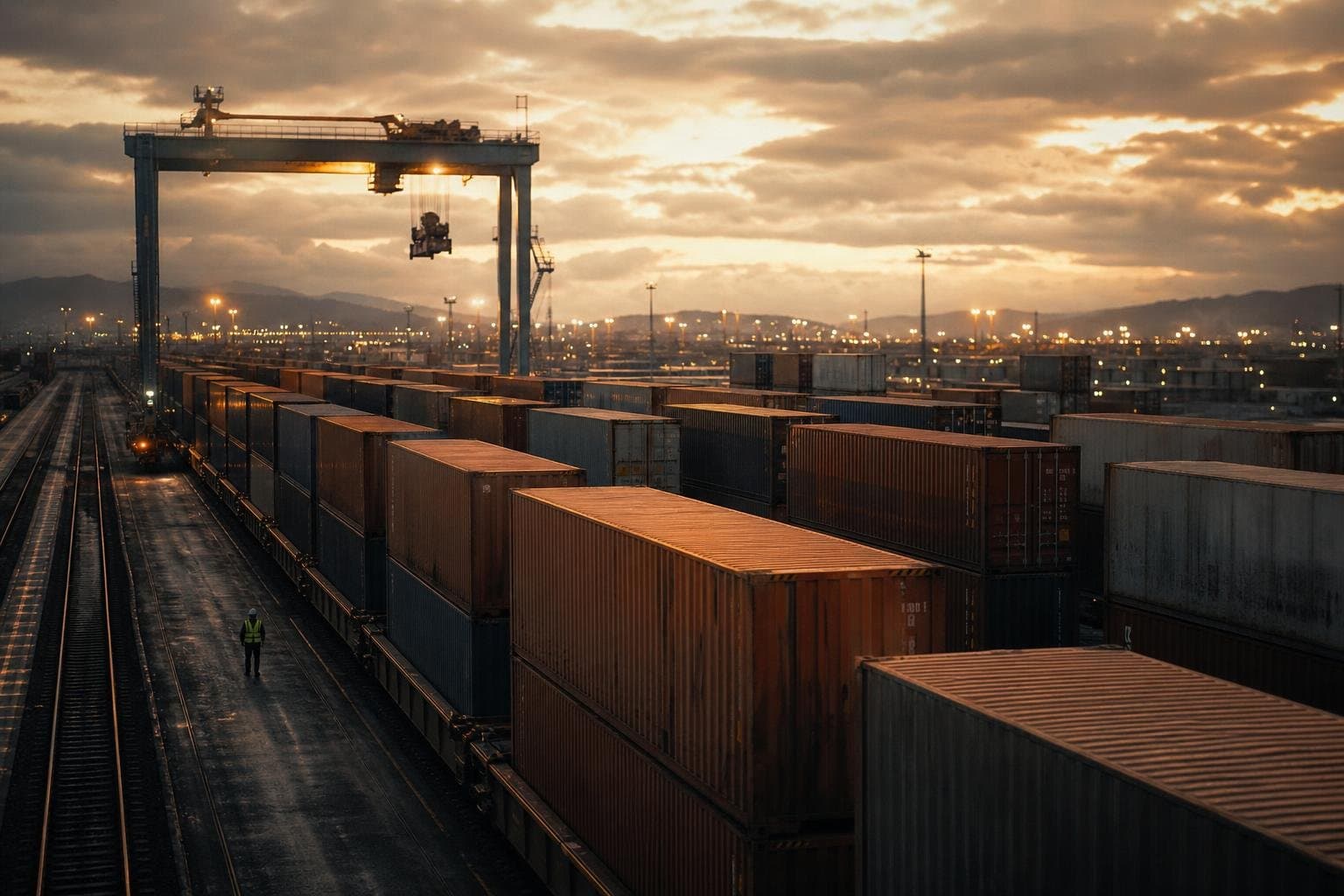

Intermodal volumes were up 11% for the week ending May 23 compared to the same week a year earlier, according to Association of American Railroads data reported by Trains. That's not a blip — it accelerated from 7% year-over-year growth the prior week, with a four-week rolling gain of 6.6%. The trucking market is tightening faster than most forecasters expected, and freight is moving to rail. The question procurement teams should be asking right now is how long the rail network can absorb this volume before the capacity cushion disappears.
The short answer: longer than you'd think, but not indefinitely.
The Substitution Story, Not the Demand Story
The Intermodal Association of North America was direct about what's driving these numbers. Their recent report, cited by Trains, called it "consistent with a substitution story (long-haul truck to rail conversion) rather than a demand story." That distinction matters enormously for how you read the capacity picture.
Substitution-driven volume is structurally different from demand-driven volume. When freight shifts modes because trucking gets expensive or constrained, it tends to concentrate on specific corridors — the lanes where intermodal already makes economic sense, roughly 550 to 1,500 miles. C.H. Robinson's June freight market update confirms this: demand growth is most pronounced in exactly that distance band, as freight that shifted back to truckload during the market downturn returns to rail.
What's pushing freight off trucks? Two compounding pressures. National average diesel prices have risen to approximately $5.50 per gallon, per C.H. Robinson's data, the highest level since — well, a while. Federal driver enforcement policies are simultaneously shrinking available trucking capacity. ACT Research polling, cited in the same update, indicates the U.S. trucking industry is entering a period of driver under-supply for the first time in approximately 3.5 years. That's not a temporary squeeze. That's a structural shift in the modal calculus.
Where the Rail Network Stands Right Now
The optimistic read is that railroads have room to absorb this. Mike Baudendistel, head of intermodal at FreightWaves, told Trains that "railroads and bimodal carriers have ample capacity to capture and retain volume growth." TD Cowen transport analyst Jason Seidl added that volume would increase through the second quarter — and the weekly data suggests that's exactly what happened.
Individual carrier performance backs this up. BNSF led year-over-year growth at 9.9% for the most recent four-week period, followed by Norfolk Southern at 6.1%, CSX at 3.3%, and Union Pacific at 3.3%. J.B. Hunt posted record first-quarter intermodal volume, including a 7% jump in March alone.
But "ample capacity" is an announced condition, not a permanent one. The Journal of Commerce is tracking a more complicated picture on the Union Pacific side: UP has extended peak surcharges to all Southern California shippers, with sources indicating a $300-per-container fee that applies once a shipper exceeds its contractual weekly allotment. Maersk, meanwhile, has temporarily shifted Southern California inland volume to UP — a move that freight forwarders and drayage providers in the Chicago area noticed when containers started routing to UP's Global IV terminal in Joliet instead of BNSF's Logistics Park Chicago.
That's the tell. When a major ocean carrier reroutes inland volume and a Class I railroad starts charging overage fees in its highest-demand corridor, the "ample capacity" framing starts to look like it describes the national average, not the specific lanes where freight is actually piling up.
The Q3 Pressure Point
The LTL market context adds another layer. PLS Logistics' mid-2026 analysis notes that structural pressures expected to build gradually have instead compounded at pace — rate increases arriving faster and with greater force than anticipated, truckload capacity tightening ahead of schedule. The Yellow Corporation bankruptcy in 2023 removed roughly 12% of national LTL capacity permanently, and that capacity never returned. Shippers who were insulated by soft demand through 2024 and 2025 are now feeling the full weight of that structural gap.
The practical implication for Q3: intermodal is absorbing overflow from both trucking and LTL simultaneously, on corridors that were already seeing the most substitution pressure. Southern California, the Southeast, and the Midwest are the three regions C.H. Robinson flags as facing the most acute trucking capacity pressure — and those are exactly the corridors where intermodal demand is concentrating.
Rail spot pricing remains competitive and closely aligned with truckload rates for now, with rate increases projected to stay in the low single digits for most of 2026. That gap between rail and truck rates is widening in intermodal's favor — but it won't stay wide if rail capacity gets absorbed faster than the network can respond.
Watch UP's surcharge policy through July. If the $300 overage fee becomes a floor rather than a ceiling, or if it spreads beyond Southern California to other high-demand corridors, that's the signal that announced capacity and operational capacity have finally diverged. At that point, the substitution story becomes a constraint story — and the costs land on whoever didn't lock in committed intermodal pricing before peak season arrived.


