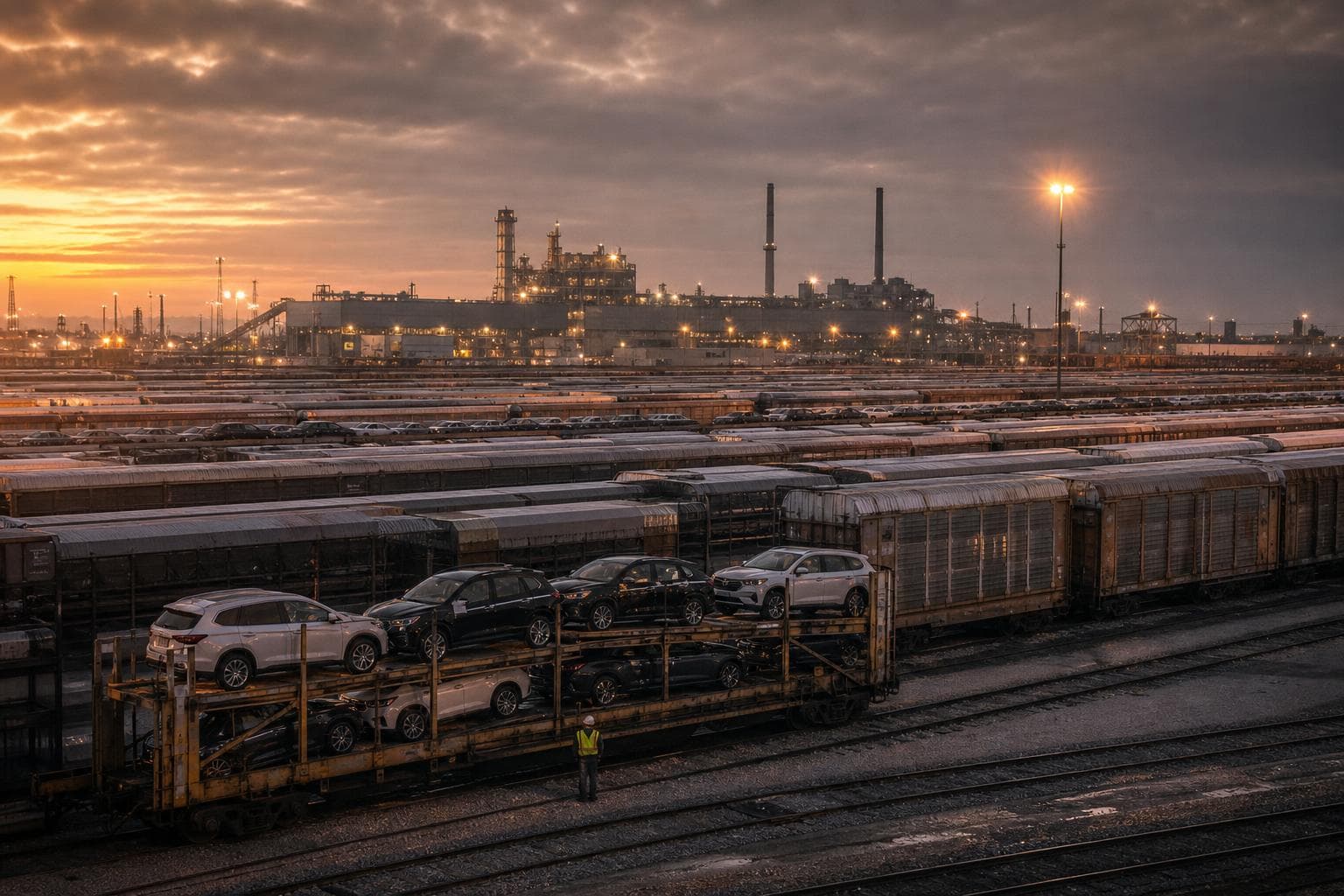

The assigned topic this week was rail capacity constraints delaying automotive parts to assembly plants. I went looking for the operational data — dwell times, specific lane constraints, intermodal volume shifts — and found something more structurally interesting: the rail constraint is real, but it's downstream of a different chokepoint that's already biting.
The Constraint Nobody's Tracking on a Map
Assembly plants run on just-in-time sequencing. A missing door handle chip doesn't slow the line — it stops it. That's the operational reality that makes automotive supply chains uniquely unforgiving, and it's why the current chip disruption deserves more attention than it's getting from freight analysts focused on modal capacity.
C.H. Robinson's January freight update flagged the core problem: legal disputes involving Nexperia, one of the automotive industry's primary chip suppliers, have triggered production delays and planned plant shutdowns across multiple major automakers in 2026. The mechanism is specific — Nexperia China stopped receiving silicon wafers from its Dutch parent, creating a wafer shortage that's now working its way through North American supplier production schedules. Nexperia is sourcing domestically as a workaround, but that transition is a six-to-nine month process. The disruption is structural, not episodic.
Here's the freight implication: when assembly plants run reduced schedules or shut down entirely, inbound parts flows don't stop — they pile up. Rail cars loaded with seats, stampings, and wiring harnesses don't disappear because a plant went dark for two weeks. They queue. And the dwell time that accumulates at rail yards near affected plants creates exactly the kind of secondary congestion that looks, from the outside, like a rail capacity problem.
The Demand Signal Is Sending Mixed Messages
Softening vehicle sales are adding another layer of complexity to the inbound picture. C.H. Robinson's May freight update reported that actual March vehicle sales came in down double-digits, with Q1 sales running approximately 6% below last year's pace. The logistics takeaway from that report is worth quoting directly: softening demand is easing near-term outbound pressure, but inbound parts flows remain active — aftermarket goods, components, and used vehicle movement are all continuing.
That's the operational paradox. Outbound finished vehicle volumes are declining, which frees up some rail capacity on those lanes. But inbound parts flows to plants running irregular schedules are creating uneven demand patterns that are harder to plan around than steady-state volume. Rail networks optimize for predictability. Irregular plant schedules — two weeks on, one week modified, restart delayed — are the worst possible input for a system that needs consistent block train loading to run efficiently.
C.H. Robinson's April summit recap put it plainly: the freight market is fragmented lane by lane, week by week. National averages are misleading. The plants experiencing inbound delays aren't experiencing a systemic rail failure — they're experiencing the localized consequence of irregular production schedules hitting a network that wasn't designed for them.
The November Deadline Changes the Calculus
Here's where the medium-term picture gets more complicated. Diginomica reported that the Busan Rapprochement — the US-China tariff agreement that temporarily lowered tariffs and extended exclusions on critical minerals, rare earths, and semiconductors — expires in November 2026. North American automotive production is heavily dependent on Chinese critical minerals and Taiwanese semiconductors. If no successor agreement is reached, the chip constraint that's currently a Nexperia-specific problem becomes an industry-wide sourcing problem simultaneously.
The operational implication for inbound rail flows: procurement teams that are currently managing irregular inbound schedules around one supplier's disruption would be managing irregular inbound schedules across multiple input categories at once. That's not a rail capacity story — that's a demand signal story that will eventually show up as rail capacity pressure.
What to Watch Before Q3 Planning Locks In
The constraint worth tracking isn't rail car availability on automotive lanes in aggregate. It's dwell time at the specific yards serving plants with known Nexperia-linked production disruptions. If dwell is rising at those yards while overall automotive rail volume is flat or declining, that's confirmation that irregular plant schedules — not network capacity — are the binding constraint.
For procurement teams finalizing Q3 inbound logistics plans: the six-to-nine month timeline for Nexperia's domestic wafer sourcing workaround puts resolution somewhere in Q3 or Q4. Build that uncertainty into your inbound buffer assumptions now, before the November trade agreement deadline adds a second variable to the same equation. The plants that get caught flat-footed won't be the ones that couldn't find rail capacity — they'll be the ones that assumed the production schedule would normalize on its own.


