
The drought narrative was always the cleanest version of the story. Water levels drop, transits get cut, rates rise, everyone waits for rain. Rain comes, problem solved. That's not where we are.
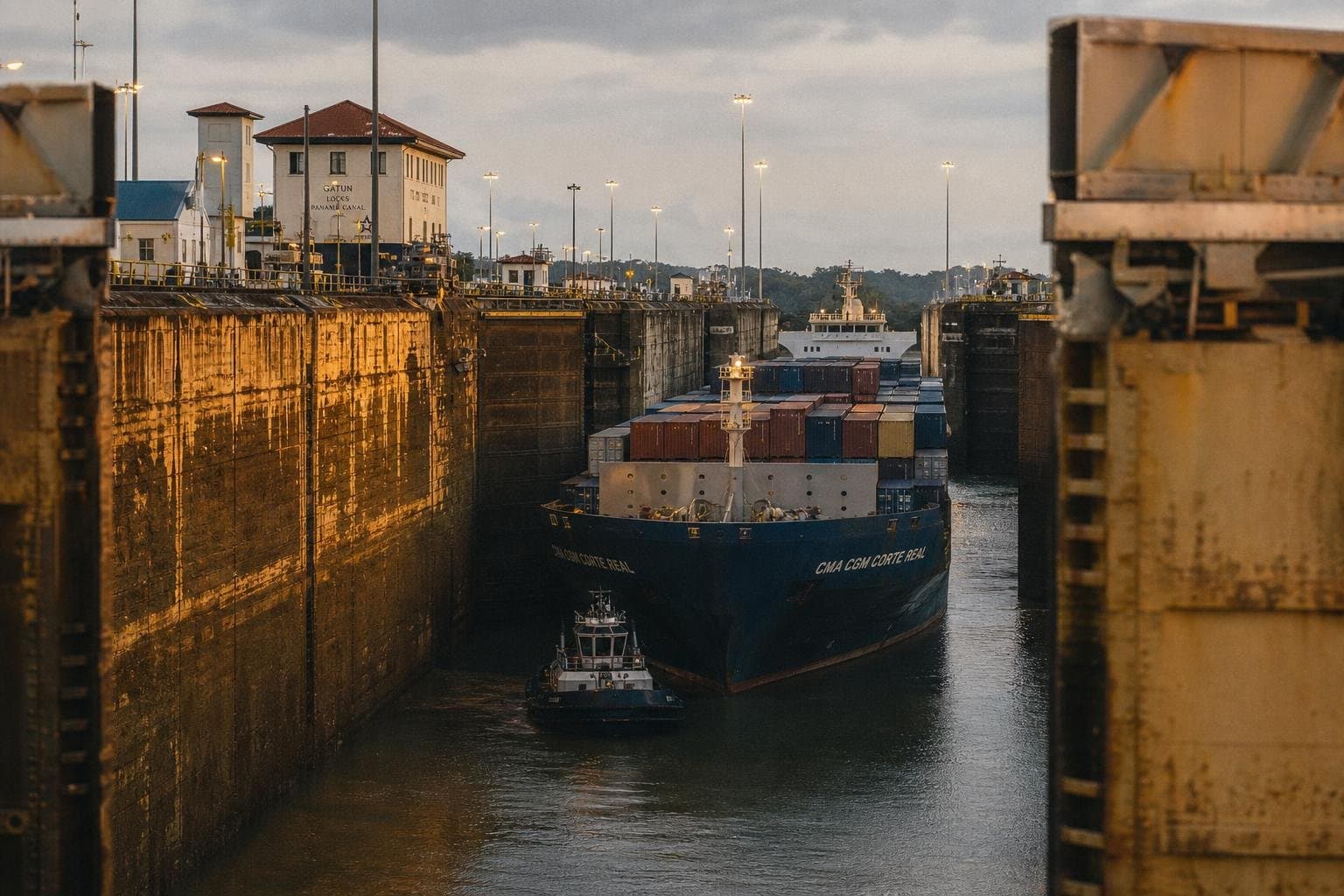
The operational picture at the Canal has shifted in ways that aren't fully captured by precipitation charts. According to Lloyd's List, the Canal's new administrator warned that daily transits could fall to as few as 27 vessels under a worst-case scenario — down from a baseline of 36 — with further cuts possible into early 2027. That's not a temporary weather disruption. That's a structural capacity ceiling with a multi-year timeline, and it's reshaping how carriers route cargo even when the auction queues aren't visibly backing up.
The more telling signal: carriers aren't waiting around to find out which scenario plays out. They're already routing around the Canal entirely.
Carriers Are Voting With Their Routes — and the Pattern Is Hardening
The Journal of Commerce has reported that ocean carriers are actively skipping both Panama Canal transits and certain China port calls as delays mount — a combination that reveals a compounding problem. The Canal constraint is interacting with port-side congestion in Asia, and carriers are responding by designing around both simultaneously rather than managing them separately.
This is the kind of routing adaptation that doesn't reverse easily. When a carrier restructures a service loop to avoid the Canal, they're not just choosing a longer path for one voyage — they're rebuilding the schedule around that path, adjusting port call sequences, repositioning vessel capacity, and recalculating transit time commitments to customers. Reversing that once canal conditions improve requires another full restructuring cycle, which takes months.
Meanwhile, the Journal of Commerce's separate analysis characterizes the Asia-Americas container system as sitting "on a knife-edge" — with schedule instability, rolled cargo, and delay risks flagged as particularly acute in the period following Golden Week. The Canal isn't the only pressure point, but it's the one that affects the entire system's routing geometry. When you constrain the main shortcut between the Pacific and Atlantic, every alternative route gets more expensive and more crowded simultaneously.
The Insurance Signal Is Worth Watching Separately
There's a downstream indicator that doesn't get enough attention in the freight trade press: what insurers are charging for the diversion routes. Lloyd's List reports that underwriters are flagging fresh risks from increased transits through the Magellan Strait and Drake Passage — the far southern routes that vessels use when the Canal isn't viable — including heavy weather exposure, and disputes between vessel owners and charterers over who bears pilotage costs on those alternative passages.
The insurance market is a leading indicator, not a lagging one. Underwriters price tomorrow's risk, not yesterday's. When Lloyd's-market insurers start publicly warning about Magellan Strait and Drake Passage exposure, they're telling you that the volume of vessels using those routes is high enough to have moved the risk calculus. That's not a commentary on what might happen — it's a reflection of what's already happening at scale.
The cost of those diversions doesn't show up cleanly in any single rate index, which is part of why it's easy to underestimate. It fragments across higher fuel burn, longer transit times, elevated insurance premiums, and charterer-owner disputes that settle quietly. The shipper's all-in landed cost goes up; the rate card says something different.
What to Watch Into Q4
The operational question for procurement teams covering US Gulf-to-Asia lanes or East Coast inbound cargo isn't whether the Canal will fully recover — it's whether the workaround routing that carriers have constructed remains stable enough to hold schedules through Q4 peak pressure.
American Shipper via FreightWaves notes that trans-Pacific container rates were sitting near $9,600 as of late September, with congestion in Asia contributing alongside resilient US-bound demand. Rate levels alone don't tell you whether the Canal specifically is the binding constraint on any given lane, but congestion compounding on both ends of a route that's already routing around a choke point is the setup for a bad Q4 outcome.
The specific milestones worth tracking: the Canal Authority's next formal transit allocation announcement (watch for whether the 32-transit floor holds or slips further toward 27), carrier schedule reliability data on US East Coast inbound services after Golden Week, and whether the Magellan/Drake insurance premium trend continues widening. If all three move in the wrong direction simultaneously, the "knife-edge" framing from JOC starts looking less like analyst hyperbole and more like a fair description of where the outbound capacity margin actually sits.
The drought restriction narrative gave everyone a clean story with a natural resolution. The operational reality is messier — and the resolution timeline is longer than the weather forecast.


