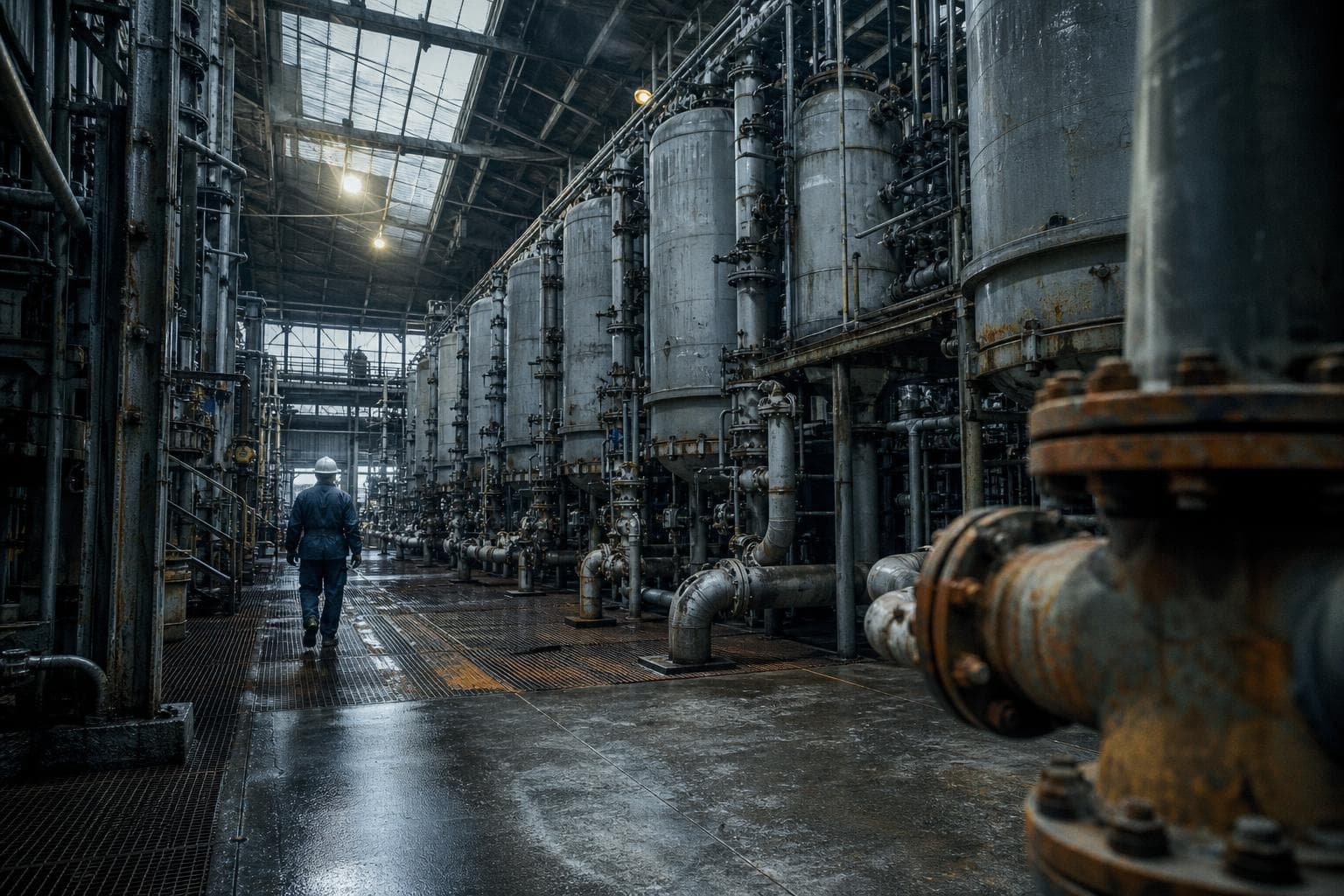

Everyone's been watching the mining side of the rare earth story — who has deposits, who's permitting new projects, which country just announced a strategic reserve. That's the wrong place to look. The constraint that actually matters to procurement managers and defense contractors isn't in the ground. It's in the separation plant.
Here's the operational reality: mining rare earth ore is, relatively speaking, the easy part. Turning that ore into purified oxides — the terbium, dysprosium, and samarium that go into high-performance magnets — requires hundreds of chemical separation stages using industrial acids, specialized equipment, and process knowledge that took China decades to accumulate. That's not a gap you close with a press release and a Pentagon contract.
Thirty Years of Atrophy, Now Visible
Last week, the Wall Street Journal reported (via UPI) that Lynas Rare Earths has begun producing purified heavy rare earth oxides at its plant in Kuantan, Malaysia — the first time heavy rare earths have been separated outside China in 30 years. The Pentagon backed this with a preliminary $96 million agreement to purchase materials, and Lynas recently achieved commercial production of samarium oxide, a heat-resistant magnet material used in advanced weapons systems.
That's genuinely significant. But read the operational fine print: for more than a decade, Lynas processed only light rare earths at Kuantan while shipping heavy rare earth materials to China for separation. The company built half the supply chain and outsourced the hard half. What's new now is that the hard half is finally being attempted outside Chinese facilities — not that it's been solved.
Experts quoted in the reporting are appropriately cautious: this effort remains early-stage and could take years to reach full-scale production. "Years" is doing a lot of work in that sentence.
The Processing Gap Is Structural, Not Political
A CSIS brief published April 27 puts the broader context in sharper relief: China's April 2025 export restrictions on heavy rare earths and permanent magnets triggered rapid disruptions across allied defense and industrial supply chains. The response from Washington has been aggressive — billions in financing across multiple agencies, price floor mechanisms, and accelerated permitting. The Trump administration has characterized it as the boldest domestic industrial policy in modern history.
That may be true. It still doesn't change the physics of chemical separation.
The PIIE framing is useful here: the debate has long been about who has the ore, but that framing is increasingly obsolete. The real chokepoint is processing infrastructure — the capacity to transform raw material into something a magnet manufacturer can actually use. Brazil has enormous critical mineral deposits and almost none of the downstream infrastructure. Australia has Lynas. The United States has ambitions and a 2027 deadline to eliminate Chinese materials from defense supply chains that, based on current production timelines, looks optimistic.
What Procurement Teams Should Actually Track
The samarium oxide milestone matters — samarium has historically been refined almost exclusively in China, and its export restrictions last year directly disrupted defense suppliers. Commercial production outside China is a real data point, not just an announcement.
But the leading indicator to watch isn't which new separation facility breaks ground. It's yield rates and throughput at the facilities already operating. Lynas's Kuantan plant is the only scaled non-Chinese heavy rare earth processor in existence. Its operational capacity — not its announced capacity — is the actual ceiling for Western defense and EV supply chains right now.
The U.S. Geological Survey has flagged samarium as among the minerals most at risk of supply disruption, warning that shortages could cost U.S. industries billions. That warning was issued before the export restrictions tightened. The gap between "we have a facility" and "we have reliable throughput at commercial scale" is where supply chain risk actually lives — and it's the number nobody is publishing yet.
Watch for Lynas's next production volume disclosures. That's the data point that will tell you whether the 2027 deadline is a plan or a wish.
Signals
- Trans-Pacific contract negotiations are being complicated by fuel surcharge disputes, per Journal of Commerce — another variable for procurement teams trying to lock in rates before summer peak season.
- Truckload rates are set to accelerate, with Knight-Swift signaling more aggressive hikes ahead, per Journal of Commerce — relevant context for anyone modeling domestic distribution costs in H2.
- Lynas samarium oxide reaching commercial production is the rare earth signal worth logging — not as a solved problem, but as a baseline to measure actual scale-up against.


