


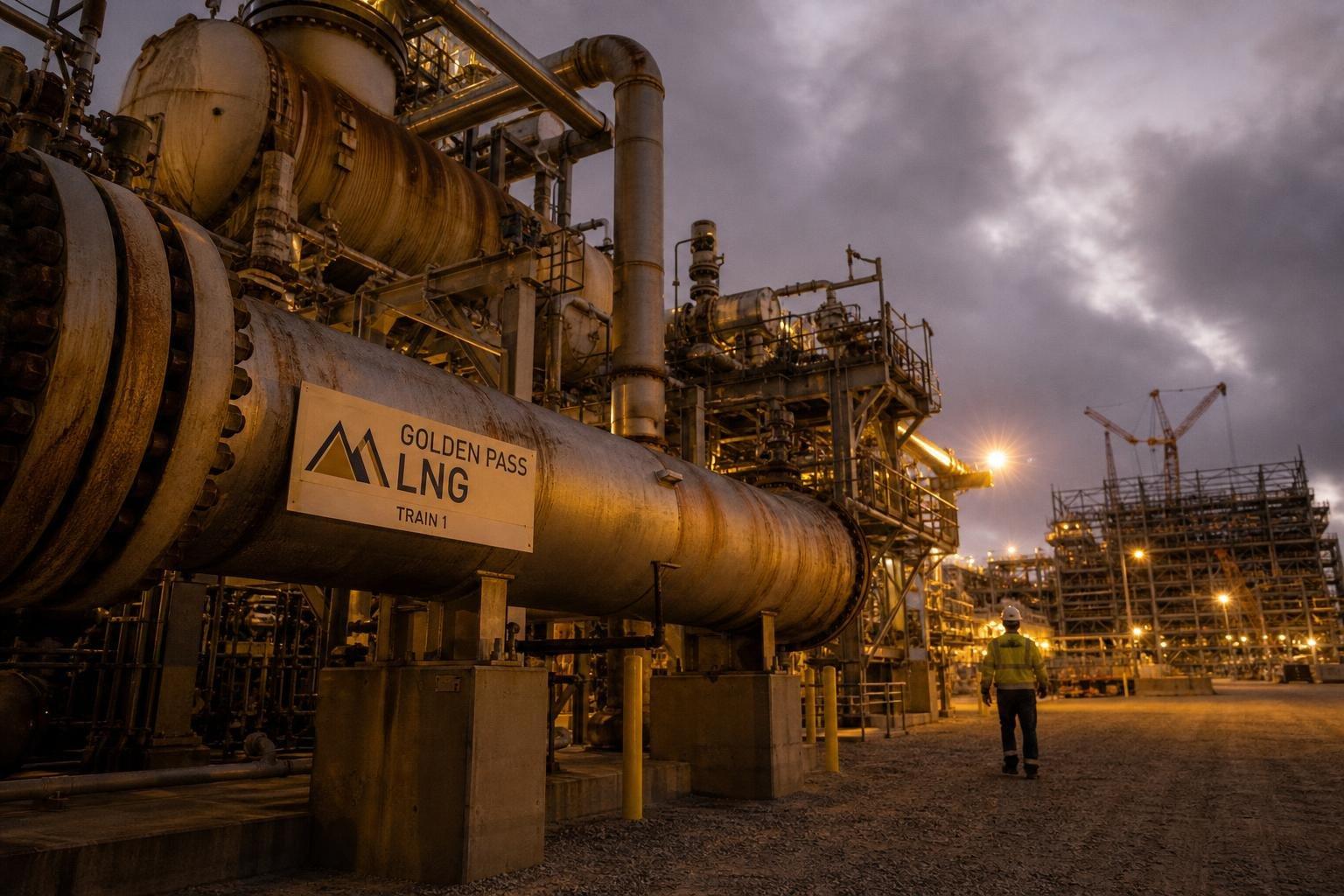

Golden Pass has three liquefaction trains. In April, exactly one of them was producing gas that made it onto a ship. That cargo — loaded onto the carrier Al Qaiyyah after Train 1 reached first production in late March — was the first proof that gas could travel the entire chain from a single operating train to a loaded vessel rather than just circulating in commissioning loops. Trains 2 and 3 were still under construction. That's the gap procurement teams need to internalize before they treat "Gulf Coast LNG capacity surge" as a settled fact: announced nameplate and actual loaded cargo are two different numbers, and right now the distance between them is wide.
Nine Terminals, One Number That Doesn't Match the Headline
PetroEyes' read of EIA data puts US liquefaction capacity in commercial operation or commissioning at 20.2 Bcf/d across nine terminals, with another 17.6 Bcf/d listed under construction for start dates running from the second half of 2026 out to 2031. Actual exports from January through July 2026 averaged 17.4 Bcf/d — up from 15.1 Bcf/d in 2025, but still well short of the listed peak. The mature terminals ran hot, hitting 97% to 127% of their individual nameplate rates in their best months, which tells you the six-plus-year-old plants (Sabine Pass, Cameron, Freeport, Calcasieu Pass) are already squeezed about as hard as physics allows. The slack isn't there. It's sitting in the newest capacity that hasn't finished ramping — Plaquemines still commissioning at an estimated 3.85 Bcf/d peak, and Golden Pass listed at 0.80 Bcf/d peak for a single commissioning unit that shipped zero cargo in 2025.
That's an outbound story, not an inbound one. Every Bcf/d of Gulf Coast LNG is gas leaving the US system for a tanker, and the bottleneck isn't dock congestion or berth availability — it's upstream of the dock, in how many trains are actually finished and pressure-tested, not how many are listed in a spreadsheet.
Why the Timing Makes This More Than a Commissioning Footnote
Normally a slow ramp at one new US terminal would be a story for LNG traders and nobody else. What makes it matter to a broader audience right now is what's happening on the supply side globally. ETI's October monthly outlook shows Qatari exports down 4.42 million tonnes year-over-year — a 66% drop — concentrated almost entirely in Qatar-to-Asia loadings, which fell 70%. US shipments to Asia grew 1.07 Mt over the same stretch, and Western African flows picked up another 0.53 Mt, which is the market's way of saying Atlantic Basin supply is doing real work covering for a Middle East outage. Lloyd's List frames this as a Hormuz-crisis reshaping of LNG trade with no clean resolution in sight, and its companion data piece notes African LNG exports hit their highest level since 2023 in March, up 17% year-on-year, as other Atlantic-facing suppliers absorb displaced demand alongside the US.
So the backdrop isn't idle. Global buyers are leaning harder on US cargoes at exactly the moment the newest US capacity — Plaquemines, Golden Pass — is still finding its footing. ETI also flags that Ras Laffan accounts for roughly 95% of the reported Qatari outage impact, and that a gradual production ramp-up there should eventually bring realized supply losses in below the headline outage figure. If and when that ramp happens, some of the trade dislocation reverses. Until then, every month that Golden Pass runs one train instead of three is a month the Atlantic Basin is carrying more of the load than its finished capacity comfortably supports.
What to Watch, Not What to Assume
Don't take "Golden Pass is online" as shorthand for "Golden Pass is at capacity" — those are different claims, and the EIA's own commissioning classification makes clear which one is still true. The things worth tracking over the next several months: whether Trains 2 and 3 at Golden Pass start producing loadable cargo, whether Plaquemines' commissioning units close the gap between their 3.85 Bcf/d listed peak and actual shipped volume, and whether Ras Laffan's ramp-up starts pulling Asian demand back toward the Middle East route rather than the Atlantic one. Any of those shifts would matter more to tanker positioning and freight rates than another press release about nameplate capacity.