


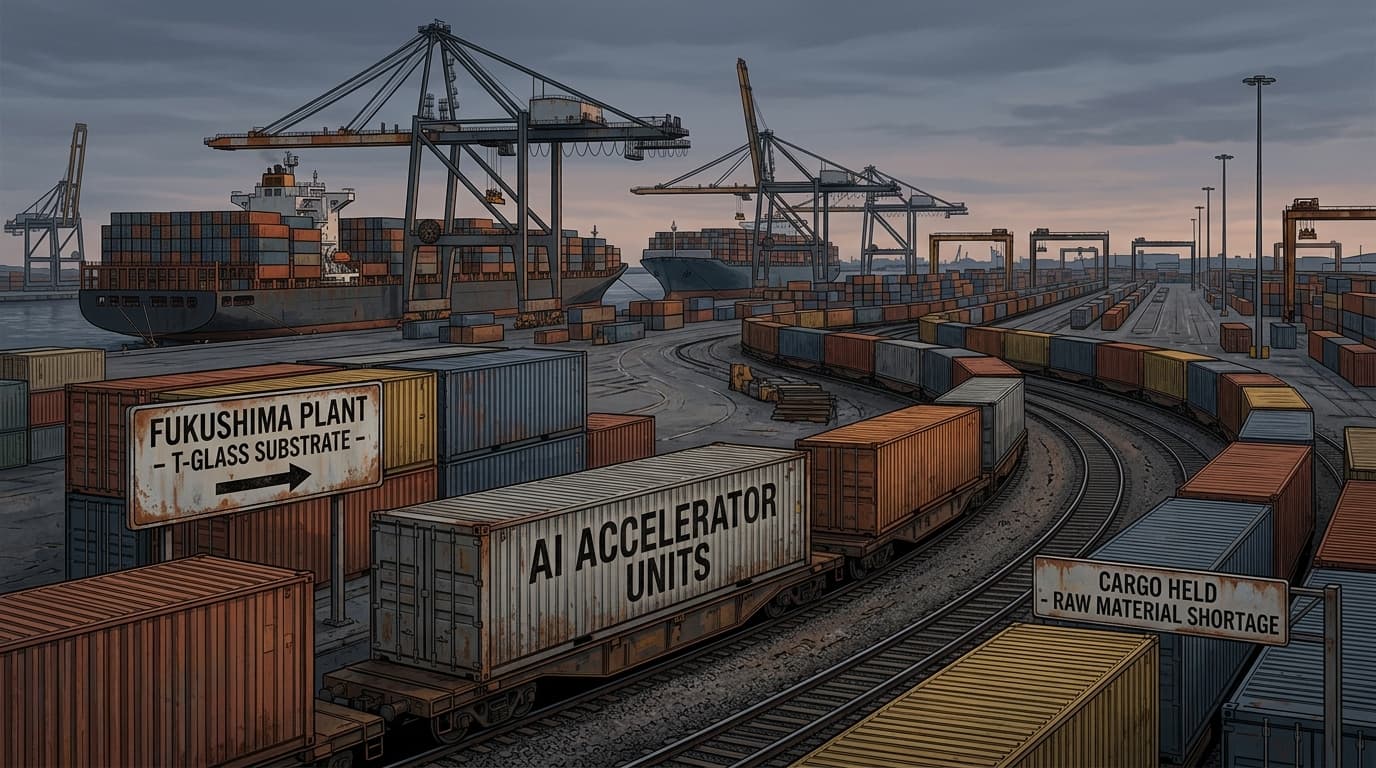

A semiconductor fab completing a wafer is roughly equivalent to a restaurant finishing a meal and then discovering the plates don't exist. The chip is real. The demand is real. The path to the customer is not.
That's the operational reality quietly tightening around AI accelerator supply chains right now — and it's coming from two directions simultaneously.
The Material Nobody Talks About
The first constraint is a substrate problem. Advanced chip packaging for AI accelerators depends on T-glass fiber — a specialized material used in the buildup film layers that connect high-bandwidth memory to logic dies in packages like NVIDIA's CoWoS configurations. There is essentially one meaningful supplier: Nittobo, whose primary production runs through a plant in Fukushima, Japan.
Tom's Hardware reports that Nittobo is tripling capacity at that facility — but the expansion won't reach market until 2027 at the earliest. That's not a rounding error. That's a two-year gap between current demand and available supply, during which every AI accelerator roadmap runs through a single plant in a single prefecture.
The pattern here is familiar to anyone who tracked the TSMC N3 ramp or the CoWoS capacity crunch of 2023: the constraint is never the headline process node. It's always one layer upstream, in a material or step that nobody thought to model as a bottleneck until it was.
The Gas Problem Nobody Expected
The second constraint is stranger. The New York Times reported that the war in Iran has knocked roughly a third of global helium supply offline. Helium isn't optional in semiconductor manufacturing — it's used in ion implantation, wafer cooling, and fiber optic production, among other steps. Gas companies are scrambling to reassure chipmakers, but reassurance and supply are different things.
This is the kind of input disruption that doesn't show up in shipping data or earnings guidance until it's already causing yield problems. Helium is consumed in the fab, before a chip ever reaches packaging. A shortage here doesn't delay shipments — it reduces the number of functional chips available to ship in the first place.
The Iran conflict is already pushing Asia-US ocean container rates up 29% via Hormuz routing disruptions, per FreightWaves. That's the visible cost. The helium constraint is the invisible one — and invisible constraints are the ones that blindside procurement teams.
Where the Pressure Actually Lands
Stack these two problems and you get a specific operational picture: AI accelerator supply is constrained upstream (helium, fab inputs), constrained midstream (T-glass, packaging capacity), and now shipping into a rate environment that's deteriorating on the primary Asia-to-US corridor. Each layer adds cost and lead time. None of them show up cleanly in a single metric.
The T-glass shortage is the one to watch most closely for procurement teams with 2026 and 2027 AI infrastructure commitments. Nittobo's capacity expansion timeline means the constraint doesn't resolve on its own before most current procurement cycles close. The question worth asking your suppliers now: what's their T-glass allocation, and who else is drawing from the same pool?
Watch for any Q2 guidance from TSMC or ASE Technology on advanced packaging yields and lead times — that's where T-glass tightness will surface first in public data.
Signals
- Asia-US container rates +29% on Hormuz disruption routing; watch whether this holds into Q2 contract season or softens as shippers reroute (FreightWaves)
- ~3 million TEUs currently tied up in port congestion globally, per DHL Global Forwarding — vessel capacity is not the binding constraint (The Loadstar)
- Helium: one-third of global supply offline; monitor Air Liquide and Linde allocation announcements for any formal force majeure language directed at semiconductor customers
This week's action item: If your supply chain touches advanced AI packaging — either as a buyer of accelerators or a supplier into that stack — map your T-glass exposure now. The Nittobo timeline is public. The allocation decisions are not.