


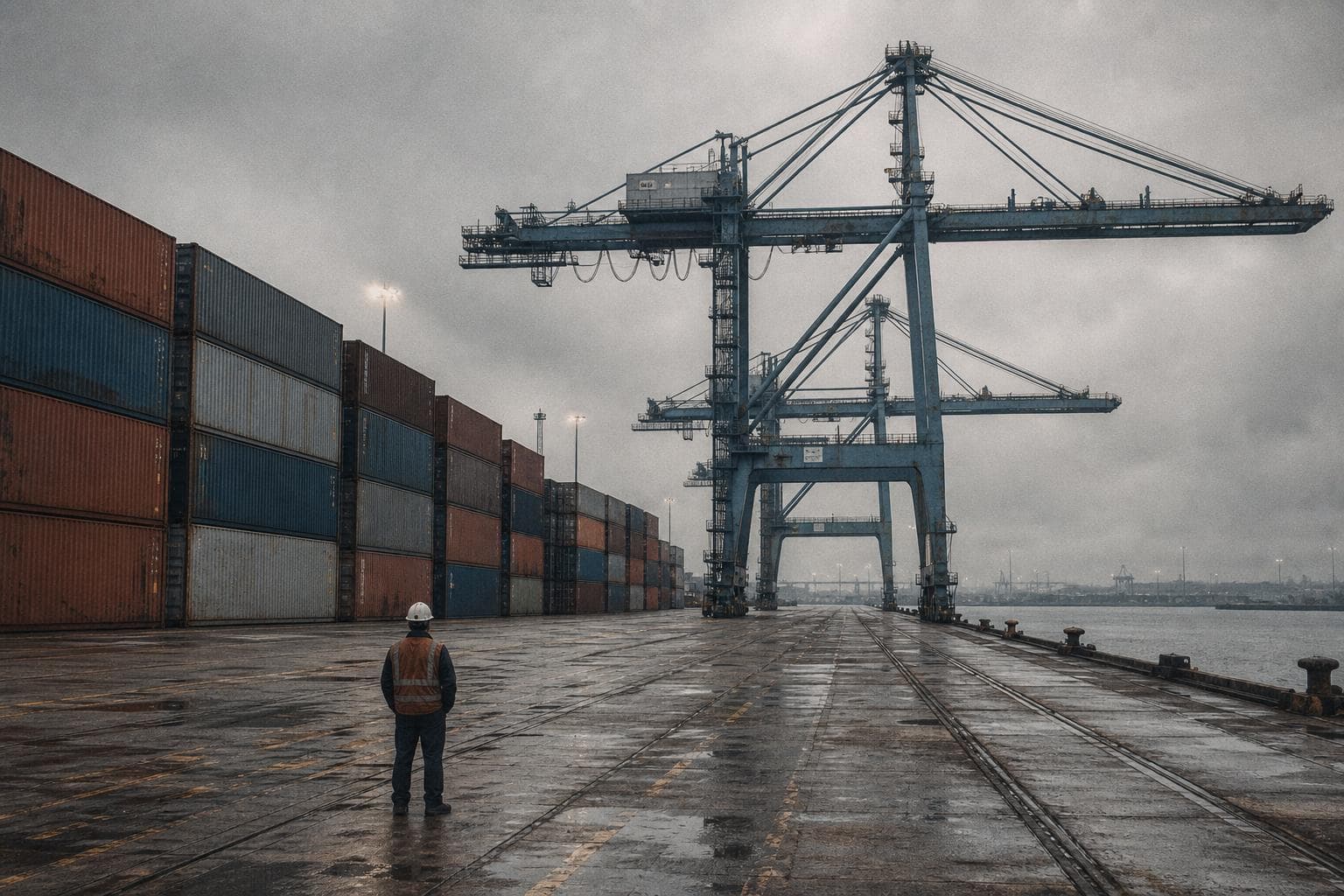

The container shipping industry is very good at modeling capacity. It is considerably less good at modeling what happens when the people who move that capacity decide to stop.
With Q3 forecasts circulating across procurement and operations teams right now, there's a notable gap in most of them: US port labor. The ILA-USMX master contract, covering East and Gulf Coast longshoremen, remains a live negotiation on automation language — the issue that blew up the January 2025 agreement and has never been cleanly resolved. That unfinished business sits directly in the path of Q3 planning.
The Forecast Models Are Optimistic. The Operational Reality Is Not.
Here's the structural problem: Q3 is already the most congested quarter on the calendar. Retailers are moving peak-season inventory, back-to-school goods are flowing, and importers who pulled forward shipments to beat tariff escalations earlier this year are still working through the downstream effects on warehouse and port dwell.
Layer on top of that the current ocean carrier order book. According to the Journal of Commerce, the carrier order book is approaching 40% of the in-service fleet — a supply overhang that has been suppressing spot rates even as demand signals remain mixed. That capacity will need somewhere to go. East and Gulf Coast ports are the primary destination for a significant share of Asia-origin container volume. If labor uncertainty causes shippers to hedge westward — routing more cargo through West Coast ports — you get congestion redistribution, not congestion relief.
The pattern here is familiar. In the weeks before any credible labor disruption risk, beneficial cargo owners (BCOs) and NVOs start making routing decisions that themselves create the bottleneck. The disruption doesn't have to happen for the operational damage to be real.
Port Houston Is Building for a Future That Requires Labor Stability
American Shipper reported that Port Houston secured a $48 million federal grant to expand the Bayport Container Terminal — specifically targeting capacity and truck flow. That's a meaningful infrastructure investment, and it signals where Gulf Coast port strategy is heading. But infrastructure grants take years to translate into operational throughput. The Bayport expansion doesn't help a Q3 that starts in six weeks.
What it does illustrate is the longer-term bet port authorities are making: that Gulf Coast volume will grow, that automation investment will follow, and that the labor framework governing all of it needs to be settled. The automation question isn't abstract for port authorities writing capital plans. It's the central variable in every expansion ROI model they're running.
What Q3 Forecasts Should Actually Say
I'd argue that any Q3 container throughput forecast for East and Gulf Coast ports that doesn't carry a labor-uncertainty discount is not a forecast — it's a wish. The honest version looks something like this:
Base case: Negotiations remain unresolved but no work action occurs. Throughput tracks roughly with demand, with moderate congestion at major East Coast hubs as peak-season volume builds. Dwell times creep up as BCOs hedge with extra buffer inventory.
Stress case: A work slowdown or selective action at major terminals — not necessarily a full strike, but the kind of deliberate friction that drops productivity 20-30% without triggering formal work-stoppage clauses. This is the scenario that doesn't show up in force majeure filings but absolutely shows up in vessel schedules and shipper costs.
Tail risk: A hard stoppage. Given the political and economic pressure on both sides, this is lower probability than it was in late 2024 — but it is not zero, and the consequences for Q3 would be severe enough that procurement teams with East Coast-heavy sourcing should have a West Coast contingency that is more than theoretical.
The Signal to Watch
The leading indicator here isn't a press release from either side. It's blank sailing announcements from carriers on Asia-East Coast strings in late June and early July. If carriers start pulling capacity from those lanes ahead of peak season — the opposite of what rational economics would suggest — that's the tell. They're pricing in disruption risk before it's public.
Watch the Journal of Commerce's drayage and port news coverage through June for any uptick in chassis repositioning away from East Coast terminals. That's the operational signal that shippers are already voting with their routing decisions.
The forecasts will get revised. The question is whether your Q3 plan gets revised before or after the constraint bites.