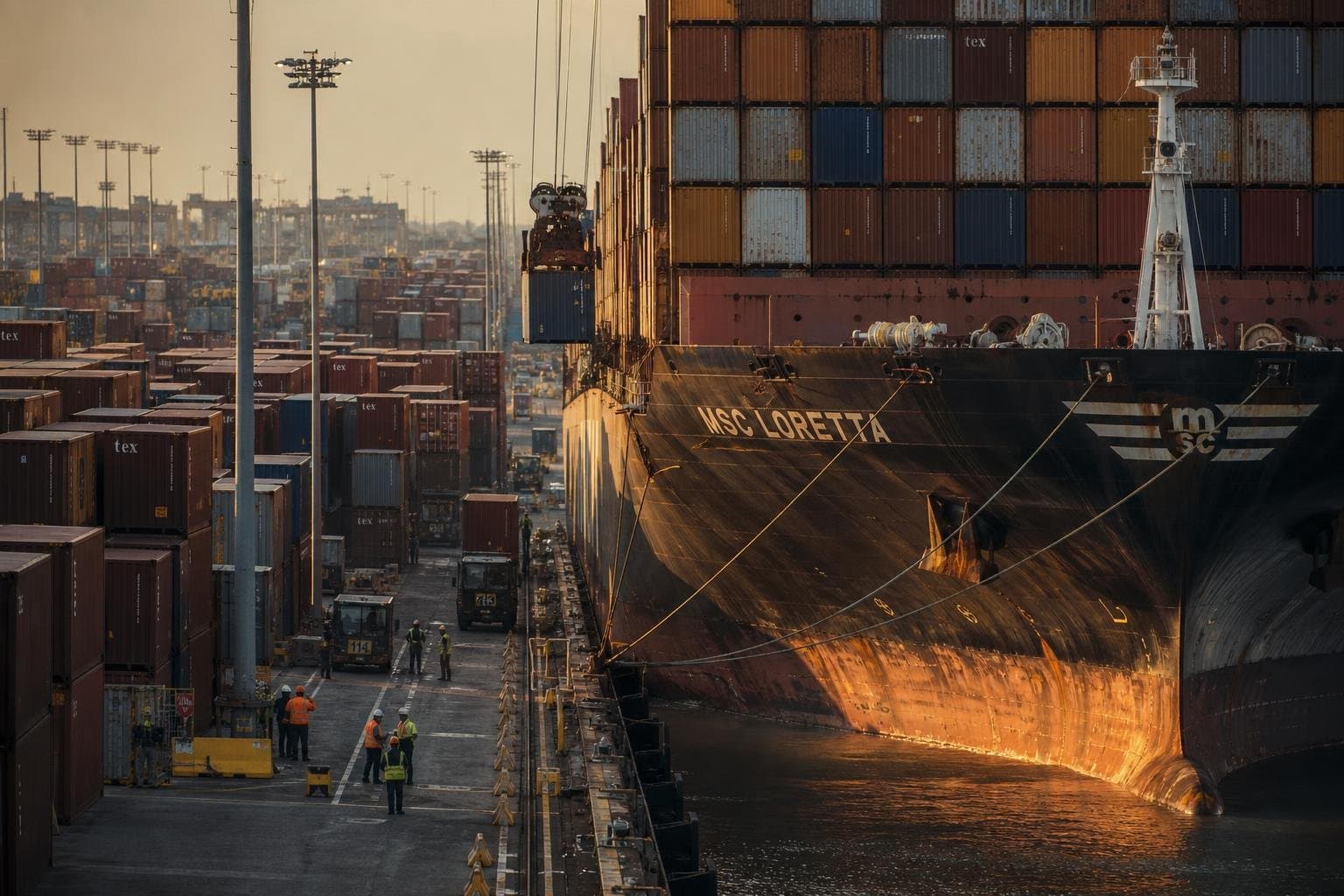

Global container shipping's on-time performance recorded its sharpest single-month decline since January 2021, according to American Shipper via FreightWaves. That's not a rounding error — January 2021 was peak pandemic chaos, the moment when every supply chain assumption broke simultaneously. Matching that drop now, in a period supposedly defined by post-pandemic operational maturity and billions in terminal investment, is worth sitting with.
The assigned topic — automation delays pushing labor negotiations as throughput targets slip — is directionally correct, but the sources available don't confirm specific negotiation timelines or named terminal projects. What they do confirm is the operational reality underneath that story: ports are slower than their announced capacity suggests, the gap between what terminals claim they can do and what they're actually doing is widening, and the cost of that gap is measurable.
The Throughput Gap Is Real, and It's Getting Harder to Hide
Marine Insight, citing UNCTAD's Review of Maritime Transport 2025 and the World Bank/S&P Global Container Port Performance Index 2025, puts numbers to what procurement managers already feel in their dwell time reports. Container ships averaged 0.8 days per port call in 2024 — but that average obscures the waiting time problem. Median anchorage wait climbed from 8.7 hours in 2023 to 13.4 hours in 2024. In the Mediterranean, average anchorage time hit roughly 10.5 hours in Q4 2025, up 33% year-over-year, driven partly by geopolitical instability rerouting traffic through already-congested chokepoints.
Dry bulk carriers sat at 2.7 days average port time. Tankers at 1.5 days. These aren't operational benchmarks being hit — they're symptoms of systems that can't clear vessels fast enough to meet the schedules carriers are selling.
The $6.9 billion figure in that same analysis represents the estimated annual cost of non-automated port operations globally. That number comes with caveats — it's a modeled estimate, not audited losses — but the directional logic is sound: when a bulk carrier waits 26 days for a berth at a South African terminal against an industry benchmark of 50 to 67 hours, someone is absorbing that cost. Usually it's the cargo owner, then the shipper, then eventually the consumer. The terminal operator's announced capacity looks fine on paper.
Trans-Pacific Rates Are Telling the Same Story From a Different Angle
American Shipper reported Wednesday that trans-Pacific spot rates hit record highs driven by strong early peak-season demand and port congestion. That pairing matters. Rate spikes driven purely by demand are one thing — they normalize as capacity responds. Rate spikes driven by congestion are stickier, because the constraint is physical, not commercial.
When port congestion is contributing to rate pressure on the trans-Pacific, it means the throughput problem is already showing up in inbound logistics costs for U.S. importers. The congestion isn't theoretical; it's being priced into freight contracts right now.
Meanwhile, the Journal of Commerce reported that German port unions launched warning strikes — a reminder that labor tension at major gateway ports doesn't need an automation dispute as a catalyst. It can arrive on its own schedule, and when it does, it compounds whatever throughput shortfall already exists. Germany's North Sea ports handle a significant share of European import distribution. Warning strikes are exactly the kind of leading indicator that doesn't show up in earnings calls until two quarters later.
What Automation Was Supposed to Solve — and Why the Gap Persists
The honest version of the automation story is this: the technology works, but the organizational readiness often doesn't. Lloyd's List's coverage of shipping's AI and digitalization challenges frames the problem precisely — the sector's biggest obstacle to operational improvement isn't the algorithms, it's fragmented data and incomplete digitalization. Terminals that can't share real-time information between their container, bulk, and breakbulk operations can't optimize across them. Automation installed on top of fragmented systems doesn't fix the coordination problem; it just automates the chaos.
This is the gap between announced capacity and operational capacity in its purest form. A terminal can announce a new automated stacking crane system and simultaneously post worse dwell times than the year before, because the crane is only one node in a system that still has manual chokepoints, mismatched scheduling rules, and information silos that prevent the whole from functioning as designed.
For procurement and operations teams, the practical implication is straightforward: don't plan inbound logistics around a terminal's announced throughput capacity. Plan around its demonstrated throughput over the past six to eight weeks, and build buffer for the anchorage wait that isn't showing up in the port's published statistics.
The next data point worth watching: whether the on-time performance decline reported for August reverses in September, or whether early peak-season congestion on the trans-Pacific locks in a second consecutive month of deterioration. If it does, the Q4 inventory positioning decisions being made right now are being made on assumptions that the operational data is already contradicting.


