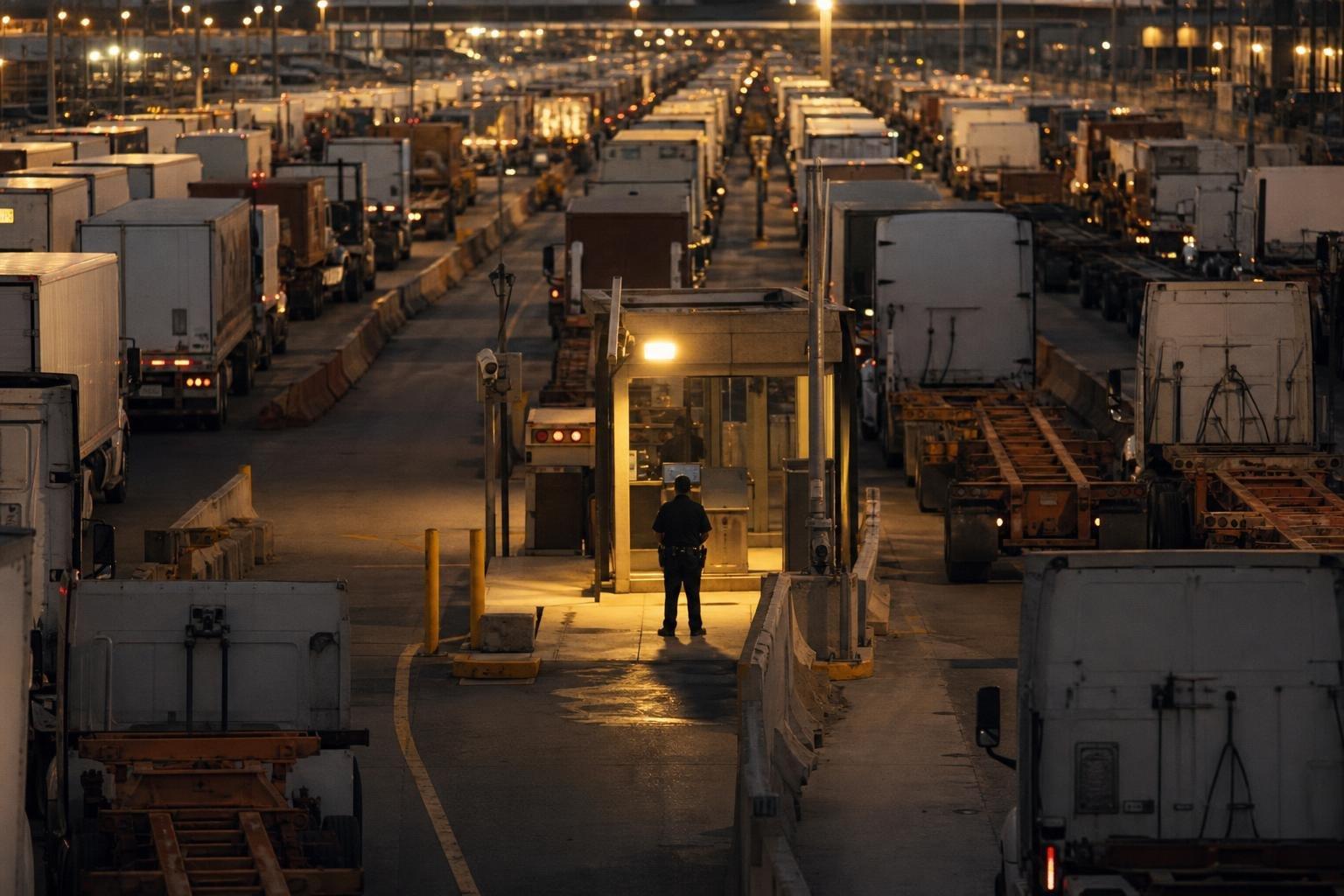

The assigned question was whether nearshoring volume is overwhelming Laredo's truck capacity. The data says something sharper: the corridor's capacity problem right now is regulatory, not volumetric, and it's hitting crossings well outside Laredo harder than Laredo itself.
Start with what actually happened in September. Between September 9 and 14, Mexico's customs agency ANAM restricted empty trucks from crossing into Mexico at Eagle Pass and Brownsville. Daily commercial crossings at those points dropped from roughly 1,000 to between 300 and 400, and about 700 tractor-trailers sat stranded on the U.S. side waiting it out (DataPortuaria). Some carriers rerouted through Laredo to keep equipment moving — which means Laredo's volume bump that week wasn't nearshoring demand showing up, it was displaced capacity from a different crossing's outage, adding miles and fuel burn for no additional freight delivered (DataPortuaria).
The Real Constraint Is a Visa Revocation, Not an Export Boom
The headline number worth sitting with: roughly 25,000 Mexican truck drivers lost eligibility when their B-1 visas were revoked, according to estimates cited by CANACAR and FreightWaves (DataPortuaria). That visa class covers specific cross-border transport activity but not cabotage — moving freight between two U.S. points — and CBP had to issue a clarification on how those rules apply (DataPortuaria). This is an inbound-capacity hit on the northbound truck pool, not a demand-side surge.
The downstream numbers from FreightWaves SONAR, presented by Julie Van de Kamp on October 13, show where the pain actually landed: load rejection rates hit 24–25% at El Paso in early July, 10% at San Diego/Otay Mesa, and just 7% at Laredo (DataPortuaria). Laredo, the busiest land port on the southern border, is actually the least stressed crossing on this measure right now. Spot rates tell the same story by corridor: San Diego–Phoenix up 57% year-over-year, Laredo–Dallas up 43%, El Paso–Dallas up 28% (DataPortuaria). FreightWaves expects the strain to persist well into 2027 (DataPortuaria).
Executives at logistics provider TRAFFIX put the structural piece in plain terms: tighter financing and tighter driver regulation together are blocking the kind of capacity expansion that followed the pandemic-era freight surge. "We're only four or five years later and we're not seeing that," said Alex Fuller, the company's vice president of commercial intelligence, in an interview with FreightWaves (via Yahoo Finance). He pointed to financing costs now running 8% to 9% as the reason new owner-operators aren't entering the market the way they did when stimulus money and cheap loans were available (Yahoo Finance).
The Nearshoring Signal Is Real — It's Just Not the Thing Straining Laredo
There is a genuine compositional shift in what's crossing north. As of C.H. Robinson's March 2026 update, non-automotive manufacturing exports — computers, electronics, machinery, industrial equipment — were up 17.8% year-over-year in January and had grown to nearly a third of total Mexican exports, with special-purpose industrial machinery surging 65.8% (C.H. Robinson). That growth concentrated in central and northern Mexico's electronics corridors. Automotive freight was moving the opposite direction, with heavy-vehicle exports down 53.8% year-over-year in January to the lowest level since the pandemic (C.H. Robinson). So the nearshoring story is real as a trade-composition shift, but it predates and sits separately from the driver-capacity shock hitting the border now.
What nearshoring does contribute is baseline volume that makes any capacity loss more expensive to absorb. Trucks crossed into the U.S. through Laredo 258,700 times in August 2026 alone, against roughly $588.5 billion in U.S.-Mexico goods trade over the first seven months of the year (Airio Bravo). With 5,214 IMMEX plants and more than 2.8 million workers tied to material crossing in both directions, there's no slack to hide a bad week in (Airio Bravo). And the cost of running a truck keeps climbing regardless of which crossing is congested — ATRI's July 2026 benchmark put average 2025 per-mile operating cost at a record $2.336 (Airio Bravo).
The thing to track isn't a Laredo bottleneck forming from export growth. It's whether CBP's cabotage clarification and any resolution on the B-1 revocations restore the driver pool before 2027, because every lane currently absorbing displaced capacity — Laredo included — is doing so at someone else's expense in miles, fuel, and dwell.


