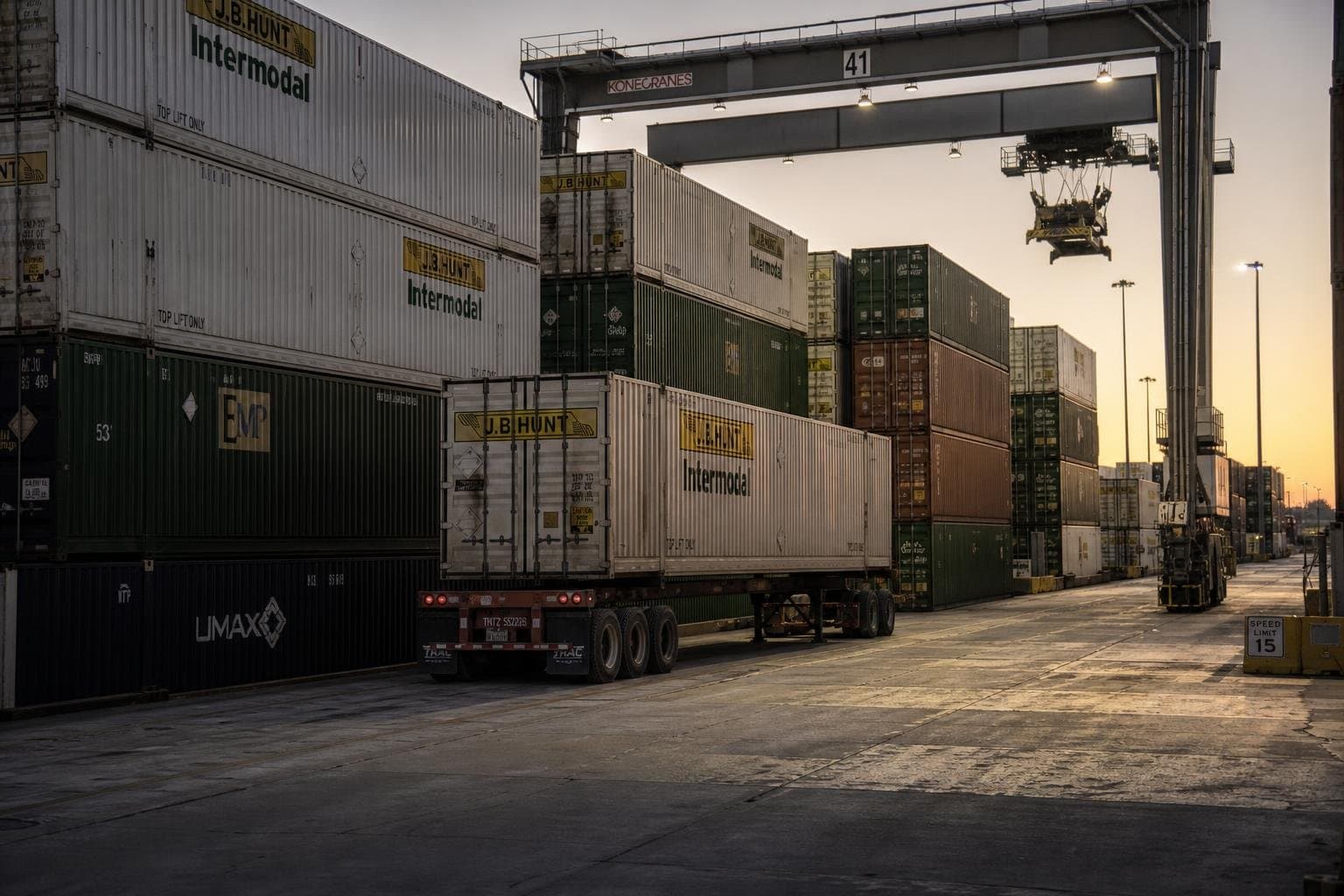

The headline from CSX's Q2 earnings was straightforward: carload and intermodal volumes both beat analyst estimates. That's the press release version. The operational version is more interesting — and more uncomfortable for anyone trying to book capacity into Q4.
Rail is absorbing freight that would normally move by truck. That's not a new story, but the scale of the underlying trade volumes driving it is. North American transborder freight hit $153.4 billion in May 2026, up 16.1% year-over-year, with rail freight specifically up 11.1% to $17.7 billion compared to $16.0 billion in May 2025. Truck freight led in absolute value at $99.7 billion, but rail's growth rate is the tell: freight is moving toward rail, not just growing uniformly across modes.
When I wrote about the rail surge in late June, the argument was that intermodal's capacity cushion wouldn't survive a sustained volume increase. The CSX earnings data and the BTS transborder numbers together suggest that sustained increase is now here. The question worth asking: where does the system actually bind?
The Volume Is Real. The Routing Pressure Is Structural.
The BTS transborder data breaks down in ways that matter for understanding where rail capacity is being absorbed. U.S.-Mexico rail freight reached $9.1 billion in May 2026, compared to $8.6 billion on the U.S.-Canada corridor. That's a meaningful split — the southern corridors, running through Laredo and El Paso into the interior, are carrying a disproportionate share of the growth.
This matters because the U.S.-Mexico rail network has historically been the tighter system. The Class I railroads serving that corridor — BNSF and Union Pacific on the U.S. side, Ferromex and KCSM on the Mexican side — have less redundancy than the northern routes. When volume spikes, the southern intermodal lanes feel it faster.
Meanwhile, the Journal of Commerce reports that Union Pacific sees a "win-win" in the CN-Norfolk Southern merger scenario, specifically because UP could provide faster Chicago transits if the deal proceeds. That framing is telling: even the railroads are signaling that Chicago — the central switching hub for virtually every east-west intermodal move — is already a friction point worth routing around. You don't propose bypass solutions unless the current path is congested.
Truck Rates Are Rising Into the Same Window
The modal shift toward rail doesn't happen in a vacuum. It's being accelerated by what's happening on the truck side. The Journal of Commerce's rate indicator projects U.S. spot and contract truckload rates rising through 2027, with the market entering what carriers are calling a "repricing cycle." When truck rates rise, intermodal's price advantage widens, and shippers who can tolerate the transit time premium move freight to rail.
The problem is that this dynamic is self-reinforcing in the short term and self-limiting in the medium term. More freight on rail tightens intermodal capacity, which pushes intermodal rates up, which narrows the spread against truck, which slows the modal shift — but not before the rail network has absorbed a volume surge it wasn't fully prepared for.
The FreightWaves intermodal data captures this in the headline: containers and trailers hauled by rail "powered ahead" while carload shipments were narrowly off. That divergence is significant. Carload is industrial freight — coal, grain, chemicals. Intermodal is the consumer and retail supply chain. When intermodal surges while carload softens, it means the consumer-facing supply chain is leaning harder on rail than the industrial economy is. That's a specific kind of capacity pressure, concentrated in the double-stack lanes and inland terminals that serve distribution centers, not bulk commodity yards.
What to Watch Before Q4 Bookings Lock In
The operational constraint that matters most right now isn't announced capacity — it's dwell time at inland intermodal terminals. When volume surges faster than terminal throughput, containers sit. That dwell converts a transit-time advantage into a transit-time liability, and shippers who moved to rail for cost reasons find themselves paying for speed they're not getting.
The CSX Q2 beat is real. The BTS volume numbers are real. But announced capacity and operational capacity are different things, and the gap between them shows up in dwell, not in earnings calls.
Three things worth tracking before Q4 commitments go out: Chicago terminal utilization rates through August, whether UP's intermodal pricing on the southern corridor moves before or after capacity tightens, and whether the CN-NS merger timeline accelerates given the routing pressure building in the Midwest. The merger case just got a new argument — congestion — and that tends to focus regulatory minds.
The freight is moving. The question is whether the infrastructure behind it moves fast enough to keep up.


