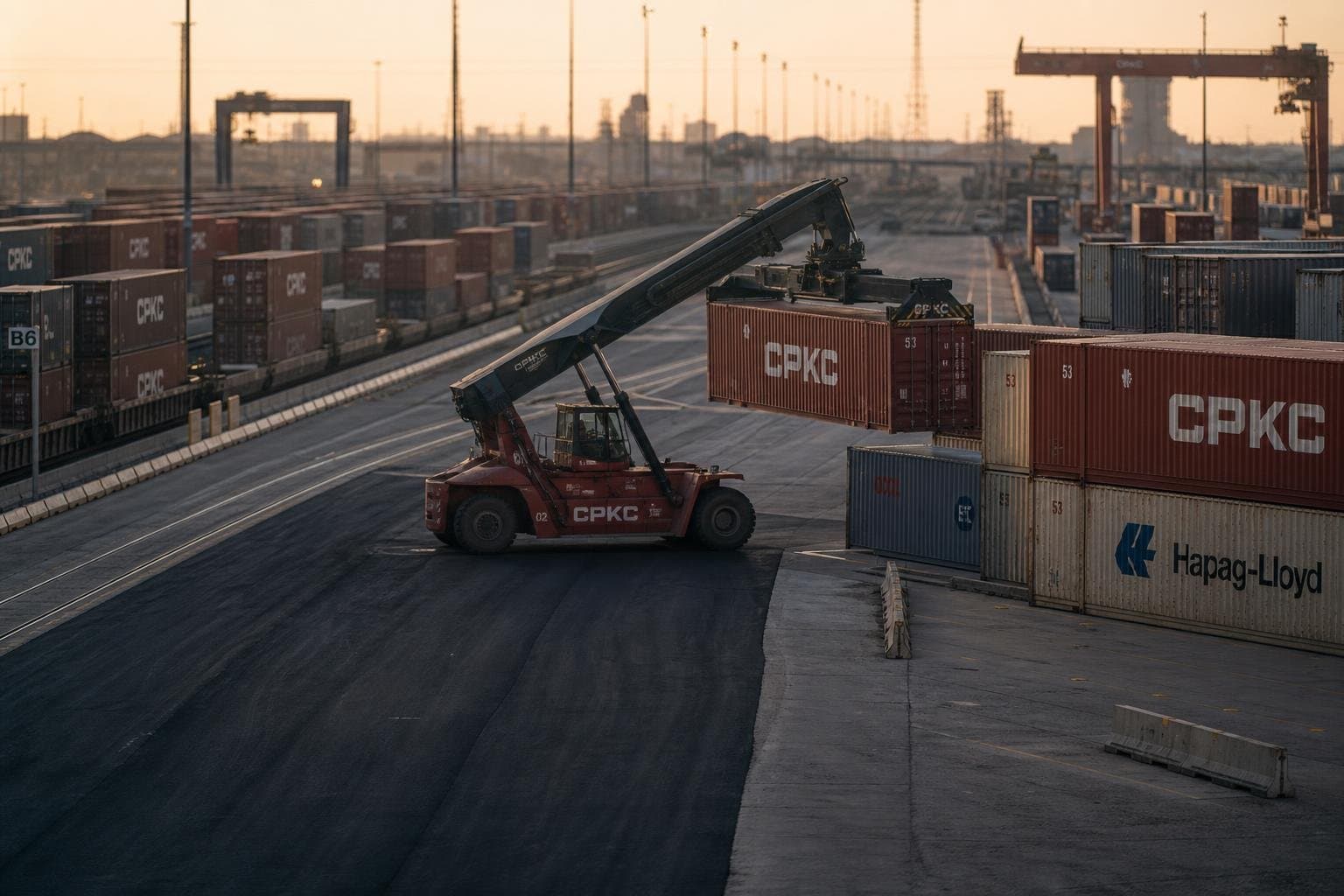

The intermodal dwell time problem usually hides in plain sight. Carriers talk about velocity metrics. Shippers complain about detention charges. And somewhere in the middle, a terminal goes down for what sounds like routine maintenance — paving work, of all things — and the ripple effects take weeks to fully clear.
That's what happened at CPKC's Bensenville intermodal facility outside Chicago, and according to the Journal of Commerce, operations there are now improving after paving-related delays disrupted throughput. The headline reads like good news. Read it as a systems analyst and it's a case study in how Class I carriers manage capacity — and who absorbs the cost when they do.
Chicago Is Still the Chokepoint That Doesn't Get Enough Credit
Bensenville sits at the center of CPKC's U.S. intermodal network. Chicago is where roughly a third of all U.S. rail freight touches a connection point, and Bensenville is one of the primary intermodal hubs feeding that interchange. When it runs well, it's invisible. When it doesn't, the backup propagates outward — into dwell times at origin terminals, into chassis availability at destination ports, into the truck queues that form when rail misses its window.
The JOC report doesn't quantify the dwell impact in specific days or TEU-equivalent figures, so I won't invent numbers. But the operational logic is straightforward: a paving project that restricts yard movement forces carriers to either slow inbound acceptance or stack containers in ways that degrade retrieval efficiency. Both outcomes extend dwell. Both push cost onto the shipper or the drayage operator waiting on the other end.
Worth noting: CPKC is a relatively new entity. The BTS freight indicators page notes that CPKC only began reporting unified data in May 2025, reflecting the April 2023 merger of Canadian Pacific and Kansas City Southern. That means we're still in the early phase of understanding how this combined network performs under stress — Bensenville being a useful early data point.
The Freight Car Utilization Trade-Off Nobody Announces
Here's the dynamic that the press release version of this story skips: when a major intermodal terminal experiences throughput constraints, Class I carriers don't just absorb the delay passively. They actively manage freight car utilization by adjusting acceptance windows, prioritizing higher-margin freight, and in some cases issuing embargoes on lower-priority lanes.
This is rational from a railroad's perspective. Freight car utilization is one of the core metrics Class I carriers optimize for — idle cars are expensive, and a constrained terminal creates exactly the conditions where cars pile up unproductively. The carrier's response is to throttle inbound volume until the terminal can process it. The shipper's experience of that decision is: my container isn't moving, and I'm not entirely sure why.
The Bensenville situation fits this pattern. The JOC report frames it as operations "improving" — which implies there was a period where they weren't. During that period, the freight car utilization math was being worked out somewhere upstream, and shippers on CPKC's Phoenix-to-Chicago or Mexico-to-Midwest corridors were likely seeing extended transit times without a clear explanation tied to "paving work at Bensenville."
BNSF's Phoenix Expansion Adds a Pressure Valve — With Limits
The timing is interesting. FreightWaves Forum flagged that BNSF recently expanded its intermodal rail option between Phoenix and North Texas, offering six days per week between those southwest hubs. That's a meaningful capacity addition on a lane that connects to Chicago-area distribution networks through a different routing.
The summary available is brief, so I won't overstate what BNSF's expansion covers. But the directional signal is clear: shippers with flexibility on routing have more options than they did six months ago. The constraint is that intermodal modal shifting requires lead time — you don't reroute a supply chain from CPKC to BNSF in a week, especially if your chassis pools, drayage contracts, and warehouse appointments are built around a specific terminal.
This is the gap between announced capacity and operational capacity that I keep coming back to. BNSF's six-days-per-week Phoenix service is real capacity. Whether your procurement team can access it given your current network commitments is a different question entirely.
What to Watch in the Next 30 Days
Bensenville recovering is good news for CPKC's network velocity. But the more useful signal will come from dwell time data at downstream terminals — particularly any Chicago-area intermodal ramps that received overflow during the disruption period. If dwell times at those facilities normalize in the next two to three weeks, the Bensenville constraint was genuinely contained. If they stay elevated, the backup ran deeper into the network than the "improving operations" framing suggests.
The BTS freight indicators dataset updates weekly and tracks rail performance metrics at the national level — not granular enough to isolate Bensenville specifically, but useful for spotting whether Class I intermodal velocity trends shift in August. That's the number worth pulling in your next procurement review, not the carrier's service advisory.
The paving is done. The question is whether the queue it created has actually cleared.


