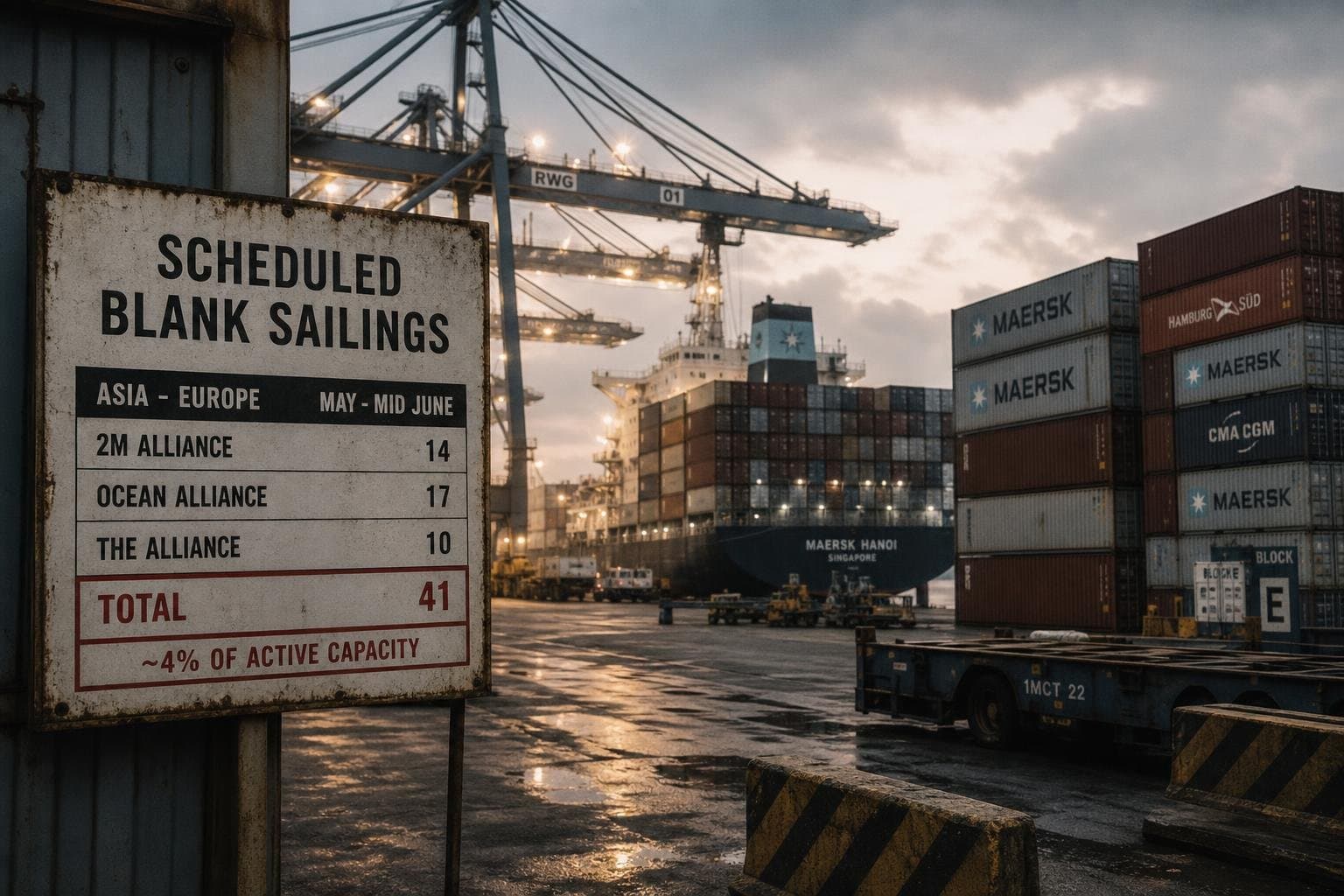

The assigned topic this week was blank sailings surging on Asia-Europe routes amid demand collapse. The operational data tells a different story — and it's worth getting right, because the difference between "demand collapse" and "capacity discipline" changes every procurement decision you'll make for Q3.
Carriers Aren't Canceling Sailings Because Demand Is Weak
Back in May, I wrote about blank sailings functioning as a rate-support mechanism when demand softened. The current Asia-Europe situation is a different animal. Alliance networks have scheduled between 30 and 41 blank sailings through mid-June, removing roughly 4% of active East-West capacity — but they're doing it into a market where spot rates are rising, not falling.
Far East–North Europe spot rates are up 44% from end-February levels, while Far East–Mediterranean rates have climbed 40% over the same period, per Sogese's June 10 Europe Container Market Update. Shanghai-to-Rotterdam rates surged 15% week-on-week to $2,773 per FEU, while Shanghai-to-Genoa jumped 20% to $3,701 per FEU in a single week in late May.
These are not the numbers of a route in demand collapse. They're the numbers of a route where carriers have learned to use blank sailings as a yield management tool rather than a distress signal. As Sogese CEO Andrea Monti put it: "carriers are positioning networks around profitability, resilience and equipment allocation rather than purely around efficiency." That's a structural shift in how alliance networks operate, and it matters more than any single week's sailing count.
The Real Pressure Is Coming From Outside the Route
The more interesting constraint on Asia-Europe isn't the blank sailings themselves — it's what's forcing the routing architecture that makes blank sailings necessary.
Continued Cape of Good Hope routing across most Asia-Europe services is absorbing vessel capacity that would otherwise be available for schedule density. Prolonged routing disruptions continue absorbing a meaningful portion of available capacity, preventing excess supply from translating into weaker pricing. Every vessel rerouted around Africa instead of through Suez is out of rotation longer — fewer available slots per week even if the total fleet size hasn't changed.
Layer on top of that the Strait of Hormuz situation. Xeneta's chief analyst Peter Sand noted that the wave of freight rate increases is being fueled by ongoing conflict in the Middle East and knock-on disruption at Southeast Asian ports, including congestion at Singapore and Port Klang as carriers adjust service networks. Sand added that "port disruption is toxic for supply chains, especially at transshipment hubs with global significance." A delayed feeder connection at Singapore doesn't just affect one shipment — it ripples through every subsequent booking on that string.
Understanding what blank sailings actually signal in this environment matters. As containers.news explains in its practical guide to canceled services, blank sailings function as a capacity management tool across multiple overlapping triggers — vessel redeployment, congestion, equipment imbalance, and schedule recovery — not simply a response to weak demand. The more useful question for planners isn't "were sailings canceled?" but "what does this change for booking windows over the next two to six weeks?"
The result is a market that is increasingly moving away from traditional seasonal expectations. June is historically a softer period for Europe-bound freight. Right now it isn't behaving like one.
July 1 Is the Date That Should Be on Your Calendar
The operational reality for shippers booking Asia-Europe cargo right now: announced capacity and operational capacity are diverging in ways that make the published schedule unreliable as a planning tool. When 30 to 41 blank sailings are scheduled through mid-June and booking windows are tightening, the gap between what a carrier's service map says and what actually departs is widening.
That gap gets more expensive on July 1. The Journal of Commerce has flagged huge rate increases facing Asia-Europe ocean shippers effective that date — which means any cargo that doesn't move before then is booking into a higher rate environment, not a softer one. The early peak season dynamic that's been visible on the Transpacific — rates to the U.S. West Coast up 108% over 14 weeks, with the Drewry World Container Index jumping 23% in a single week to $3,433 per 40-foot container — appears to be migrating to Asia-Europe trades with a lag.
For procurement teams, the practical implication is straightforward: if you're modeling Q3 inbound logistics costs for European distribution based on Q1 contract rates, those models are wrong. The question isn't whether rates will be higher — they will be. The question is whether your contracts have rate escalation clauses that reflect a market where carriers have


