


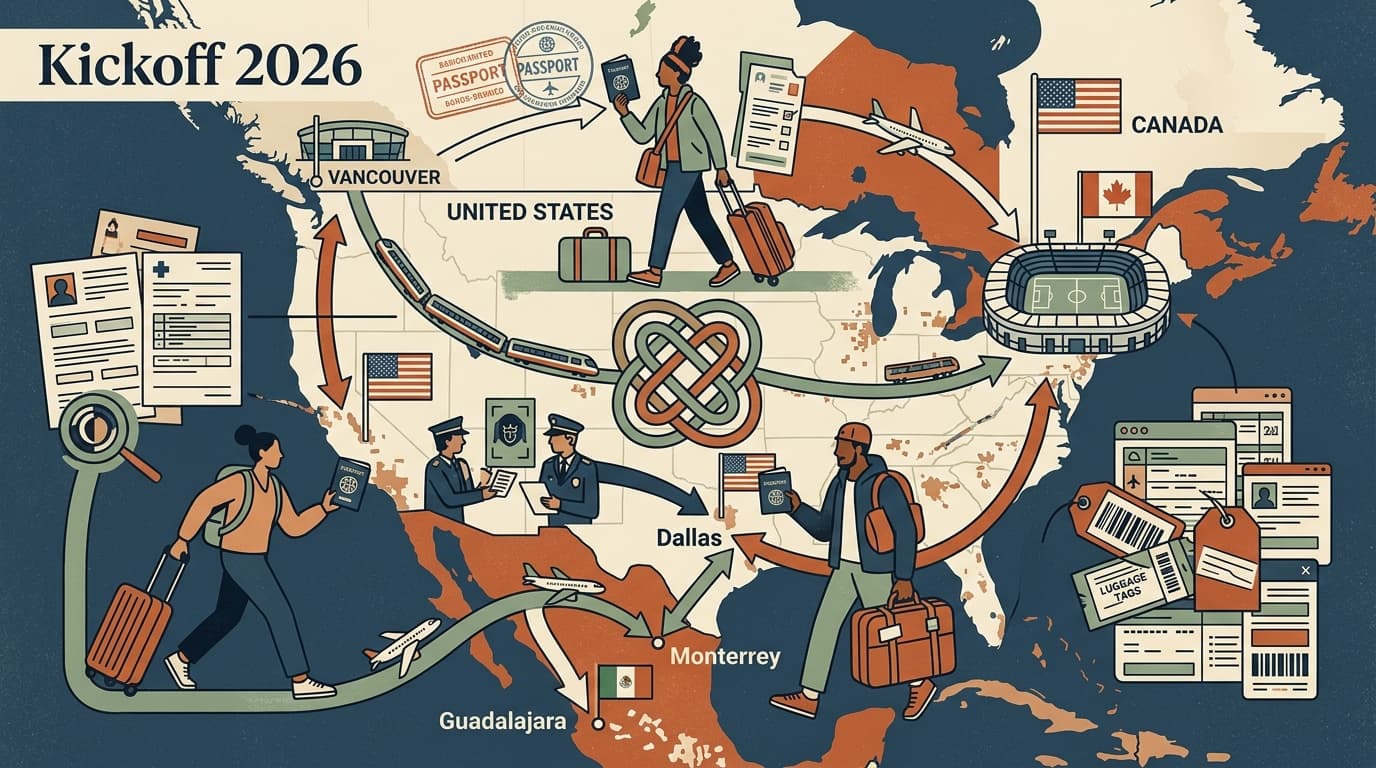

The 2026 World Cup spans a continent. Sixteen host cities across the United States, Canada, and Mexico — from Vancouver to Guadalajara, from Boston to Dallas — mean that a fan following their national team through the group stage could cross two international borders before the knockout rounds even begin.
That's not a feature. That's a stress test.
FIFA's confirmed host city list runs from Monterrey in the south to Toronto in the north — roughly 2,500 miles of tournament footprint. For context, every previous World Cup fit inside a single country. Even the sprawling 1994 edition, also hosted by the USA, didn't require fans or teams to clear customs between matches.
The visa situation alone is genuinely complicated. A supporter from, say, Nigeria traveling to see their team play in Mexico City, then Kansas City, then potentially Toronto needs three separate entry documents — a Mexican visa, a US visa, and a Canadian ETA. FIFA and the host federations have pushed for streamlined cross-border arrangements, but as of now, no unified tournament credential replaces standard immigration requirements. That's a real friction point for fans from countries that face tighter visa scrutiny, and it disproportionately affects supporters from Africa, Asia, and parts of Latin America.
Then there's the travel math. FIFA assigned Guadalajara and Monterrey as hosts for the intercontinental playoff tournament in March 2026 — a signal that Mexico's venues are ready and operational well ahead of the summer. But during the main event, a team drawn into a group with matches split between a Mexican city and a US city faces a cross-border travel schedule that no World Cup squad has ever had to manage. Jet lag isn't the issue; customs delays, equipment logistics, and security protocols are.
What co-hosting does give you, though, is atmosphere at a scale that's genuinely unprecedented. Sixteen cities means sixteen distinct soccer cultures activating simultaneously. The Mexican fanbase in Los Angeles turns SoFi Stadium into a de facto home game for El Tri. Toronto's multicultural density means almost any match there will have a legitimate home crowd for at least one side. Dallas, New York, Miami — these aren't neutral venues. They're diaspora epicenters.
The 1994 World Cup proved American stadiums could generate noise and passion that surprised even skeptics. In 2026, those same cities are demographically unrecognizable from thirty years ago. The soccer-specific infrastructure — supporter culture, local leagues, media coverage — has grown enormously. The atmosphere ceiling is higher than it's ever been on this continent.
The logistical complexity is real and shouldn't be waved away. But the payoff — a tournament that feels alive in three countries at once, drawing on three distinct soccer traditions — is the whole point of this experiment. Whether FIFA and the host nations have actually solved the cross-border mechanics will become clear fast once the group stage draw drops and travel routes get mapped.
⚽ Countdown Corner
48 teams. 16 cities. 3 countries. 104 matches. The 2026 World Cup will be the largest in the tournament's history — and the final is scheduled for MetLife Stadium in New Jersey, which holds over 82,000 and has no roof. Fingers crossed for a dry July 19th.