


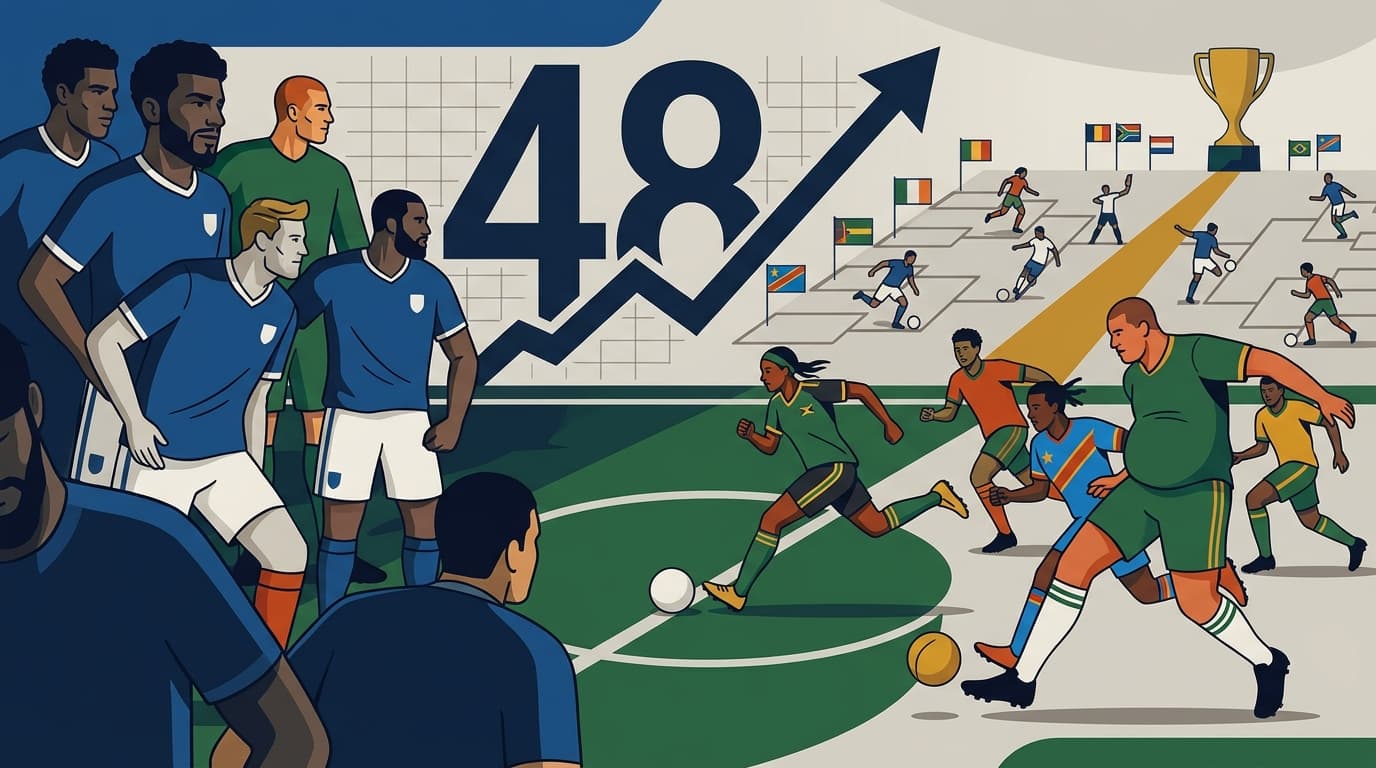

The 2026 World Cup's expansion to 48 teams doesn't just add bodies to the bracket — it reshapes the math of an upset. More teams means more group-stage games, more mismatches on paper, and more moments where a well-organized side with nothing to lose can ambush a heavyweight still finding its rhythm. The question isn't which small nations showed up. It's which ones showed up ready.
A few names keep surfacing in the serious preview conversation. RotoWire's group-by-group breakdown flags Jamaica's pace and set-piece threat as a genuinely disruptive combination — the kind of team that doesn't need to outplay you for 90 minutes, just hurt you twice on the counter. DR Congo gets mentioned in the same breath: physical, powerful, and increasingly coherent as a unit. These aren't romantic picks. They're teams with specific tactical profiles that create specific problems.
The broader pattern here — and I'd argue this is the real story of the expanded format — is that qualifying form is a better signal than reputation right now. A nation that ground through a brutal confederation gauntlet and arrived unbeaten in their final qualifying stretch is more dangerous than a mid-tier European side that sleepwalked through a soft group. The 48-team field rewards teams that peaked at the right moment, not teams that peaked in 2014.
What to watch as the draw approaches: which of these sides land in groups with one genuine giant and two beatable opponents. That's the bracket configuration that turns "interesting underdog" into "actual knockout-round threat." Jamaica or DR Congo in that spot? Circle the date.
Player Spotlight — A Name to Learn Before June
New Caledonia's playoff run is a story worth following — a Pacific island nation two wins away from the World Cup stage for the first time, still needing to beat Jamaica and then Congo in the inter-confederation playoffs to secure their place. RotoWire notes their underdog spirit as a genuine tactical identity, not just a narrative. Their players won't be household names yet. That's the point. If they clear the playoff hurdle, at least one of them will be by the end of the group stage.
Host City Note — 48 Teams Means 48 Sets of Fans
The expanded 48-team format doesn't just change the bracket — it floods the host cities with fanbases that have never traveled to a World Cup before. New nations mean new supporters, new flags in the stands, new street-level energy in Atlanta, Vancouver, and Mexico City. For a tournament that's already the largest in history, that cultural texture might be the most underrated storyline of the whole summer.
Countdown Corner
The 2026 tournament will feature 16 more nations than any previous World Cup. Sixteen countries whose fans have never watched their team play on this stage. That's not a footnote — that's an entire emotional subplot running parallel to every match. Someone's going to cry in the stands at Azteca for the first time. Probably a lot of someones.