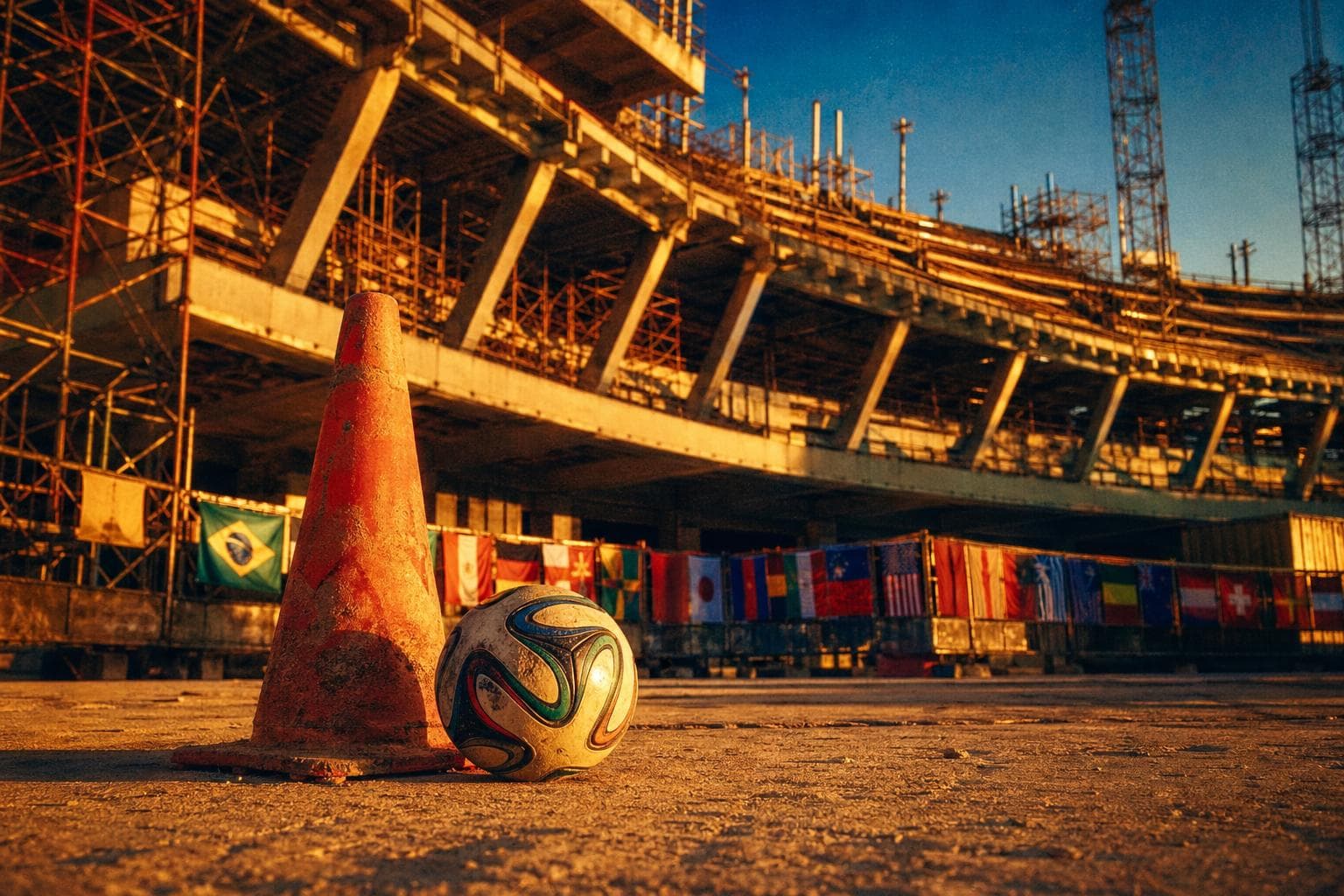

Day 44 until kickoff
Forty-four days. The stadiums are ready. The groups are set. And somewhere in the bowels of city hall offices across eleven American cities, someone is staring at a spreadsheet wondering whether the billions spent on infrastructure will still matter in August.
That's the question worth sitting with right now — not who wins Group C, but what this tournament actually leaves behind.
The Price Tag Is Real. The Legacy Is Murkier.
Combined public and private investment across the eleven U.S. host cities has approached $14 billion, covering stadium renovations, fan infrastructure, transportation upgrades, and security apparatus. That figure, from Altitudes Magazine's April reporting, is staggering — and it's still being tallied. No previous World Cup host nation has spent at this scale.
The honest answer to "will it last?" is: it depends enormously on which city you're asking about, and what kind of investment you're counting.
Stadium renovations are the trickiest category. Most of the U.S. venues are NFL stadiums that needed relatively modest soccer-specific upgrades — temporary seating configurations, pitch installations, broadcast infrastructure. Those changes largely revert after the tournament. The stadium itself remains, but it was already there. The World Cup didn't build it; it polished it.
Transportation and fan-zone infrastructure is where the legacy case gets more interesting. Cities that used World Cup deadlines to accelerate transit projects they already wanted — expanded rail connections, upgraded pedestrian corridors, improved signage and wayfinding — will keep those improvements long after the final whistle. The tournament functioned as a forcing mechanism: a hard external deadline that moved projects from "planned" to "built."
New York Is Trying to Make the Legacy Intentional
The most deliberate legacy-building effort I've seen documented is happening in New York. The NYC Council has introduced a package of legislation designed to ensure the tournament's economic benefits spread across all five boroughs rather than pooling around MetLife Stadium in New Jersey. The bills would create a cultural passport program encouraging visitors to explore the city beyond the obvious tourist corridors, mandate expanded public bathroom access (genuinely underrated civic infrastructure), establish anti-scam education for tourists, and — my personal favorite — co-name streets after soccer legends, including Thierry Henry Way in Manhattan and Pelé Way in Queens.
The economic projection attached to the New York metro's eight matches: $3.3 billion in expected economic impact. Speaker Julie Menin framed the legislation explicitly around equity — making sure the benefits "don't only stay in a few neighborhoods." That's the right instinct, and it's also the harder thing to execute. Cultural passport programs are only as good as their uptake.
The street co-namings, though? Those stay forever. Forty years from now, someone will walk past Pelé Way in Queens and have no idea why it's called that. That's legacy in its most durable, slightly absurd form.
The Tension Nobody Wants to Talk About
There's a counterargument worth acknowledging, and The Guardian laid it out bluntly last weekend: the original "United 2026" bid promised to "bring the game to all," and the reality has diverged sharply. A ticket to the World Cup final at MetLife Stadium can now cost nearly $11,000. FIFA instituted dynamic pricing. The $60 tickets it made available after fan backlash represent roughly 1.6% of a stadium's sellable capacity.
If the tournament's economic benefits flow primarily to FIFA, to hotel chains, to secondary ticket markets, and to the neighborhoods already well-positioned to capture tourist spending — then the infrastructure investments matter less than they appear. The roads get repaved, but the people who live on them can't afford to watch the games.
That tension doesn't negate the real infrastructure gains. But it does complicate the legacy story that host cities are eager to tell.
Player Spotlight: The Host Nation Pressure Is Real
The U.S. men's national team enters this tournament carrying a particular kind of weight — not just the usual host-nation expectations, but the symbolic burden of a country that spent $14 billion on the party and needs its own team to show up. I'd argue the pressure on Gregg Berhalter's successor (the USMNT coaching situation has been its own ongoing saga) is unlike anything an American soccer coach has faced. The infrastructure is built. The stage is set. Now someone has to perform on it.
Watch for the USMNT's final pre-tournament friendlies in late May and early June as the real temperature check on squad cohesion.
Host City Note: Los Angeles Is Juggling a Lot
Altitudes Magazine noted that Los Angeles is simultaneously preparing for the World Cup and the 2028 Summer Olympics — which means its infrastructure investments are doing double duty. That's actually the strongest legacy case of any host city: every dollar spent on transportation, fan infrastructure, and venue upgrades gets amortized across two of the world's biggest sporting events within three years. LA's $14 billion share isn't just for July. It's a down payment on 2028.
Countdown Corner
The 2026 World Cup will be the first to feature 48 teams — up from 32 in every tournament since 1998. That expansion means 12 groups of four teams, with the top two from each group plus the eight best third-place finishers advancing to the round of 32. It also means more matches, more cities, more infrastructure pressure — and, somewhere in the draw, at least one group that will produce a result nobody saw coming. That's the part I can't wait for.


