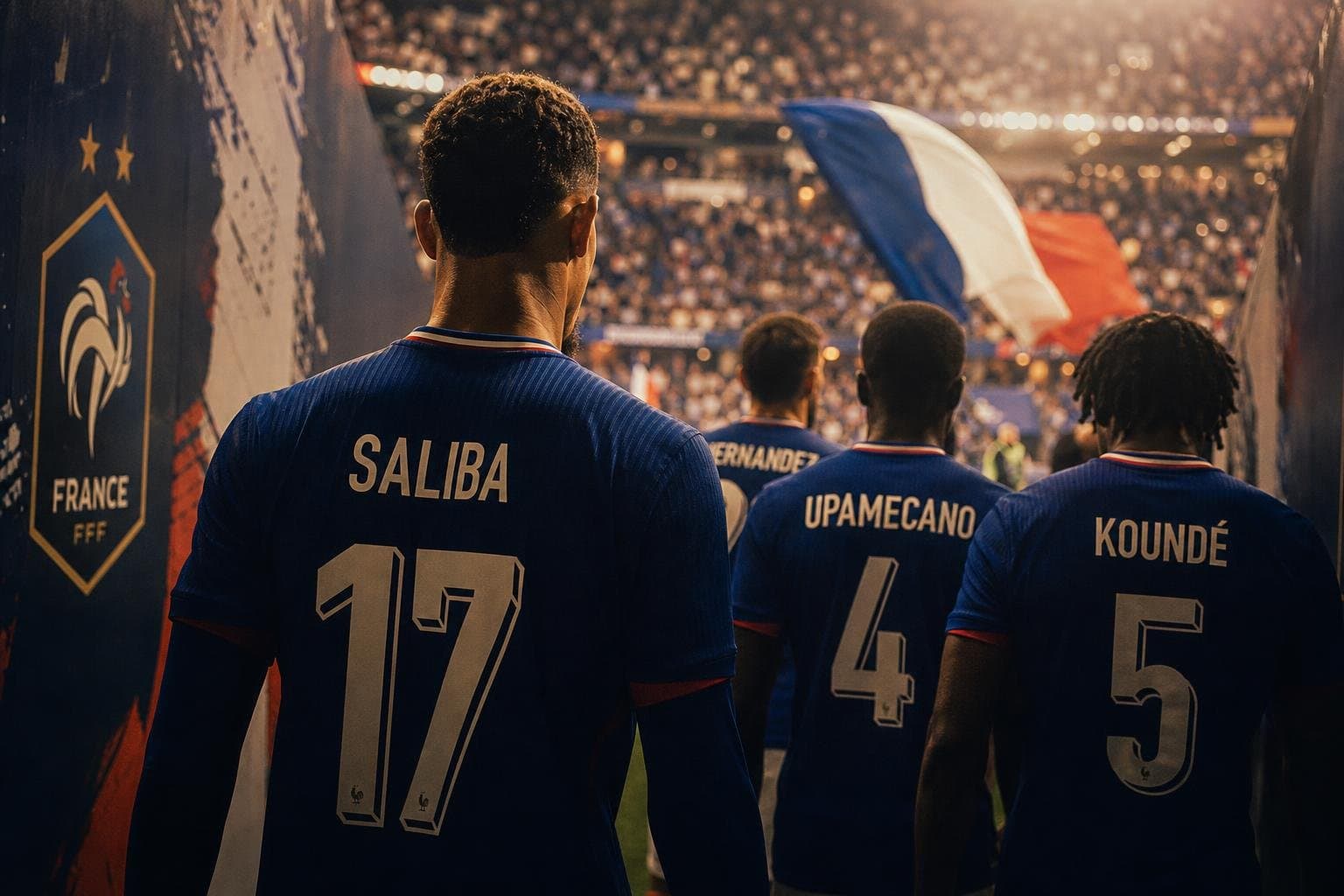

Day 3 until kickoff
Three days out, and the most interesting story about France's defense isn't a crisis — it's a scare that turned out fine, and what it revealed about how much Didier Deschamps is depending on a very specific group of players.
William Saliba arrived at the French national team camp this week carrying some kind of knock after playing the full 120 minutes of Arsenal's Champions League final defeat to PSG. For a few hours, there were genuine questions about whether his tournament was in jeopardy. Then Deschamps appeared before cameras and delivered the most reassuring sentence in French football: "William is fine and will be managed." Crisis averted. But the brief panic told you everything about how load-bearing Saliba has become for this squad.
The Backline Deschamps Actually Has
Let's be precise about what France's defense looks like heading into this tournament, because it's genuinely impressive — and genuinely concentrated.
France named their 26-man squad on May 14, and the center-back options are: Saliba (Arsenal), Ibrahima Konaté (Liverpool), Dayot Upamecano (Bayern Munich), and Maxence Lacroix (Crystal Palace). That's a formidable quartet on paper. Saliba has been Deschamps' first-choice partner for Upamecano during qualifying, and The Athletic's tactical breakdown of Group I notes that Saliba played only 27 minutes at the last World Cup — meaning Qatar was essentially a preview, and 2026 is his moment.
The full-back picture is similarly deep. Kounde at right-back has been outstanding under Hansi Flick at Barcelona, while the left side has options in Theo Hernandez and Lucas Hernandez, with Lucas Digne and Malo Gusto providing further cover. France's defensive depth is real. The concern isn't the names — it's the mileage.
Saliba wasn't the only player arriving late and tired. Deschamps confirmed he's managing six players who were involved in the Champions League final — including PSG's five winners (Bradley Barcola, Lucas Hernandez, Ousmane Dembélé, Désiré Doué, and Warren Zaïre-Emery) alongside Saliba. That's nearly a quarter of the squad arriving on fumes, with France's opener against Senegal on June 16.
The Assigned Topic's Premise Needs Adjusting
The framing of a "defensive crisis" doesn't quite hold up against the sources. France's backline isn't being rebuilt — it's arguably the strongest it's been in years. What's real is the injury anxiety, the fatigue management, and the question of whether Deschamps can get his best defenders to the tournament sharp rather than just present.
FIFA's official squad announcement notes that Mbappé headlines the squad and is very much in it — so the "without Mbappé's pace" angle doesn't reflect the confirmed reality. Mbappé is in Deschamps' 26. What is true is that Deschamps is working with a squad that includes several players returning from injury absences — Kounde, Bradley Barcola, and Manu Koné were all out for March friendlies, having missed matches against Brazil and Colombia.
The actual defensive story is more interesting than a crisis: it's about whether a backline full of elite club talent can function as a cohesive unit when they've barely trained together.
Deschamps' Real Headache Is Timing, Not Talent
Squawka's tactical profile of France frames Deschamps' modus operandi clearly: keep things compact and structured with a defensive-minded double pivot while allowing the supreme talent of the attacking stars to shine. That structure depends on the defensive unit being organized and automatic — the kind of chemistry that comes from repetition, not from talent alone.
France play Ivory Coast in a friendly in Nantes before a second warm-up against Northern Ireland in Lille, then head to North America. That's two matches to get six Champions League finalists integrated, rotation decisions made, and a defensive shape that functions on instinct rather than effort.
Senegal on June 16 at MetLife Stadium is not a gentle opener. Group I is described by The Athletic as statistically the strongest group in the tournament — France, Senegal, Norway, and Iraq. Norway are back at a World Cup for the first time since 1998 and caused genuine disruption in qualifying. Iraq sneaked in via the inter-confederation playoff, 40 years on from their sole prior appearance — meaning even the group's nominal minnow arrived the hard way.
France consistently rank among the tournament favorites, and their ability to manage pressure situations is cited as one of their greatest strengths heading into 2026. The talent is there. The question


